| Template |


Justitia Jurnal Hukum takes all allegations of research and publication misconduct extremely seriously. We are committed to protecting the integrity of the academic record and will investigate every suspicion or allegation of misconduct, whether it is raised before or after publication.
Publication misconduct includes, but is not limited to:
Plagiarism: The unacknowledged copying of another person’s work, ideas, or language.
Data Fabrication or Falsification: Inventing data or intentionally manipulating research data, processes, or results to present a false conclusion.
Redundant/Duplicate Publication: Submitting or publishing the same manuscript (or a manuscript with substantial overlap) in multiple journals simultaneously.
Authorship Disputes: Inclusion of "ghost" or "guest" authors, or omitting individuals who qualify for authorship.
Undeclared Conflicts of Interest: Failing to disclose relationships or financial interests that could bias the research or its evaluation.
The Editorial Board will follow the guidelines and flowcharts provided by the Committee on Publication Ethics (COPE) when dealing with allegations of misconduct.
Initial Assessment: Upon receiving an allegation (from a reviewer, reader, or automated screening tool), the Editor-in-Chief will conduct an initial review to determine the validity and severity of the claim.
Author Notification and Response: If the allegation has merit, the Editor-in-Chief will contact the corresponding author, presenting the evidence and requesting a formal explanation.
Investigation: If the author's response is unsatisfactory or admits guilt, the journal may involve the authors' affiliated institution or funding body to conduct a more thorough investigation.
Depending on the severity of the confirmed misconduct, Justitia Jurnal Hukum may take one or more of the following actions:
Pre-publication: Immediate rejection of the manuscript and a warning issued to the authors.
Post-publication (Minor issues): Publication of a formal Correction (Erratum/Corrigendum).
Post-publication (Severe issues): Publication of a formal Retraction notice, clearly stating the reason for retraction. The original article will remain online but will be prominently marked as "RETRACTED."
Embargo: Refusal to accept future submissions from the offending author(s) for a specified period.
We encourage anyone who suspects publication misconduct in our journal to report it directly to the Editor-in-Chief with specific details and supporting evidence.
| Template |
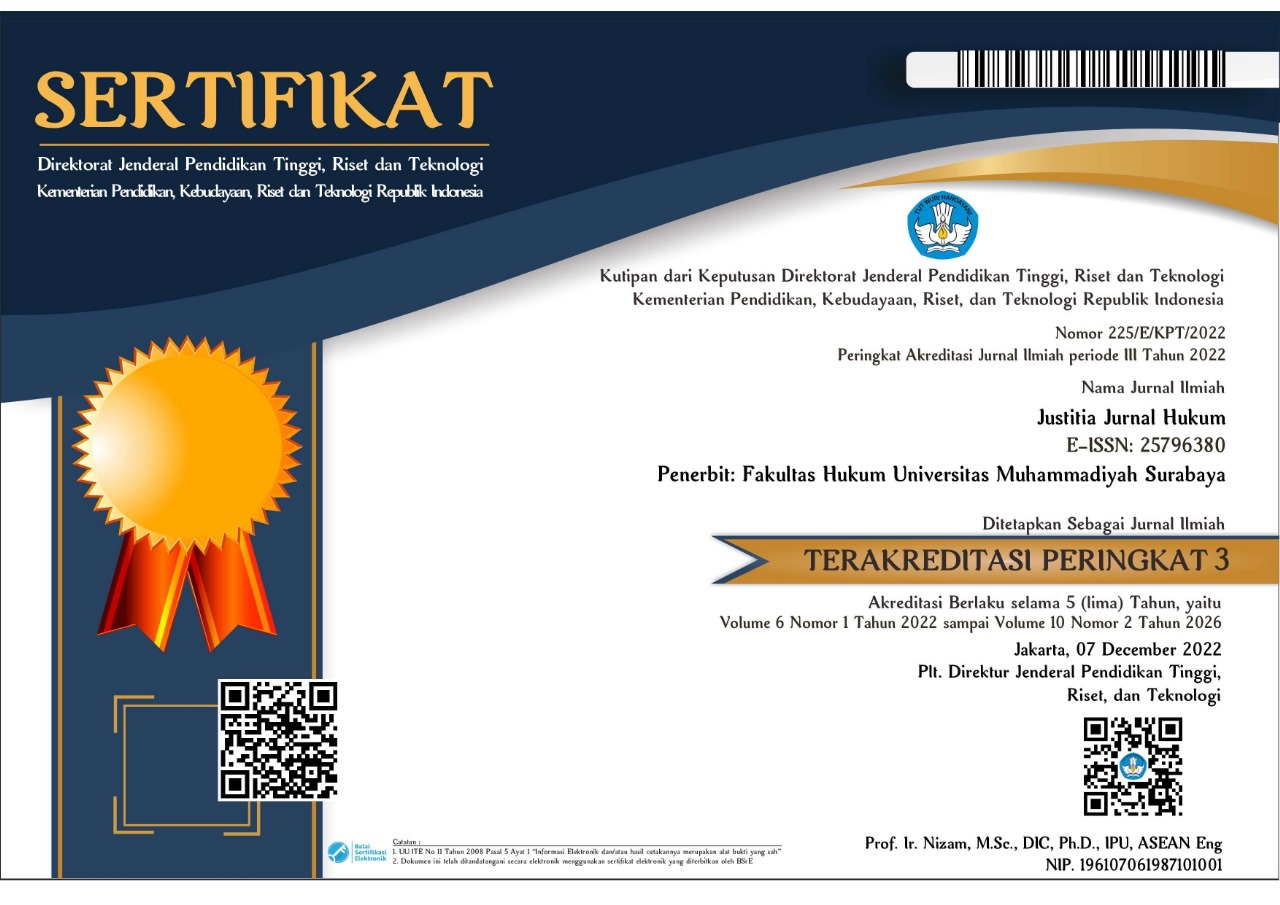
| Certificate of Accreditation |
| Tools |


| Visitors |
| Current Indexing |