| Template |


Justitia Jurnal Hukum adopts the following policy regarding the use of generative Artificial Intelligence (AI) and AI-assisted technologies. This policy aims to provide transparency and clear guidance to authors, reviewers, editors, and readers, aligning with international publishing standards as part of our preparation for Scopus indexing.
Justitia Jurnal Hukum recognizes the potential of generative AI and AI-assisted technologies (“AI Tools”), when used responsibly, to help researchers work efficiently, synthesize complex legal literature, identify research gaps, and improve language readability. AI tools must never be used as a substitute for human critical thinking, legal expertise, and evaluation. Authors are fully responsible and accountable for the contents of their work, including:
Verification of Output: Carefully reviewing and verifying the accuracy, comprehensiveness, and impartiality of all AI-generated output (including checking references, as AI-generated citations can be incorrect or fabricated).
Authentic Contribution: Thoroughly editing and adapting all material to ensure the manuscript represents the author’s authentic legal analysis, interpretation, and original insights.
Transparent Disclosure: Ensuring that the use of any AI tools is made clear and transparent to readers by including a dedicated AI declaration statement upon submission.
Data Privacy & IP: Safeguarding data privacy, intellectual property, and confidentiality by checking the terms and conditions of any AI tool used.
Responsible Use of AI Tools
Authors must ensure that the privacy and confidentiality of their data and inputs including unpublished manuscripts are maintained. Particular care should be taken to avoid inputting personally identifiable or confidential legal data. Authors must ensure they do not grant AI tools the right to use their inputted materials for model training in a way that restricts subsequent publication.
Disclosure Statement
Authors should disclose the use of AI tools for manuscript preparation in a separate AI declaration statement within their manuscript upon submission (placed before the list of references). Basic grammar, spelling, and punctuation checks do not require declaration. Any substantial use of AI in drafting or literature analysis must be fully described.
Authorship
AI tools cannot be listed as an author or co-author, nor cited as an author. Authorship implies responsibilities, ethical obligations, and legal accountability that can only be attributed to and performed by human authors.
Use in Figures and Images
The use of Generative AI to create or alter images, figures, or artwork in submitted manuscripts is not permitted, except where it forms an integral part of the approved research methodology (duly documented in the methods section).
When a researcher is invited to review a manuscript for Justitia Jurnal Hukum, the manuscript must be treated as a strictly confidential document. Reviewers must not upload submitted manuscripts (or parts thereof) into generative AI tools, as this violates author confidentiality and data privacy rights. Peer review relies on human legal expertise, critical reasoning, and original assessment. Reviewers must not use AI tools to generate review reports. Reviewers remain fully accountable for the content and integrity of their review reports.
Editors must treat submitted manuscripts and confidential editorial communications (such as decision letters) with the utmost confidentiality. Editors must not upload manuscripts into generative AI tools.
Managing the editorial evaluation and final publishing decisions requires human critical thinking, academic judgment, and ethical oversight that cannot be delegated to AI tools. Editors are fully responsible for the editorial process and decision-making.
If an editor suspects that an author or reviewer has violated this AI policy, they reserve the right to take appropriate editorial action in accordance with publication ethics.
| Template |
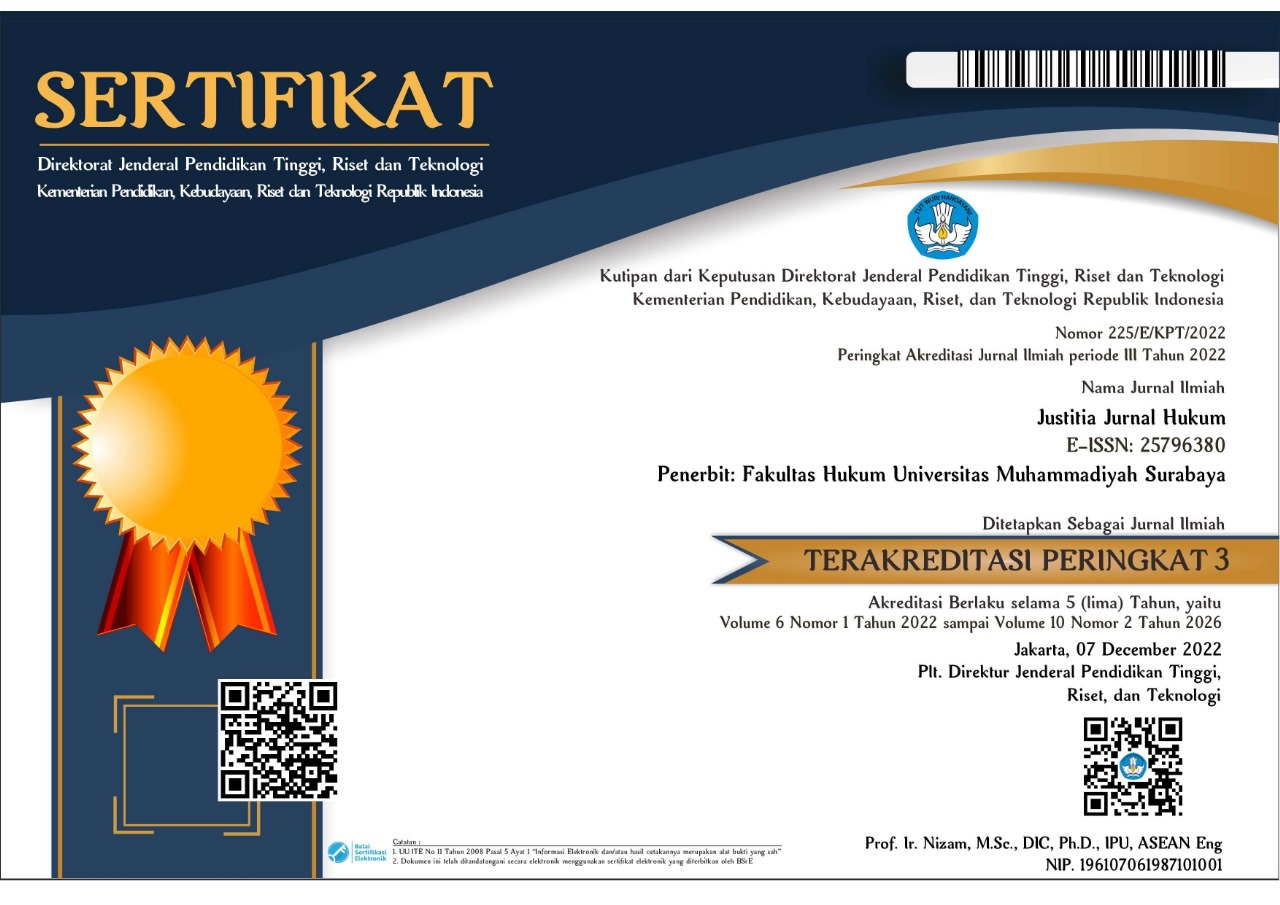
| Certificate of Accreditation |
| Tools |


| Visitors |
| Current Indexing |