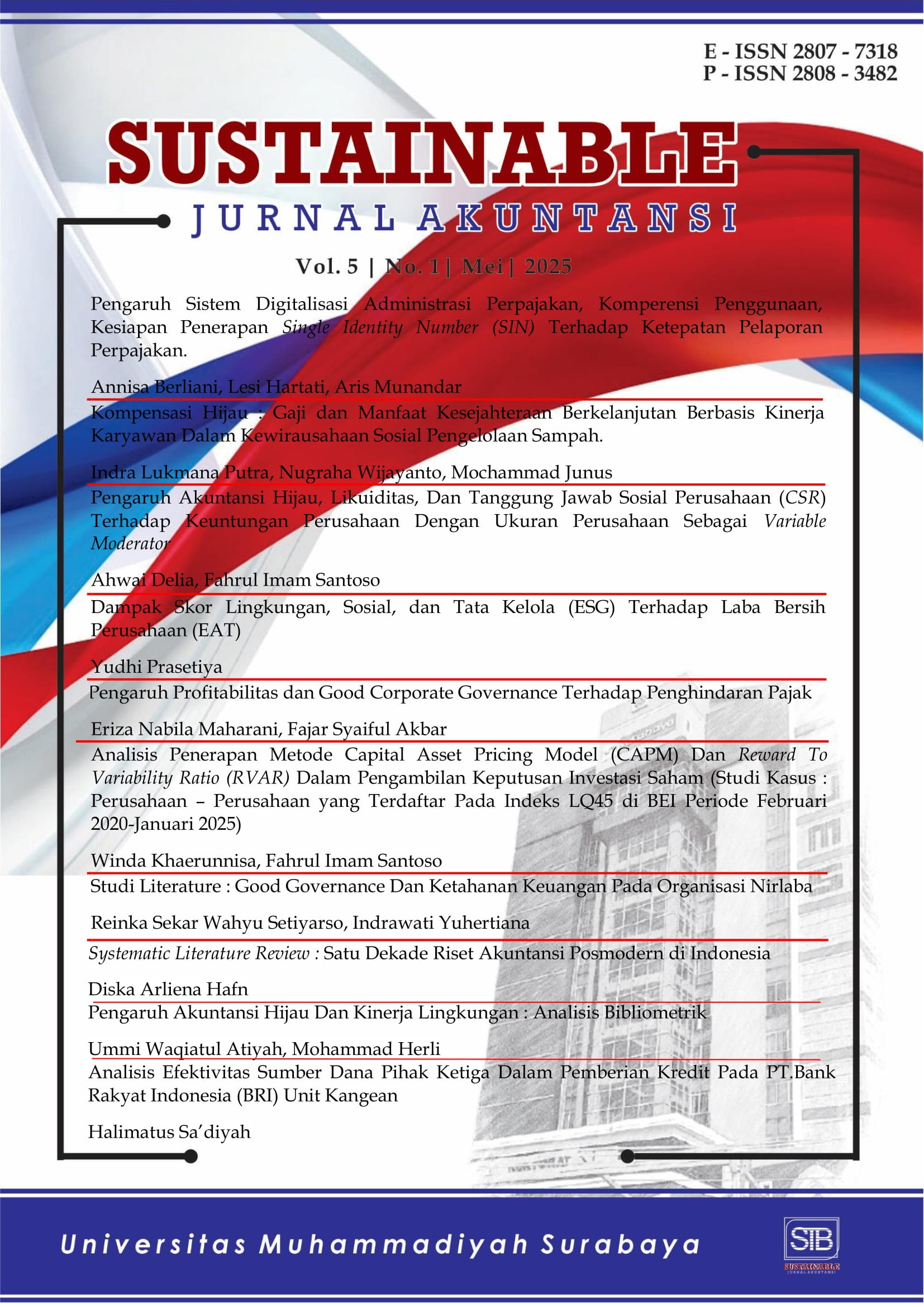
Green Compensation: Sustainable Salary and Welfare Benefit on Employee Performance in Waste Management Social Entrepreneurship
DOI:
https://doi.org/10.30651/stb.v5i1.26136Keywords:
green compensation, sustaianble salary, employee performance, social entrepreneurship, waste managementAbstract
Green compensation, reward system for employee performance, is crucial for sustainability in organizations requiring human resources, including waste management social entrepreneurship. Social entrepreneurship, built on social intentions and goals, represents an innovative approach to addressing social problems while creating business opportunities. Social enterprises that empower surrounding communities, rewards are implemented through salaries and welfare benefits. Relationship between compensation, benefits, and employee performanced in waste management social entrepreneurship varies, with evidence showing that adequate compensation significantly enhances productivity and motivation. Particularly relevant in waste management, where employee engagement is essential for effective operations. Quantitative research aims to determine whether salary and welfare benefits influence employee performance in a waste management social enterprise.Research sample consists of 103 staff members who have been empowered by the organization, which has been in operation for over 12 years. Data were collected using a structured questionnaire distributed to all employees in the sample. Data were processed using statistical analysis software (such as SPSS) determine strength and significancy relationships between variables. Findings reveal salary and welfare benefits significancy impact on employee performance. However, magnitude influence falls within the moderate category, suggesting that other factors not examined in this study also affect performance. Additional factors warrant further investigation to provide a more comprehensive understanding of employee performance drivers
References
Ampong, I. (2024). Assessing the effect of employee welfare and compensation on organizational performance: a case of Sahel Sahara Bank Ghana limited. https://doi.org/10.1080/23311975.2024.2315690
Annisa, F. R., Dasman, L., & Nico, P. M. (2025). The Impact of Employee Performance and Community Participation on Solid Waste Management Effectiveness in Bukittinggi City, Indonesia. https://doi.org/10.1051/bioconf/202515506010
Darby, L., & Jenkins, H. (2006). Applying sustainability indicators to the social enterprise business model: The development and application of an indicator set for Newport Wastesavers, Wales. International Journal of Social Economics, 33(5/6), 411–431. https://doi.org/10.1108/03068290610660689
Delmas, M. A., & Pekovic, S. (2018). Corporate sustainable innovation and employee behavior. Journal of Business Ethics, 150(4), 1071–1088. https://doi.org/10.1007/s10551-016-3221-2
Hair, J. F., Risher, J. J., Sarstedt, M., & Ringle, C. M. (2019). When to use and how to report the results of PLS-SEM. European Business Review, 31(1), 2–24. https://doi.org/10.1108/EBR-11-2018-0203
Hameed, Z., Khan, I. U., Islam, T., Sheikh, Z., & Naeem, R. M. (2020). Do green HRM practices influence employees’ environmental performance? International Journal of Manpower, 41(7), 1061–1079. https://doi.org/10.1108/IJM-08-2019-0407
Haque, F. (2017). The effects of board characteristics and sustainable compensation policy on carbon performance of UK firms. British Accounting Review, 49(3), 347–364. https://doi.org/10.1016/J.BAR.2017.01.001
Hasibuan, R. (2016). Analisis Dampak Limbah Atau Sampah Rumah Tangga Terhadap Pencemaran Lingkungan Hidup. Jurnal Ilmiah Advokasi, 4(1), 42-52.
Jaikumar, S. P. (2023). A Study on Training and Development Employee Welfare Seshasayee Paper & Boards Ltd in Erode. International Journal of Innovative Research in Information Security. https://doi.org/10.26562/ijiris.2023.v0904.28
Jayapriya, K., & Hibli, S. (2023). A Study on Employees Welfare Measures, Bescal Steels Industries Pvt Ltd., George Town, Chennai. International Journal of Innovative Research in Information Security. https://doi.org/10.26562/ijiris.2023.v0904.34
Junus, M., Nurcahyani, V., Saptono, R., Maulana, N., Putra, I. L., & Fahreza, Z. (2025). Implementation of Random Forest Algorithm for Air Quality Classification: A Case Study of DKI Jakarta's Air Quality Index. International Journal of Innovative Science and Research Technology, 10(3), 2169-2173.
Kementerian, KLHK. (2022). Peraturan Menteri Lingkungan Hidup Dan Kehutanan 2022 Tentang Sistem Informasi Pengelolaan Sampah Nasional.
Lin, P., & Chang, Y.-H. (2023). How do employee salary/benefits and csr/esg performance affect employee productivity and firm performance-evidence from steel industry listed firms in taiwan. International Journal of Business Research, 23(1), 39–71. https://doi.org/10.18374/ijbr-23-1.5
Mulia, Mahmudah. (2020). Social Entrepreneurship Mewujudkan Kesejahteraan Masyarakat Berdasarkan Prinsip-Prinsip Ekonomi Syariah. El-Iqtishady.
Mustika, I., Oktavendi, T. W., & Affan, M. W. (2023). Environmental Cost Accounting Practices in Waste Management. Journal of Multiperspectives on Accounting Literature, 1(1), 8–20. https://doi.org/10.22219/jameela.v1i1.27921
Obeidat, S. M., & Abdalla, S. O. (2022). Achieving sustainable development through green HRM: The role of HR analytics. InSustainable Development Through Data(pp. 151–169). https://doi.org/10.1007/978-3-031-12527-0_10
Puspitasari, A., Palupiningtyas, D., & SN, K. (2024). Sinergi Keberlanjutan: Mengungkap Pengaruh Green Compensation and Benefits terhadap Peningkatan Kinerja Karyawan. https://doi.org/10.61132/prosemnasimkb.v1i1.18
Putra, I. L. (2024). Efek Teknologi Informasi dan Work Life Balance Terhadap Kinerja Karyawan Pada New Normal: Efek Teknologi Informasi dan Work Life Balance Terhadap Kinerja Karyawan Pada New Normal. Advantage: Journal of Management and Business, 2(1), 19-31.
Putra, I. L. (2024). Manajemen Aset. CV. Dewa Publishing.
Qodriatun, S. N. (2014). Meningkatkan kesejahteraan masyarakat melalui pengelolaan sampah berdasarkan UU No. 18 Tahun 2008. Pusat Pengkajian Pengolahan Data Dan Informasi DPR RI.
Rahmah, Naila, Novita Sari, and Dania Amrina. (2021). Kajian Dampak Sampah Rumah Tangga Terhadap Lingkungan Dan Perekonomian Bagi Masyarakat Kecamatan Sukarame Kota Bandar Lampung Berdasarkan Perspektif Islam. Holistic Journal Of Management Research 6. https://doi.org/10.24252/jurisprudentie.v4i1.3661
Saeed, B. B., Afsar, B., Hafeez, S., Khan, I., Tahir, M., & Afridi, M. A. (2019). Promoting employees’ pro-environmental behavior through green human resource management practices. Corporate Social Responsibility and Environmental Management, 26(2), 424–438. https://doi.org/10.1002/csr.1694
Samsu, H. (2019). Pengaruh tunjangan kesejahteraan terhadap produktivitas kerja karyawan pada Rumah Sakit Jasa Kartini. Jurnal Ekonomi Perjuangan (JUMPER), 1
Seto, S., & Merdja, J. (2020). Pengaruh pemberian gaji terhadap motivasi kerja dan profesionalisme guru honor. Pedagogika, 11,, 42–48.
Tenrinippi, A. (2019). Kewirausahaan sosial dalam mengatasi kemiskinan melalui pemberdayaan masyarakat. Jurnal Ekonomi dan Pembangunan, 27(1), 45-58.
World Population Review (WPC). (2023). World population by country 2023.
Downloads
Published
Issue
Section
License
Copyright (c) 2025 SUSTAINABLE : ACCOUNTING JOURNAL

This work is licensed under a Creative Commons Attribution 4.0 International License.
Copyright
Copyright for articles published in Sustainable: Accounting Journal.
Authors must submit copyright to the journal by signing and sending the copyright assignment form (template) via email sustainable@um-surabaya.ac.id
Authors can disseminate their articles through any media.
Licence
Every work written by the author is licensed under a Creative Commons Attribution-NonCommercial 4.0 International License.