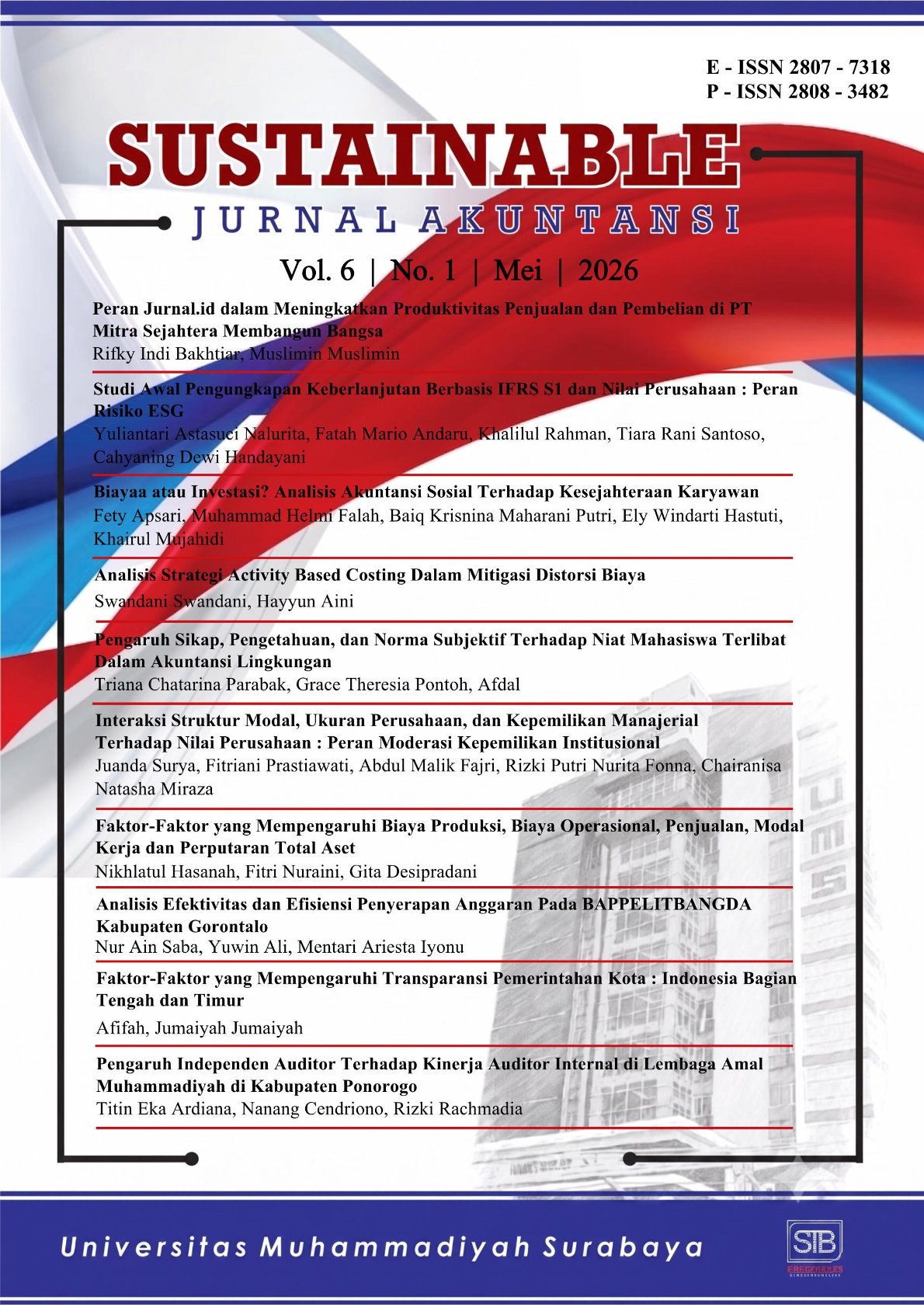
The Influence of Attitudes, Knowledge, and Subjective Norms on Students’ Intentions to Engage in Environmental Accounting
DOI:
https://doi.org/10.30651/stb.v6i1.31076Keywords:
attitudes; knowledge; subjective norms; intentions; sustainability accountingAbstract
Environmental sustainability issues show an increasing urgency in the development of educational practices and systems in the modern era. The purpose of this study is to investigate how attitudes, knowledge, and subjective norms affect students’ intention to engage in environmental accounting. This study was carried out at Hasanuddin University’s Faculty of Economics and Business using a quantitative methodology. The primary data used in this study was collected by questionnaires and subjected to PLS-SEM analysis. The study’s findings show that intentions to engage in environmental accounting are influenced by attitudes, knowledge, and subjective norms. The implication is that it is necessary to strengthen learning strategies to shape attitudes, increase understanding, and reinforce subjective norms in order to encourage students’ intentions in the field of sustainability accounting.
References
Agshari, Z., Rismawati, & Supri, Z. (2024). Application of Green Accounting Concepts through Accounting Education in Support of Green Economy. 689–701. https://doi.org/10.24843/EJA.2024.v34.i03.p10
Amrullah, M. T., Fauziah, N., Kurnia, L., Gunardi, P., & Jakarta, C. (2025). Accounting Students ’ Intention towards the Sustainable Auditor Profession : A Case Study at ABC College. 2(1), 14–27.
da Cunha, Í. G. F., Policarpo, R. V. S., de Oliveira, P. C. S., Abdala, E. C., & do Nascimento Rebelatto, D. A. (2025). A systematic review of ESG indicators and corporate performance: proposal for a conceptual framework. Future Business Journal, 11(1), 1–25. https://doi.org/10.1186/s43093-025-00539-1
De Silva, T. A., & Nilipour, A. (2024). Is the accounting curricula keeping up with sustainability development? Accounting Education, 34(4), 470–498. https://doi.org/10.1080/09639284.2024.2351951
Eugenio, T., Carreira, P., Miettinen, N., & Lourenço, I. M. E. C. (2022). Understanding students’ future intention to engage in sustainability accounting: the case of Malaysia and the Philippines. Journal of Accounting in Emerging Economies, 12(4), 695–715. https://doi.org/10.1108/JAEE-10-2020-0277
Fenny Zyahwa, Rachmat Pramukty, & Tri Yulaeli. (2023). The Influence of Motivation, Perception, and Tax Knowledge on Career Choice Interests in the Field of Taxtion (A Study of Students in the Faculty of Economics and Business at Ubhara Jaya). MUQADDIMAH: Journal of Economics, Management, Accounting and Business, 1(1), 211–229. https://doi.org/10.59246/muqaddimah.v1i1.106
Firmansyah, A. (2025).The Urgency of Integrating Sustainability Accounting into Higher Education Curricula in the ESG Era. Akuntansiku, 4(1), 78–93. https://doi.org/10.54957/akuntansiku.v4i1.1482
Jogiyanto, H. M. (2007). Behavioral Information System (1st ed.). ANDI Publishing.
Kwakye, T. O., Welbeck, E. E., Owusu, G. M. Y., & Anokye, F. K. (2018). Determinants of intention to engage in Sustainability Accounting & Reporting (SAR): the perspective of professional accountants. International Journal of Corporate Social Responsibility, 3(1). https://doi.org/10.1186/s40991-018-0035-2
Maricar, A., & Pariyawan, S. (2024). Implementation of Environmental Accounting in Relation to the Triple Bottom Line Concept Toward a Green Economy to Achieve Sustainability at PT Varia Usaha Beton ( VUB ) Sidoarjo. 2(1).
Nurita, V., & Sisdianto, E. (2025). The Role of Environmental Accounting in the Disclosure of Sustainability Information in Financial Statements in the Digital Age. 2(1), 406–418.
Ratnaningsih, S. D. A., Ghozali, I., & Harto, P. (2024). Antecedents of students’ intention to be sustainable accountants: evidence from Indonesia. Arab Gulf Journal of Scientific Research, 42(4), 1950–1968. https://doi.org/10.1108/AGJSR-08-2023-0366
Sarfraz, M., Ozturk, I., Yoo, S., Raza, M. A., & Han, H. (2023). Toward a new understanding of environmental and financial performance through corporate social responsibility, green innovation, and sustainable development. Humanities and Social Sciences Communications, 10(1), 1–17. https://doi.org/10.1057/s41599-023-01799-4
Satiti, W. T., Narayani, P. R., & Ivada, E. (2025). Green Accounting Education and Digital Innovation: The Role Of Accounting Education Students In Achieving The SDGs. August, 97–105.
Simalango, A, F, R., & Hasibuan, A. F. (2024). The Influence of Environmental Knowledge) Dan Environmental Concern on Green Purchase Intention Among State University Students in Medan. Journal of Multidisciplinary Scientific Research, 8(8), 2118–7451.
Soares, E. C., Lima, N. C., & Matos Coelho, A. F. (2024). Towards sustainability engaged accounting: A behavioral approach. Revista Contabilidade e Financas, 35(95). https://doi.org/10.1590/1808-057x20242019.en
Sulemana, I., Cheng, L., Agyemang, A. O., Osei, A., & Nagriwum, T. M. (2025). Stakeholders and sustainability disclosure: Evidence from an emerging market. Sustainable Futures, 9, 100445. https://doi.org/10.1016/j.sftr.2025.100445
Sumarsono, H., Maharani, S. N., & Istiqomah, M. (2024). Green Accounting Concept Based on University Social Responsibility. https://doi.org/10.4108/eai.26-9-2023.2350760
Downloads
Published
How to Cite
Issue
Section
License
Copyright (c) 2026 SUSTAINABLE

This work is licensed under a Creative Commons Attribution 4.0 International License.
Copyright
Copyright for articles published in Sustainable: Accounting Journal.
Authors must submit copyright to the journal by signing and sending the copyright assignment form (template) via email sustainable@um-surabaya.ac.id
Authors can disseminate their articles through any media.
Licence
Every work written by the author is licensed under a Creative Commons Attribution-NonCommercial 4.0 International License.