

Bilah Samping Artikel
Unduhan
Isi Artikel Utama
Abstrak
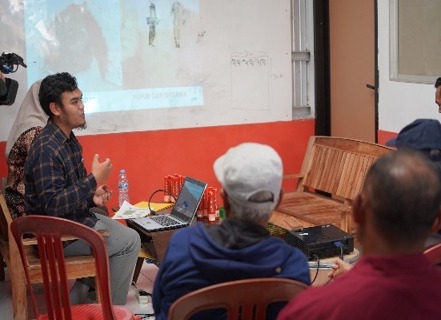
Penerapan praktik pertanian berkelanjutan seringkali terhambat oleh kesenjangan antara kesadaran petani dan implementasi praktisnya. Di kawasan agropolitan Lembang, praktik pembakaran limbah pertanian yang tidak berkelanjutan masih terjadi, menunjukkan kegagalan dalam difusi teknologi alternatif. Kondisi ini menciptakan ketergantungan pada pupuk kimia mahal dan mengancam keberlanjutan agrikultur lokal. Program pengabdian kepada masyarakat ini bertujuan untuk mengakselerasi adopsi inovasi teknologi tepat guna melalui kerangka teori difusi inovasi, dengan memberdayakan petani untuk mengubah limbah menjadi aset produktif. Metode yang digunakan adalah desain kuantitatif one-group pre-test-post-test yang dilaksanakan pada tanggal 21 September 2025. Intervensi dalam bentuk lokakarya partisipatif dilaksanakan sebagai saluran komunikasi utama untuk memperkenalkan teknologi pengomposan ember tumpuk kepada 16 orang petani tomat beef yang tergabung dalam Asosiasi Agrotani Lembang. Analisis data menggunakan uji-t sampel berpasangan menunjukkan keberhasilan intervensi dalam melewati tahap pengetahuan dan persuasi. Hasilnya adalah peningkatan skor pemahaman rata-rata yang signifikan secara statistik, dari 45,8 pada pre-test menjadi 88,5 pada post-test. Disimpulkan bahwa lokakarya partisipatif merupakan strategi komunikasi yang sangat efektif untuk memulai proses difusi, dengan membangun sikap positif dan kepercayaan diri di kalangan petani yang sangat penting untuk keputusan adopsi dan penyebaran inovasi lebih lanjut dalam sistem sosial mereka.
Kata Kunci
Rincian Artikel

Artikel ini berlisensiCreative Commons Attribution-ShareAlike 4.0 International License.
Hak cipta artikel dimiliki oleh jurnal AKSIOLOGIYA

Ciptaan disebarluaskan di bawah Lisensi Creative Commons Atribusi-NonKomersial 4.0 Internasional.
Referensi
- Bandura, A. (2015). On Deconstructing Commentaries Regarding Alternative Theories of Self-Regulation. Journal of Management, 41(4), 1025–1044. https://doi.org/10.1177/0149206315572826
- Basrimas, M. J. A. (2022). Komunikasi Partisipatif dalam Inovasi Pengelolaan Sampah melalui Program Jasa Angkutan Sampah Pilot Project. Jurnal Ilmu Politik Dan Komunikasi, 12(1), 87–108. https://doi.org/10.34010/jipsi.v12i1.6313
- Basso, B., Dumont, B., Cammarano, D., Pezzuolo, A., Marinello, F., & Sartori, L. (2016). Environmental and Economic Benefits of Variable Rate Nitrogen Fertilization in a Nitrate Vulnerable Zone. Science of The Total Environment, 545–546, 227–235. https://doi.org/10.1016/j.scitotenv.2015.12.104
- Berlian, L., Khaerunnisa Nabila, Amanda Putri Viony, & Fatiha Tyannisa. (2025). Penerapan Sistem Ember Tumpuk untuk Pembuatan Pupuk Organik Cair Limbah Sayur di Desa Klebet. KRESNA: Jurnal Riset Dan Pengabdian Masyarakat, 5(1), 172–181. https://doi.org/10.36080/kresna.v5i1.217
- Colton, J. S. (2015). Adoption, Diffusion, and Scaling of Agricultural Technologies in Developing Countries. In E. Lichtfouse (Ed.), Sustainable Agriculture Reviews (Vol. 18, pp. 45–75). Springer International Publishing. https://doi.org/10.1007/978-3-319-21629-4_2
- Duque-Acevedo, M., Belmonte-Ureña, L. J., Plaza-Úbeda, J. A., & Camacho-Ferre, F. (2020). The Management of Agricultural Waste Biomass in the Framework of Circular Economy and Bioeconomy: An Opportunity for Greenhouse Agriculture in Southeast Spain. Agronomy, 10(4), 489. https://doi.org/10.3390/agronomy10040489
- Etikan, I. (2016). Comparison of Convenience Sampling and Purposive Sampling. American Journal of Theoretical and Applied Statistics, 5(1), 1. https://doi.org/10.11648/j.ajtas.20160501.11
- Hassan, S. (2023). Pretest and Posttest Reliability to Measure the Impact of Online Team-Based Learning Workshops During the COVID-19 Pandemic as a Continuing Faculty Development Activity Among Health Professional Educators. Journal of Educational Research and Reviews, 10(9), 140–144. https://doi.org/10.33495/jerr_v10i9.22.142
- Hidayat, M. S., Anggita, D., Solikhah, D. P., Handayani, T. S., Selegani, F., Nuramelia, Y., & Ianto, S. A. G. (2024). Penyuluhan dan Pelatihan Pembuatan Pupuk Cair Organik Menggunakan Ember Tumpuk di RT 4 dan 8 Dusun Karangjambe Banguntapan. Mohuyula : Jurnal Pengabdian Kepada Masyarakat, 3(2), 41. https://doi.org/10.31314/mohuyula.3.2.41-45.2024
- Huang, T., Ma, J., Song, S., Ling, Z., Macdonald, R. W., Gao, H., Tao, S., Shen, H., Zhao, Y., Liu, X., Tian, C., Li, Y., Jia, H., Lian, L., & Mao, X. (2022). Health and Environmental Consequences of Crop Residue Burning Correlated with Increasing Crop Yields Midst India’s Green Revolution. Npj Climate and Atmospheric Science, 5(1), 81. https://doi.org/10.1038/s41612-022-00306-x
- Insani, R., Sulistyowati, D., & Pradiana, W. (2020). Respon Petani dalam Pemanfaatan Limbah Organik Sayur sebagai Pupuk Kompos pada Komoditas Sayuran di Desa Cikidang, Kecamatan Lembang, Kabupaten Bandung Barat. Agricore: Jurnal Agribisnis Dan Sosial Ekonomi Pertanian Unpad, 5(1). https://doi.org/10.24198/agricore.v5i1.28656
- Kyere, I., & Kankam, P. K. (2025). Environmental Information Dissemination in Ghanaian Waste Management. Information Development, 02666669251336546. https://doi.org/10.1177/02666669251336546
- Lal, R. (2016). Soil Health and Carbon Management. Food and Energy Security, 5(4), 212–222. https://doi.org/10.1002/fes3.96
- Lan, R., Eastham, S. D., Liu, T., Norford, L. K., & Barrett, S. R. H. (2022). Air Quality Impacts of Crop Residue Burning in India and Mitigation Alternatives. Nature Communications, 13(1), 6537. https://doi.org/10.1038/s41467-022-34093-z
- Listina, S. A., Sampurno, R. M., Ciptaningtyas, D., & Thoriq, A. (2022). Model Prediksi Kadar Air Media Tanam Menggunakan Regresi Linear Berganda (Studi Kasus Kebun Tomat Beef di Serenity Farm Mitra Habibi Garden). Jurnal Teknotan, 16(3), 133. https://doi.org/10.24198/jt.vol16n3.1
- Liu, Y., Shi, K., Liu, Z., Qiu, L., Wang, Y., Liu, H., & Fu, X. (2022). The Effect of Technical Training Provided by Agricultural Cooperatives on Farmers’ Adoption of Organic Fertilizers in China: Based on the Mediation Role of Ability and Perception. International Journal of Environmental Research and Public Health, 19(21), 14277. https://doi.org/10.3390/ijerph192114277
- Manea, E. E., Bumbac, C., Dinu, L. R., Bumbac, M., & Nicolescu, C. M. (2024). Composting as a Sustainable Solution for Organic Solid Waste Management: Current Practices and Potential Improvements. Sustainability, 16(15), 6329. https://doi.org/10.3390/su16156329
- Maryono, M., Killoes, A. M., Adhikari, R., & Abdul Aziz, A. (2024). Agriculture Development through Multi-Stakeholder Partnerships in Developing Countries: A Systematic Literature Review. Agricultural Systems, 213, 103792. https://doi.org/10.1016/j.agsy.2023.103792
- Mathur, R., & Srivastava, V. K. (2019). Crop Residue Burning: Effects on Environment. In N. Shurpali, A. K. Agarwal, & V. Srivastava (Eds.), Greenhouse Gas Emissions (pp. 127–140). Springer Singapore. https://doi.org/10.1007/978-981-13-3272-2_9
- Melaku, B. S., Sefereh, E. Y., Emunu, M. H., & Wassie, D. Y. (2024). Application of Communication Strategies in the Diffusion of Agricultural Innovations and Technologies: The Case of Amhara Regional Agricultural Research Institute, Ethiopia. Cogent Social Sciences, 10(1), 2306704. https://doi.org/10.1080/23311886.2024.2306704
- Muhyi, Y., & Fathia, S. D. (2024). Strategi Diversifikasi untuk Meningkatkan Pendapatan Komoditi Tomat Beef dan Selada Kering di PT. Momenta Agrikultura Amazing Farm Lembang, Jawa Barat. Agroinovasi: Jurnal Ilmu Dan Teknologi Pertanian, 1(1), 40–49. https://doi.org/10.71024/agroinovasi.2024.v1i1.8
- Na Talang, R. P., Na Sorn, W., Polruang, S., & Sirivithayapakorn, S. (2024). Alternative crop residue management practices to mitigate the environmental and economic impacts of open burning of agricultural residues. Scientific Reports, 14(1), 14372. https://doi.org/10.1038/s41598-024-65389-3
- Pezzullo, P. C., & Cox, R. (2025). Environmental Communication and the Public Sphere (7th ed.). SAGE Publications.
- Pradhan, A., Wakchaure, G. C., Shid, D., Minhas, P. S., Biswas, A. K., & Reddy, K. S. (2023). Impact of Residue Retention and Nutrient Management on Carbon Sequestration, Soil Biological Properties, and Yield in Multi-Ratoon Sugarcane. Frontiers in Sustainable Food Systems, 7, 1288569. https://doi.org/10.3389/fsufs.2023.1288569
- Pratiwi, Y. I., Huda, N., & Wahono, E. (2022). Effect of Giving Organic Waste-Based POC to the Growth of Kailan Plants (Brassica oleracea L.). Agricultural Science, 5(2), 136–142. https://doi.org/10.55173/agriscience.v5i2.75
- Rahmi, N. S. (2024). Improving Statistical Analysis in Supporting Big Data Era for SMA Negeri 1 Krembung Teachers. Journal of Innovation and Applied Technology, 10(01), 64–71. https://doi.org/10.21776/ub.jiat.2024.10.01.012
- Rasanjali, W. M. C., Wimalachandra, R. D. M. K. K., Sivashankar, P., & Malkanthi, S. H. P. (2021). Impact of Agricultural Training on Farmers’ Technological Knowledge and Crop Production in Bandarawela Agricultural Zone. Applied Economics & Business, 5(1), 37–50. https://doi.org/10.4038/aeb.v5i1.27
- Raza, M. H., Abid, M., Faisal, M., Yan, T., Akhtar, S., & Adnan, K. M. M. (2022). Environmental and Health Impacts of Crop Residue Burning: Scope of Sustainable Crop Residue Management Practices. International Journal of Environmental Research and Public Health, 19(8), 4753. https://doi.org/10.3390/ijerph19084753
- Reganold, J. P., & Wachter, J. M. (2016). Organic Agriculture in the Twenty-First Century. Nature Plants, 2(2), 15221. https://doi.org/10.1038/nplants.2015.221
- Rogers, E. M., Singhal, A., & Quinlan, M. M. (2019). Diffusion of Innovations 1. In D. W. Stacks, M. B. Salwen, & K. C. Eichhorn, An Integrated Approach to Communication Theory and Research (3rd ed., pp. 415–434). Routledge. https://doi.org/10.4324/9780203710753-35
- Rokhmaniyah, Alfata, G., Syahendra, O. I., Fatikha, N. H., Mutimah, S. Y., Muthmainnah, G., Puspita, G., Cahyani, R. Y., Nafila, S., Suprayogi, Y., & Rinjani, Z. (2024). Pelatihan Pembuatan Ember Tumpuk Sebagai Media Pengolahan Pupuk Organik Cair. Kreasi: Jurnal Inovasi Dan Pengabdian Kepada Masyarakat, 4(3), 280–288. https://doi.org/10.58218/kreasi.v4i3.967
- Santosa, S., Munif Said Hassan, & Abdul Hayat Kasim. (2023). Ecoenzym Quality and Potential of Residues as Bioactivator for Organic Waste Composting. Jurnal Pengelolaan Sumberdaya Alam Dan Lingkungan (Journal of Natural Resources and Environmental Management), 13(3), 417–424. https://doi.org/10.29244/jpsl.13.3.417-424
- Sari, T. P., & Basmantra, I. N. (2023). Pemanfaatan Sampah Organik Rumah Tangga Menjadi Eco Enzyme Dalam Upaya Pemberdayaan Ekonomi Masyarakat Desa Rejasa. Vivabio: Jurnal Pengabdian Multidisiplin, 5(2), 78–84. https://doi.org/https://doi.org/10.35799/vivabio.v5i2.46516
- Servaes, J. (2020). Handbook of Communication for Development and Social Change (1st ed.). Routledge.
- Stiggins, R. J. (2017). The Perfect Assessment System. ASCD.
- Sullivan, G. M., & Artino, A. R. (2013). Analyzing and Interpreting Data From Likert-Type Scales. Journal of Graduate Medical Education, 5(4), 541–542. https://doi.org/10.4300/JGME-5-4-18
- Taherdoost, H. (2016). Validity and Reliability of the Research Instrument; How to Test the Validation of a Questionnaire/Survey in a Research. SSRN Electronic Journal. https://doi.org/10.2139/ssrn.3205040
- Velasco-Muñoz, J. F., Aznar-Sánchez, J. A., López-Felices, B., & Román-Sánchez, I. M. (2022). Circular Economy in Agriculture: An Analysis of the State of Research Based on the Life Cycle. Sustainable Production and Consumption, 34, 257–270. https://doi.org/10.1016/j.spc.2022.09.017
- Velenturf, A. P. M., & Purnell, P. (2021). Principles for a Sustainable Circular Economy. Sustainable Production and Consumption, 27, 1437–1457. https://doi.org/10.1016/j.spc.2021.02.018
- Wauters, V. M., & Hoidal, N. (2022). Horizontalism and Wisdom Dialogues to Build Trust: A Case Study of Collaborations With Immigrant Farmers in Minnesota. Frontiers in Sustainable Food Systems, 6, 872751. https://doi.org/10.3389/fsufs.2022.872751
Referensi
Bandura, A. (2015). On Deconstructing Commentaries Regarding Alternative Theories of Self-Regulation. Journal of Management, 41(4), 1025–1044. https://doi.org/10.1177/0149206315572826
Basrimas, M. J. A. (2022). Komunikasi Partisipatif dalam Inovasi Pengelolaan Sampah melalui Program Jasa Angkutan Sampah Pilot Project. Jurnal Ilmu Politik Dan Komunikasi, 12(1), 87–108. https://doi.org/10.34010/jipsi.v12i1.6313
Basso, B., Dumont, B., Cammarano, D., Pezzuolo, A., Marinello, F., & Sartori, L. (2016). Environmental and Economic Benefits of Variable Rate Nitrogen Fertilization in a Nitrate Vulnerable Zone. Science of The Total Environment, 545–546, 227–235. https://doi.org/10.1016/j.scitotenv.2015.12.104
Berlian, L., Khaerunnisa Nabila, Amanda Putri Viony, & Fatiha Tyannisa. (2025). Penerapan Sistem Ember Tumpuk untuk Pembuatan Pupuk Organik Cair Limbah Sayur di Desa Klebet. KRESNA: Jurnal Riset Dan Pengabdian Masyarakat, 5(1), 172–181. https://doi.org/10.36080/kresna.v5i1.217
Colton, J. S. (2015). Adoption, Diffusion, and Scaling of Agricultural Technologies in Developing Countries. In E. Lichtfouse (Ed.), Sustainable Agriculture Reviews (Vol. 18, pp. 45–75). Springer International Publishing. https://doi.org/10.1007/978-3-319-21629-4_2
Duque-Acevedo, M., Belmonte-Ureña, L. J., Plaza-Úbeda, J. A., & Camacho-Ferre, F. (2020). The Management of Agricultural Waste Biomass in the Framework of Circular Economy and Bioeconomy: An Opportunity for Greenhouse Agriculture in Southeast Spain. Agronomy, 10(4), 489. https://doi.org/10.3390/agronomy10040489
Etikan, I. (2016). Comparison of Convenience Sampling and Purposive Sampling. American Journal of Theoretical and Applied Statistics, 5(1), 1. https://doi.org/10.11648/j.ajtas.20160501.11
Hassan, S. (2023). Pretest and Posttest Reliability to Measure the Impact of Online Team-Based Learning Workshops During the COVID-19 Pandemic as a Continuing Faculty Development Activity Among Health Professional Educators. Journal of Educational Research and Reviews, 10(9), 140–144. https://doi.org/10.33495/jerr_v10i9.22.142
Hidayat, M. S., Anggita, D., Solikhah, D. P., Handayani, T. S., Selegani, F., Nuramelia, Y., & Ianto, S. A. G. (2024). Penyuluhan dan Pelatihan Pembuatan Pupuk Cair Organik Menggunakan Ember Tumpuk di RT 4 dan 8 Dusun Karangjambe Banguntapan. Mohuyula : Jurnal Pengabdian Kepada Masyarakat, 3(2), 41. https://doi.org/10.31314/mohuyula.3.2.41-45.2024
Huang, T., Ma, J., Song, S., Ling, Z., Macdonald, R. W., Gao, H., Tao, S., Shen, H., Zhao, Y., Liu, X., Tian, C., Li, Y., Jia, H., Lian, L., & Mao, X. (2022). Health and Environmental Consequences of Crop Residue Burning Correlated with Increasing Crop Yields Midst India’s Green Revolution. Npj Climate and Atmospheric Science, 5(1), 81. https://doi.org/10.1038/s41612-022-00306-x
Insani, R., Sulistyowati, D., & Pradiana, W. (2020). Respon Petani dalam Pemanfaatan Limbah Organik Sayur sebagai Pupuk Kompos pada Komoditas Sayuran di Desa Cikidang, Kecamatan Lembang, Kabupaten Bandung Barat. Agricore: Jurnal Agribisnis Dan Sosial Ekonomi Pertanian Unpad, 5(1). https://doi.org/10.24198/agricore.v5i1.28656
Kyere, I., & Kankam, P. K. (2025). Environmental Information Dissemination in Ghanaian Waste Management. Information Development, 02666669251336546. https://doi.org/10.1177/02666669251336546
Lal, R. (2016). Soil Health and Carbon Management. Food and Energy Security, 5(4), 212–222. https://doi.org/10.1002/fes3.96
Lan, R., Eastham, S. D., Liu, T., Norford, L. K., & Barrett, S. R. H. (2022). Air Quality Impacts of Crop Residue Burning in India and Mitigation Alternatives. Nature Communications, 13(1), 6537. https://doi.org/10.1038/s41467-022-34093-z
Listina, S. A., Sampurno, R. M., Ciptaningtyas, D., & Thoriq, A. (2022). Model Prediksi Kadar Air Media Tanam Menggunakan Regresi Linear Berganda (Studi Kasus Kebun Tomat Beef di Serenity Farm Mitra Habibi Garden). Jurnal Teknotan, 16(3), 133. https://doi.org/10.24198/jt.vol16n3.1
Liu, Y., Shi, K., Liu, Z., Qiu, L., Wang, Y., Liu, H., & Fu, X. (2022). The Effect of Technical Training Provided by Agricultural Cooperatives on Farmers’ Adoption of Organic Fertilizers in China: Based on the Mediation Role of Ability and Perception. International Journal of Environmental Research and Public Health, 19(21), 14277. https://doi.org/10.3390/ijerph192114277
Manea, E. E., Bumbac, C., Dinu, L. R., Bumbac, M., & Nicolescu, C. M. (2024). Composting as a Sustainable Solution for Organic Solid Waste Management: Current Practices and Potential Improvements. Sustainability, 16(15), 6329. https://doi.org/10.3390/su16156329
Maryono, M., Killoes, A. M., Adhikari, R., & Abdul Aziz, A. (2024). Agriculture Development through Multi-Stakeholder Partnerships in Developing Countries: A Systematic Literature Review. Agricultural Systems, 213, 103792. https://doi.org/10.1016/j.agsy.2023.103792
Mathur, R., & Srivastava, V. K. (2019). Crop Residue Burning: Effects on Environment. In N. Shurpali, A. K. Agarwal, & V. Srivastava (Eds.), Greenhouse Gas Emissions (pp. 127–140). Springer Singapore. https://doi.org/10.1007/978-981-13-3272-2_9
Melaku, B. S., Sefereh, E. Y., Emunu, M. H., & Wassie, D. Y. (2024). Application of Communication Strategies in the Diffusion of Agricultural Innovations and Technologies: The Case of Amhara Regional Agricultural Research Institute, Ethiopia. Cogent Social Sciences, 10(1), 2306704. https://doi.org/10.1080/23311886.2024.2306704
Muhyi, Y., & Fathia, S. D. (2024). Strategi Diversifikasi untuk Meningkatkan Pendapatan Komoditi Tomat Beef dan Selada Kering di PT. Momenta Agrikultura Amazing Farm Lembang, Jawa Barat. Agroinovasi: Jurnal Ilmu Dan Teknologi Pertanian, 1(1), 40–49. https://doi.org/10.71024/agroinovasi.2024.v1i1.8
Na Talang, R. P., Na Sorn, W., Polruang, S., & Sirivithayapakorn, S. (2024). Alternative crop residue management practices to mitigate the environmental and economic impacts of open burning of agricultural residues. Scientific Reports, 14(1), 14372. https://doi.org/10.1038/s41598-024-65389-3
Pezzullo, P. C., & Cox, R. (2025). Environmental Communication and the Public Sphere (7th ed.). SAGE Publications.
Pradhan, A., Wakchaure, G. C., Shid, D., Minhas, P. S., Biswas, A. K., & Reddy, K. S. (2023). Impact of Residue Retention and Nutrient Management on Carbon Sequestration, Soil Biological Properties, and Yield in Multi-Ratoon Sugarcane. Frontiers in Sustainable Food Systems, 7, 1288569. https://doi.org/10.3389/fsufs.2023.1288569
Pratiwi, Y. I., Huda, N., & Wahono, E. (2022). Effect of Giving Organic Waste-Based POC to the Growth of Kailan Plants (Brassica oleracea L.). Agricultural Science, 5(2), 136–142. https://doi.org/10.55173/agriscience.v5i2.75
Rahmi, N. S. (2024). Improving Statistical Analysis in Supporting Big Data Era for SMA Negeri 1 Krembung Teachers. Journal of Innovation and Applied Technology, 10(01), 64–71. https://doi.org/10.21776/ub.jiat.2024.10.01.012
Rasanjali, W. M. C., Wimalachandra, R. D. M. K. K., Sivashankar, P., & Malkanthi, S. H. P. (2021). Impact of Agricultural Training on Farmers’ Technological Knowledge and Crop Production in Bandarawela Agricultural Zone. Applied Economics & Business, 5(1), 37–50. https://doi.org/10.4038/aeb.v5i1.27
Raza, M. H., Abid, M., Faisal, M., Yan, T., Akhtar, S., & Adnan, K. M. M. (2022). Environmental and Health Impacts of Crop Residue Burning: Scope of Sustainable Crop Residue Management Practices. International Journal of Environmental Research and Public Health, 19(8), 4753. https://doi.org/10.3390/ijerph19084753
Reganold, J. P., & Wachter, J. M. (2016). Organic Agriculture in the Twenty-First Century. Nature Plants, 2(2), 15221. https://doi.org/10.1038/nplants.2015.221
Rogers, E. M., Singhal, A., & Quinlan, M. M. (2019). Diffusion of Innovations 1. In D. W. Stacks, M. B. Salwen, & K. C. Eichhorn, An Integrated Approach to Communication Theory and Research (3rd ed., pp. 415–434). Routledge. https://doi.org/10.4324/9780203710753-35
Rokhmaniyah, Alfata, G., Syahendra, O. I., Fatikha, N. H., Mutimah, S. Y., Muthmainnah, G., Puspita, G., Cahyani, R. Y., Nafila, S., Suprayogi, Y., & Rinjani, Z. (2024). Pelatihan Pembuatan Ember Tumpuk Sebagai Media Pengolahan Pupuk Organik Cair. Kreasi: Jurnal Inovasi Dan Pengabdian Kepada Masyarakat, 4(3), 280–288. https://doi.org/10.58218/kreasi.v4i3.967
Santosa, S., Munif Said Hassan, & Abdul Hayat Kasim. (2023). Ecoenzym Quality and Potential of Residues as Bioactivator for Organic Waste Composting. Jurnal Pengelolaan Sumberdaya Alam Dan Lingkungan (Journal of Natural Resources and Environmental Management), 13(3), 417–424. https://doi.org/10.29244/jpsl.13.3.417-424
Sari, T. P., & Basmantra, I. N. (2023). Pemanfaatan Sampah Organik Rumah Tangga Menjadi Eco Enzyme Dalam Upaya Pemberdayaan Ekonomi Masyarakat Desa Rejasa. Vivabio: Jurnal Pengabdian Multidisiplin, 5(2), 78–84. https://doi.org/https://doi.org/10.35799/vivabio.v5i2.46516
Servaes, J. (2020). Handbook of Communication for Development and Social Change (1st ed.). Routledge.
Stiggins, R. J. (2017). The Perfect Assessment System. ASCD.
Sullivan, G. M., & Artino, A. R. (2013). Analyzing and Interpreting Data From Likert-Type Scales. Journal of Graduate Medical Education, 5(4), 541–542. https://doi.org/10.4300/JGME-5-4-18
Taherdoost, H. (2016). Validity and Reliability of the Research Instrument; How to Test the Validation of a Questionnaire/Survey in a Research. SSRN Electronic Journal. https://doi.org/10.2139/ssrn.3205040
Velasco-Muñoz, J. F., Aznar-Sánchez, J. A., López-Felices, B., & Román-Sánchez, I. M. (2022). Circular Economy in Agriculture: An Analysis of the State of Research Based on the Life Cycle. Sustainable Production and Consumption, 34, 257–270. https://doi.org/10.1016/j.spc.2022.09.017
Velenturf, A. P. M., & Purnell, P. (2021). Principles for a Sustainable Circular Economy. Sustainable Production and Consumption, 27, 1437–1457. https://doi.org/10.1016/j.spc.2021.02.018
Wauters, V. M., & Hoidal, N. (2022). Horizontalism and Wisdom Dialogues to Build Trust: A Case Study of Collaborations With Immigrant Farmers in Minnesota. Frontiers in Sustainable Food Systems, 6, 872751. https://doi.org/10.3389/fsufs.2022.872751