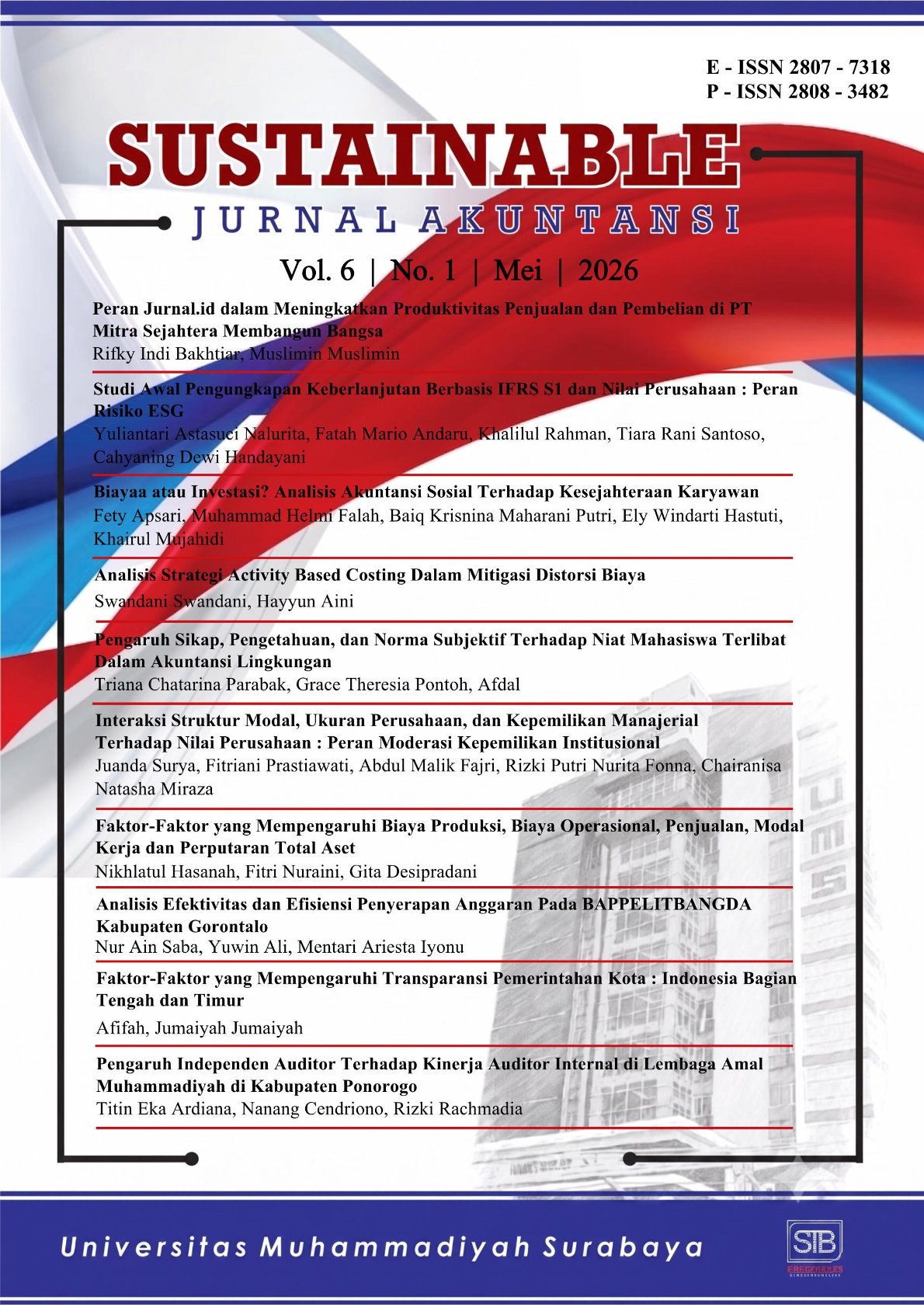
Pengaruh Sikap, Pengetahuan, dan Norma Subjektif terhadap Niat Mahasiswa Telibat dalam Akuntansi Lingkungan
DOI:
https://doi.org/10.30651/stb.v6i1.31076Kata Kunci:
sikap; pengetahuan; norma subjektif; niat; akuntansi keberlanjutanAbstrak
Masalah keberlanjutan lingkungan menunjukkan urgensi yang semakin meningkat dalam pengembangan praktik dan sistem pendidikan di era modern. Tujuan studi ini adalah untuk menyelidiki bagaimana sikap, pengetahuan, dan norma subjektif memengaruhi niat mahasiswa untuk terlibat dalam akuntansi lingkungan. Studi ini dilakukan di Fakultas Ekonomi dan Bisnis Universitas Hasanuddin menggunakan metodologi kuantitatif. Data primer yang digunakan dalam penelitian ini dikumpulkan melalui kuesioner dan dianalisis menggunakan analisis PLS-SEM. Temuan penelitian menunjukkan bahwa niat untuk terlibat dalam akuntansi lingkungan dipengaruhi oleh sikap, pengetahuan, dan norma subjektif. Implikasinya adalah perlu memperkuat strategi pembelajaran untuk membentuk sikap, meningkatkan pemahaman, dan memperkuat norma subjektif guna mendorong niat mahasiswa di bidang akuntansi keberlanjutan.
Referensi
Agshari, Z., Rismawati, & Supri, Z. (2024). Application of Green Accounting Concepts through Accounting Education in Support of Green Economy. 689–701. https://doi.org/10.24843/EJA.2024.v34.i03.p10
Amrullah, M. T., Fauziah, N., Kurnia, L., Gunardi, P., & Jakarta, C. (2025). Accounting Students ’ Intention towards the Sustainable Auditor Profession : A Case Study at ABC College. 2(1), 14–27.
da Cunha, Í. G. F., Policarpo, R. V. S., de Oliveira, P. C. S., Abdala, E. C., & do Nascimento Rebelatto, D. A. (2025). A systematic review of ESG indicators and corporate performance: proposal for a conceptual framework. Future Business Journal, 11(1), 1–25. https://doi.org/10.1186/s43093-025-00539-1
De Silva, T. A., & Nilipour, A. (2024). Is the accounting curricula keeping up with sustainability development? Accounting Education, 34(4), 470–498. https://doi.org/10.1080/09639284.2024.2351951
Eugenio, T., Carreira, P., Miettinen, N., & Lourenço, I. M. E. C. (2022). Understanding students’ future intention to engage in sustainability accounting: the case of Malaysia and the Philippines. Journal of Accounting in Emerging Economies, 12(4), 695–715. https://doi.org/10.1108/JAEE-10-2020-0277
Fenny Zyahwa, Rachmat Pramukty, & Tri Yulaeli. (2023). The Influence of Motivation, Perception, and Tax Knowledge on Career Choice Interests in the Field of Taxtion (A Study of Students in the Faculty of Economics and Business at Ubhara Jaya). MUQADDIMAH: Journal of Economics, Management, Accounting and Business, 1(1), 211–229. https://doi.org/10.59246/muqaddimah.v1i1.106
Firmansyah, A. (2025).The Urgency of Integrating Sustainability Accounting into Higher Education Curricula in the ESG Era. Akuntansiku, 4(1), 78–93. https://doi.org/10.54957/akuntansiku.v4i1.1482
Jogiyanto, H. M. (2007). Behavioral Information System (1st ed.). ANDI Publishing.
Kwakye, T. O., Welbeck, E. E., Owusu, G. M. Y., & Anokye, F. K. (2018). Determinants of intention to engage in Sustainability Accounting & Reporting (SAR): the perspective of professional accountants. International Journal of Corporate Social Responsibility, 3(1). https://doi.org/10.1186/s40991-018-0035-2
Maricar, A., & Pariyawan, S. (2024). Implementation of Environmental Accounting in Relation to the Triple Bottom Line Concept Toward a Green Economy to Achieve Sustainability at PT Varia Usaha Beton ( VUB ) Sidoarjo. 2(1).
Nurita, V., & Sisdianto, E. (2025). The Role of Environmental Accounting in the Disclosure of Sustainability Information in Financial Statements in the Digital Age. 2(1), 406–418.
Ratnaningsih, S. D. A., Ghozali, I., & Harto, P. (2024). Antecedents of students’ intention to be sustainable accountants: evidence from Indonesia. Arab Gulf Journal of Scientific Research, 42(4), 1950–1968. https://doi.org/10.1108/AGJSR-08-2023-0366
Sarfraz, M., Ozturk, I., Yoo, S., Raza, M. A., & Han, H. (2023). Toward a new understanding of environmental and financial performance through corporate social responsibility, green innovation, and sustainable development. Humanities and Social Sciences Communications, 10(1), 1–17. https://doi.org/10.1057/s41599-023-01799-4
Satiti, W. T., Narayani, P. R., & Ivada, E. (2025). Green Accounting Education and Digital Innovation: The Role Of Accounting Education Students In Achieving The SDGs. August, 97–105.
Simalango, A, F, R., & Hasibuan, A. F. (2024). The Influence of Environmental Knowledge) Dan Environmental Concern on Green Purchase Intention Among State University Students in Medan. Journal of Multidisciplinary Scientific Research, 8(8), 2118–7451.
Soares, E. C., Lima, N. C., & Matos Coelho, A. F. (2024). Towards sustainability engaged accounting: A behavioral approach. Revista Contabilidade e Financas, 35(95). https://doi.org/10.1590/1808-057x20242019.en
Sulemana, I., Cheng, L., Agyemang, A. O., Osei, A., & Nagriwum, T. M. (2025). Stakeholders and sustainability disclosure: Evidence from an emerging market. Sustainable Futures, 9, 100445. https://doi.org/10.1016/j.sftr.2025.100445
Sumarsono, H., Maharani, S. N., & Istiqomah, M. (2024). Green Accounting Concept Based on University Social Responsibility. https://doi.org/10.4108/eai.26-9-2023.2350760
Unduhan
Diterbitkan
Terbitan
Bagian
Lisensi
Hak Cipta (c) 2026 SUSTAINABLE

Artikel ini berlisensi Creative Commons Attribution 4.0 International License.
Hak Cipta
Hak cipta terhadap artikel yang diterbitkan di Sustainable : Jurnal Akuntansi.
Penulis harus menyerahkan hak cipta pada jurnal dengan menandatangai dan mengirimkan form penyerahan hak cipta (template) melalui email sustainable@um-surabaya.ac.id
Penulis dapat menyebarluaskan artikelnya melalui media manapun.
Lisensi
Setiap karya yang ditulis penulis dilisensi dengan Creative Commons Attribution-NonCommercial 4.0 International License.