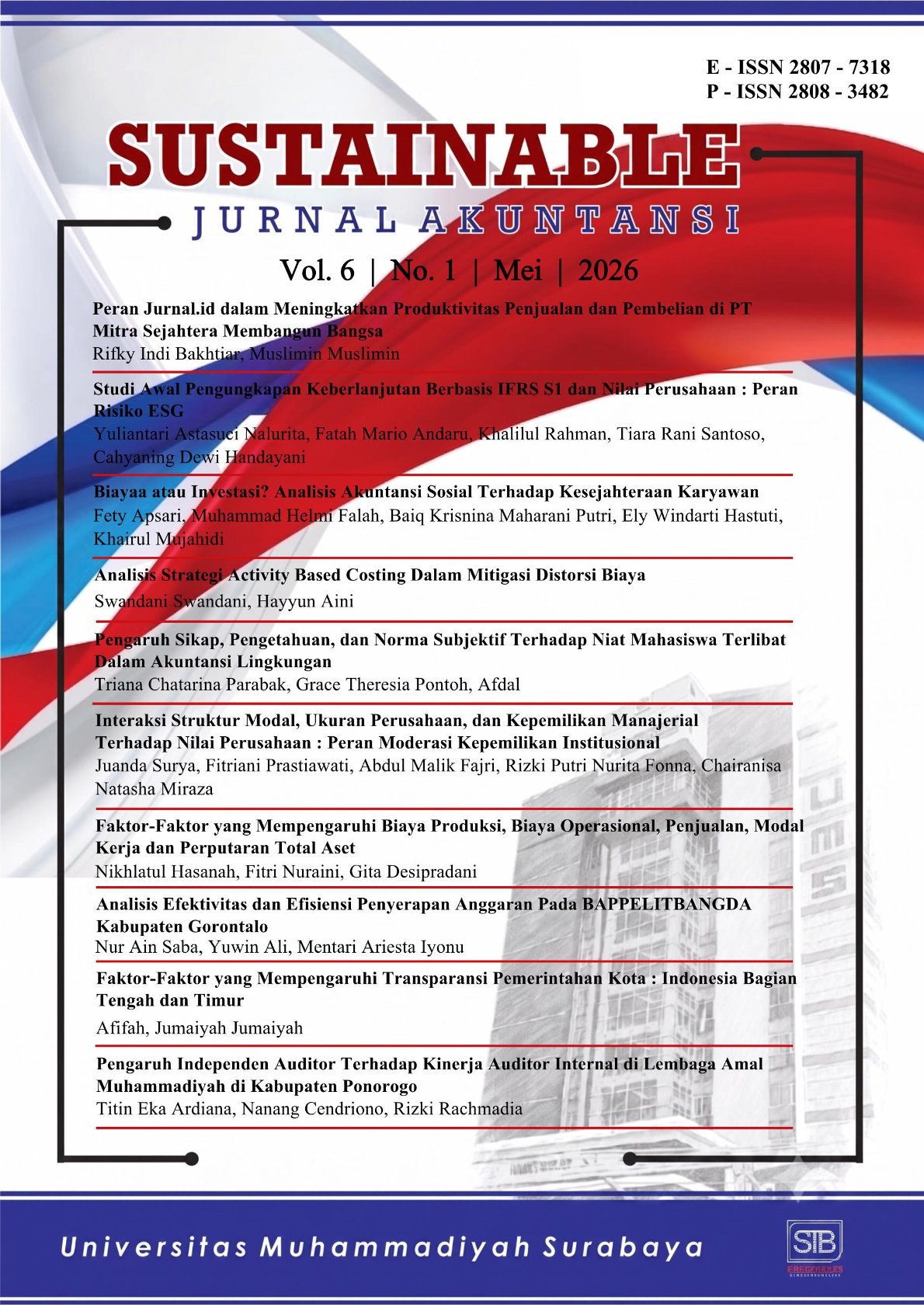
Cost or Investment? A Social Accounting Analysis of Employee Welfare
DOI:
https://doi.org/10.30651/stb.v6i1.30977Keywords:
Employee welfare, social accounting, human capital, costs, investmentAbstract
This study aims to analyze how employee well-being is interpreted and represented in social accounting practices, particularly in the debate over whether employee-related expenditures are positioned as costs or investments. This study uses a qualitative approach with a case study design at PT Unilever Indonesia for the 2022–2024 period. Data were obtained from annual reports and sustainability reports, then analyzed using thematic content analysis to identify patterns in narratives, measurement, and accounting recognition related to employee well-being. The results show that the company consistently allocates resources for fair remuneration, competency development, occupational health and safety, mental well-being, and diversity and inclusion. These practices are supported by measurable and transparent quantitative indicators. However, all employee-related expenditures remain recorded as operating expenses in the financial statements. This finding reveals a duality of representation: strategically, well-being is framed as an investment in human capital, but technically, accounting still treats it as a current-period expense. This research emphasizes the importance of developing a more humanistic social accounting approach to representing human value within organizations
References
Abinaya, V., Amritha, S., Sumathi, G., Sujith, B., & Ranjith, R. (2024). Impact of welfare measures on job satisfaction of employees concerning the engineering industry. 256–259. https://doi.org/10.4324/9781003606642-62
Akshara, S. (2025). A Study on Employees Welfare Practices at Synflix Pharmaceutical PVT LTD. Indian Scientific Journal of Research in Engineering and Management, 09(04), 1–9. https://doi.org/10.55041/ijsrem45759
Anand, N., Lakshmi, V., Jena, S. K., Pundir, A., Lourens, M., & Prusty, A. (2024). Exploring the Link between Employee Well-Being and Organizational Performance. 11, 1–6. https://doi.org/10.1109/tqcebt59414.2024.10545103
Anandhi. S, A.R.Jahnvi, Akhila.N. (2025). Integrating Human Capital into ESG Reporting: A Pathway to Sustainable Value Creation. International Scientific Journal of Engineering and Management. 4, 51-56. https://doi.org/10.55041/ISJEM.ESEH009
Asriyanti, S., Febrianti, A. A., Wulansari, F. N., Mubarok, S., & Anshori, M. I. (2024). The Role of Human Resource Management Strategy in Increasing Employee Work Productivity. Pusat Publikasi Ilmu Manajemen, 2(3), 08–21. https://doi.org/10.59603/ppiman.v2i3.388
Castrillón Cifuentes, J. A., & De León Cuesta, E. (2021). Retos actuales de la función social de la contabildad. 36(68), 176–189. https://doi.org/10.25100/CDEA.V36I68.7893
D’souza, S. (2014). Social accounting – an analysis. Sai Om Journal of Commerce & Management: A Peer Reviewed International Journal, 1(4), 11–15.
Ghaly, M., Dang, V. A., & Stathopoulos, K. (2015). Cash Holdings and Employee Welfare. Social Science Research Network. https://papers.ssrn.com/sol3/papers.cfm?abstract_id=2595124
Grugulis, I. (2024). Human capital theory (pp. 93–99). Edward Elgar Publishing. https://doi.org/10.4337/9781035308767.ch10
Hahn, R., & Lülfs, R. (2013). Legitimizing Negative Aspects in GRI-Oriented Sustainability Reporting: A Qualitative Analysis of Corporate Disclosure Strategies. Social Science Research Network. https://papers.ssrn.com/sol3/papers.cfm?abstract_id=2290167
Kumari, S., & Gope, A. K. (2025). Role of Employee Well- Being on Organisational Performance: A Review of Research. Asian Journal of Management, 158–163. https://doi.org/10.52711/2321-5763.2025.00025
Kurniawati, E., Budiyanto, B., & Raharjo, I. B. (2025). Sustainability Reporting: Framing Theory and Rhetoric Theory Perspectives. International Journal of Accounting and Economics Studies, 12(4), 399–411. https://doi.org/10.14419/nmyz3j97
Konieczny, G., Kolisnichenko, P., Górska, M., & Górski, T. (2023). The role of well-being in sustainable corporate development of companies. Economics, Finance and Management Review. https://doi.org/10.36690/2674-5208-2023-3-59-67
Murmyilo, J. D. (2023). The concept of employee wellbeing as the basis of social responsibility of organizations. Экономический Вектор, 1(32), 18–21. https://doi.org/10.36807/2411-7269-2023-1-32-18-21
Moreeva, E. V., & Ananchenkova, P. I. (2023). Some aspects of theoretical approaches to problematization of human capital measurement: expenditures or investments. Učenye Zapiski Rossijskoj Akademii Predprinimatelʹstva. Rolʹ i Mesto Predprinimatelʹstva v Èkonomike Rossii. https://doi.org/10.24182/2073-6258-2023-22-3-131-135
Nowell, L. (2022). Employee Welfare Provisions (pp. 473–494). IGI Global eBooks. https://doi.org/10.4018/978-1-6684-2405-6.ch025
P, N., & Kandavel, R. (2025). Employee welfare measures: building a happier and healthier workforce. EPRA International Journal of Economics, Business and Management, 210–213. https://doi.org/10.36713/epra21280
Rahman, I. ur, & Tahseen, M. (2023). Analyzing Employee Well-being in Corporate Sectors: Data Insights and Statistical Findings. Indian Scientific Journal of Research in Engineering and Management, 07(03). https://doi.org/10.55041/ijsrem18225
Roekhudin. (2023). Human Resource Accounting Toward Human Welfare. Journal of Namibian Studies: History Politics Culture, 33. https://doi.org/10.59670/jns.v33i.609
Saiganesh, J. (2025). A Study on Workplace Well-Being & Worklife Balance. Indian Scientific Journal of Research in Engineering ind Management, 09(04), 1–9. https://doi.org/10.55041/ijsrem46153
Zaidi, M. (2012). Social Accounting in India. 1(1), 8–12. https://www.longdom.org/abstract/social-accounting-in-india-1847.html
Downloads
Published
Issue
Section
License
Copyright (c) 2026 SUSTAINABLE

This work is licensed under a Creative Commons Attribution 4.0 International License.
Copyright
Copyright for articles published in Sustainable: Accounting Journal.
Authors must submit copyright to the journal by signing and sending the copyright assignment form (template) via email sustainable@um-surabaya.ac.id
Authors can disseminate their articles through any media.
Licence
Every work written by the author is licensed under a Creative Commons Attribution-NonCommercial 4.0 International License.