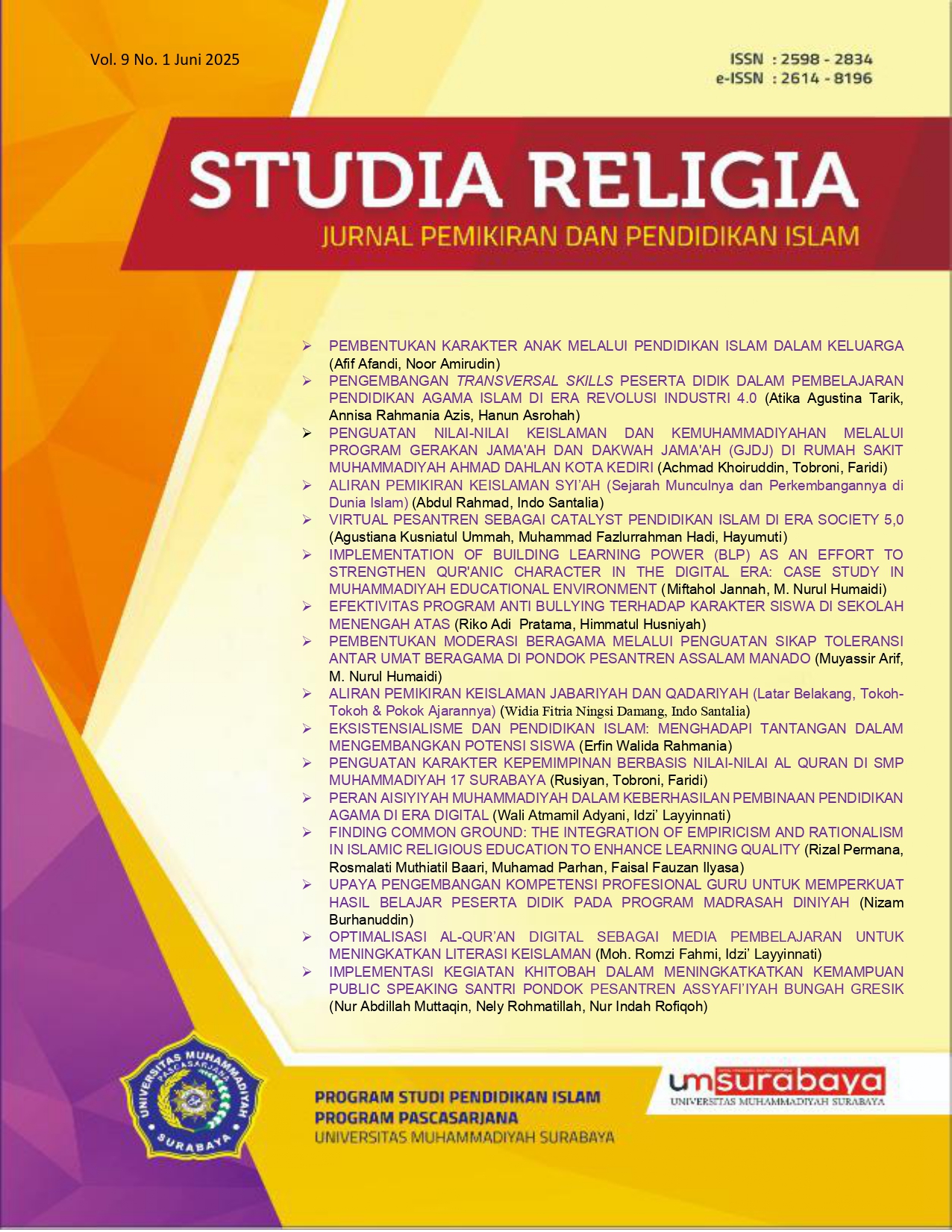
EKSISTENSIALISME DAN PENDIDIKAN ISLAM: MENGHADAPI TANTANGAN DALAM MENGEMBANGKAN POTENSI SISWA
DOI:
https://doi.org/10.30651/sr.v9i01.24852Abstract
This article discusses the integration of existentialism values into Islamic education, particularly in the context of developing students' potential. Existentialism, as a philosophical movement emphasizing individual freedom, the search for meaning in life, and personal responsibility, offers a distinct approach to education that is more authentic and based on free thinking. On the other hand, Islamic education emphasizes the importance of morality, piety, and social responsibility in all aspects of learning. This article examines how these two perspectives can be integrated within Islamic education, identifying both the opportunities and challenges encountered in its application. The opportunities found include providing space for students' personal development, while the main challenge lies in balancing free thinking with religious obligations. The article suggests the implementation of a flexible curriculum based on students' interests, as well as the development of an approach that combines individual freedom with Islamic values, guiding students toward a meaningful and responsible life.
Keyword: Keywords: Existentialism; Islamic Education; Student Potential
References
Elviana, P. (2017). Pembentukan sikap mandiri dantanggung jawab melalui penerapan metode sosiodrama dalam pembelajaran pendidikan kewarganegaraan. Citizenship Jurnal Pancasila Dan Kewarganegaraan, 5(2), 134. https://doi.org/10.25273/citizenship.v5i2.1643
Faizi, N. (2023). Landasan filosofis terhadap pengembangan kurikulum pendidikan islam. Al-Ulum Jurnal Pemikiran Dan Penelitian Ke Islaman, 10(3), 315-329. https://doi.org/10.31102/alulum.10.3.2023.315-329
Hudia, T. (2023). Islamic education in the era of disruption. GIC, 1, 237-241. https://doi.org/10.30983/gic.v1i1.172
Iqbal, M. (2022). Challenges of implementing character education based on islamic values in the independent campus learning curriculum (mbkm). Qalamuna Jurnal Pendidikan Sosial Dan Agama, 14(1), 757-768. https://doi.org/10.37680/qalamuna.v14i1.4839
Jamil, S. (2023). Analisis relevansi pendidikan nasional dan pendidikan islam. wistara, 4(2), 111-120. https://doi.org/10.23969/wistara.v4i2.10720
Julianti, S. and Maemonah, M. (2022). Pemikiran eksistensialisme pada pendidikan anak usia dini (kajian studi pembelajaran berbasis alam). Indonesian Journal of Early Childhood Jurnal Dunia Anak Usia Dini, 4(1), 158. https://doi.org/10.35473/ijec.v4i1.1039
Nafsaka, Z. (2023). Dinamika pendidikan karakter dalam perspektif ibnu khaldun: menjawab tantangan pendidikan islam modern. Jurnal Impresi Indonesia, 2(9), 903-914. https://doi.org/10.58344/jii.v2i9.3211
Najmi, H. (2023). Pendidikan moderasi beragama dan implikasinya terhadap sikap sosial peserta didik. Al-Muttaqin, 9(1), 17-25. https://doi.org/10.37567/al-muttaqin.v9i1.2067
Saidah, Z. (2021). Penanaman nilai-nilai pendidikan islam berbasis kearifan lokal pada anak usia dini di era digital. Al-Tarbiyah Jurnal Pendidikan (The Educational Journal), 31(1), 1. https://doi.org/10.24235/ath.v31i1.8430
Sunarso, S. (2010). Mengenal filsafat eksistensialisme jean-paul sartre serta implementasinya dalam pendidikan. Informasi, 36(1). https://doi.org/10.21831/informasi.v1i1.5659
Tambak, S. (2015). Metode diskusi dalam pembelajaran pendidikan agama islam. Al-Hikmah Jurnal Agama Dan Ilmu Pengetahuan, 12(1), 1-20. https://doi.org/10.25299/jaip.2015.vol12(1).1444
Zulkarnain, Z. and Zubaedi, Z. (2021). Implementation of community-based education management: a case study of islamic boarding schools in bengkulu city, indonesia. Cypriot Journal of Educational Sciences, 16(5), 2640-2650. https://doi.org/10.18844/cjes.v16i5.6331
Downloads
Published
Issue
Section
License
Copyright (c) 2025 Erfin Walida Rahmania

This work is licensed under a Creative Commons Attribution-NonCommercial 4.0 International License.
Penulis tetap memegang hak atas karyanya dan memberikan hak publikasi pertama kepada jurnal ini yang secara simultan karya tersebut dilisensikan di bawah:
Creative Commons Attribution-NonCommercial 4.0 International License