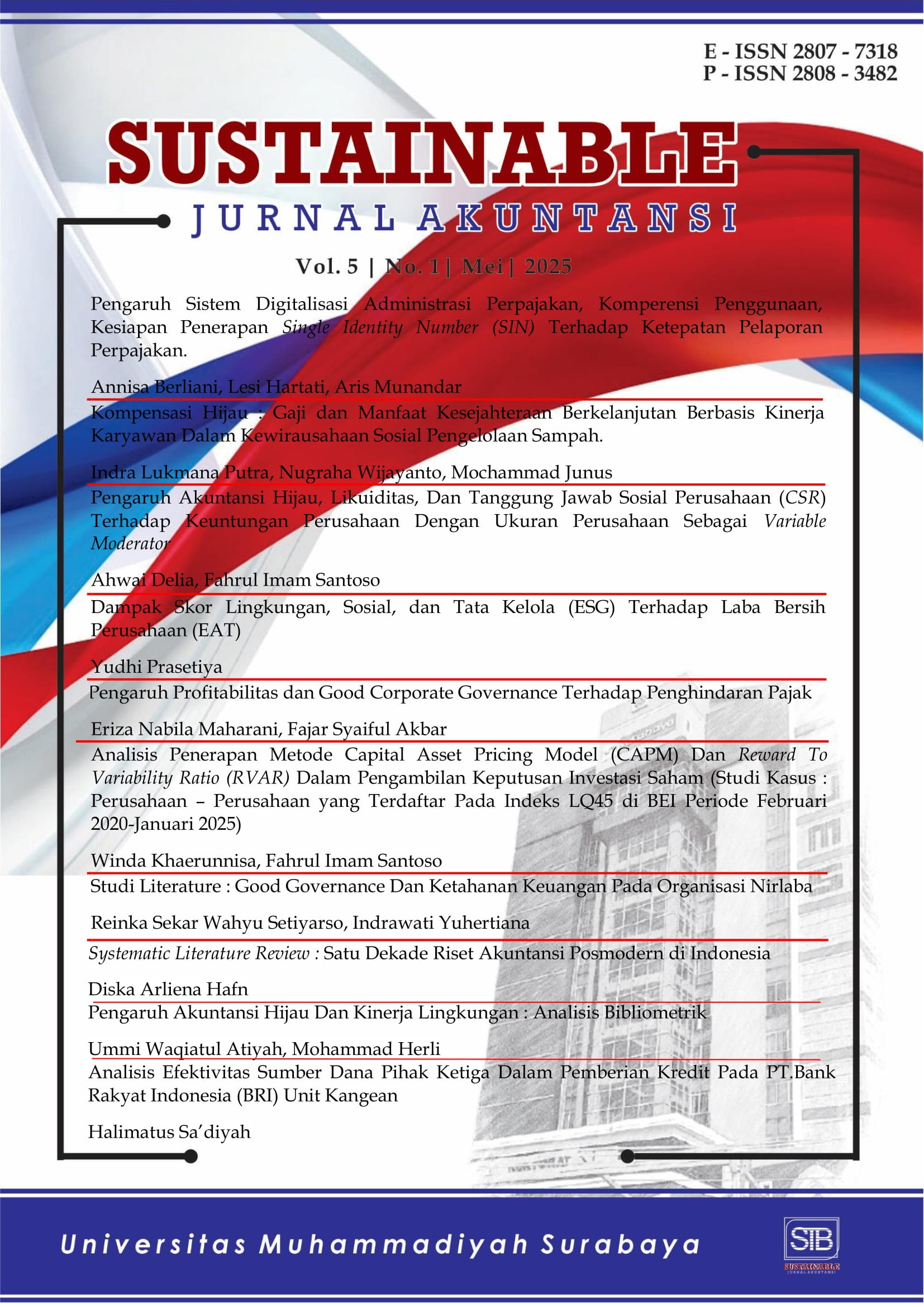
Analysis of the Effectiveness of Third Party Funding Sources in Lending at PT. Bank Rakyat Indonesia (BRI) Kangean Unit
DOI:
https://doi.org/10.30651/stb.v5i1.26510Keywords:
Effectiveness, Third Party Funds, CreditAbstract
Bank Rakyat Indonesia (BRI) is a business entity with the task of collecting funds from the community in the form of deposits and rechannelling them back to the community in the form of credit with the aim of improving the standard of living of many people. The purpose of this research determined the level of effectiveness of third-party funding sources in distributing credit to Bank Rakyat Indonesia in Kangean of Sumenep in the period of 2020 - 2023. The method used a qualitative descriptive method with the type of data used that was primary data through interviews, observations and documentation. To measure the effectiveness of third-party funding sources in credit distribution, this research used analysis of Loan Deposit Ratio (LDR). The results based on the calculation of the Loan Deposit Ratio (LDR) in 2020 and 2021 LDR which was achieved in the range of 49% and 55%, meaning that the use of third- party sources of funds in credit distribution was not effectively used. In 2022 and 2023, the LDR reached in the range of 65% and 61% meant that the use of third-party sources of funds in credit distribution had been used very effectively. The use of third-party funding sources in credit distribution for 4 years from 2020 – 2023 LDR which was achieved in the range of 58% meant that the use of third-party funding sources in credit distribution was still ineffective. Since, many funds had not been channelled as a result of the impact of the Covid-19 pandemic and strong competition between banks and high interest rates can reduce public interest in applying for credit.
References
Andria, V. R. (2006). Credit management handbook: Theories, concepts, procedures, and applications of practical guidelines for students, bankers, and customers. PT Raja Grafindo Persada.
Cashmere. (2014). Banks and other financial institutions. PT Raja Grafindo Persada.
Dendawijaya, L. (2011). Bank management. Graha Indonesia.
Firmansyah, D. I., & Riduwan, A. (2021). The effect of working capital turnover, leverage, and liquidity on profitability. Journal of Accounting Science and Research, 10 (2460-0585), 1-18.
Hasibuan, M. (2016). Basics of banking. Erlangga.
Hantono. (2018). Concept of financial statement analysis with a ratio approach. CV Budi Utama.
Indonesia, B. (2013). Loan deposit ratio (LDR) provisions. Invesnesia.com. https://www.invesnesia.com/loan-to-deposit-ratio-ldr
Indonesia, B. (2020, December 10). Definition, formula and components of loan to deposit ratio (LDR). Kajianpustaka.com. https://www.kajianpustaka.com/
Iradati, S., & Asih, D. N. L. (2024). The effect of third party funds, capital adequacy, nonperforming loans, and lending interest rates on bank profitability (Case study of BUMN Banks listed on the IDX in 2015-2022). Journal MISSY (Management and Business Strategy), 5(1), 13-22.
Irmayanti, Arief, M., & Yuliyanti, L. (2023). The effect of third party funds and lending on profitability in the banking sector listed on the IDX. Journal of Finance, Entrepreneurship, and Accounting Education Research, 2(3), 255-272.
Jatmiko, U., & Agustin, B. H. (2018). Analysis of financing to deposit ratio and third party funds on return on assets at PT Bank Rakyat Indonesia Syariah. An-Nisbah: Journal of Sharia Economics, 4(2), 99-126.
Korompis, V. E., Rotinsulu, T. O., & Sumarauw, J. (2015). Comparative analysis of bank health level based on RGEC method (Study on PT. Bank Rakyat Indonesia Tbk and PT. Bank Mandiri Tbk in 2012-2014). EMBA Journal, 3(4), 433-442.
Manimpurung, L., Nangoy, S. C., & Mangantar, M. (2014). Analysis of financial performance using CAMEL at PT Bank Rakyat Indonesia (Persero) Tbk. EMBA Journal, 2(1), 404410.
Martono, H., & Harjito, D. A. (2012). Financial management. Ekonisia.
Mulyo, G. P., & Mutmainah, S. (2019). Determinants of profit distribution management of Islamic banks in Indonesia for the period 2008-2011. IMANENSI: Journal of Islamic Economics,
Management and Accounting, 1(1), 31-41. https://doi.org/10.34202/imanensi.1.1.2013.31-41
Nawatri, M. N., Topowijono, T., & Husaini, A. (2015). The effectiveness of banking risk management processes in controlling credit risk (Study at PT. Bank Rakyat Indonesia (Persero) Tbk Kawi Malang branch). Journal of Business Administration (JAB), 25(1),
1-12. https://administrasibisnis.studentjournal.ub.ac.id
Nesti, A., Jaya, H., & Putra, R. E. (2016). Analysis of the internal control system in the process of granting credit at PT Bank Rakyat Indonesia Tbk Batam branch. MEASUREMEN, 3(2), 132-153.
Suhikmat, & Handayani, D. N. (2020). The effect of third party funds, bad debts and investment on net income of PT Bank Rakyat Indonesia (Persero), Tbk. Journal of Accounting FEUB, 14(2), 34-54.
Wedhananda, I. N. P., Yudiaatmaja, F., & Suwendra, I. W. (2020). The effect of third party funds and lending on revenue: Case studies in bank sub-sector companies listed on the Indonesia Stock Exchange. Journal of Ganesha University of Education, Department of Management, 8(2020), 113-120.
Downloads
Published
Issue
Section
License
Copyright (c) 2025 SUSTAINABLE : ACCOUNTING JOURNAL

This work is licensed under a Creative Commons Attribution 4.0 International License.
Copyright
Copyright for articles published in Sustainable: Accounting Journal.
Authors must submit copyright to the journal by signing and sending the copyright assignment form (template) via email sustainable@um-surabaya.ac.id
Authors can disseminate their articles through any media.
Licence
Every work written by the author is licensed under a Creative Commons Attribution-NonCommercial 4.0 International License.