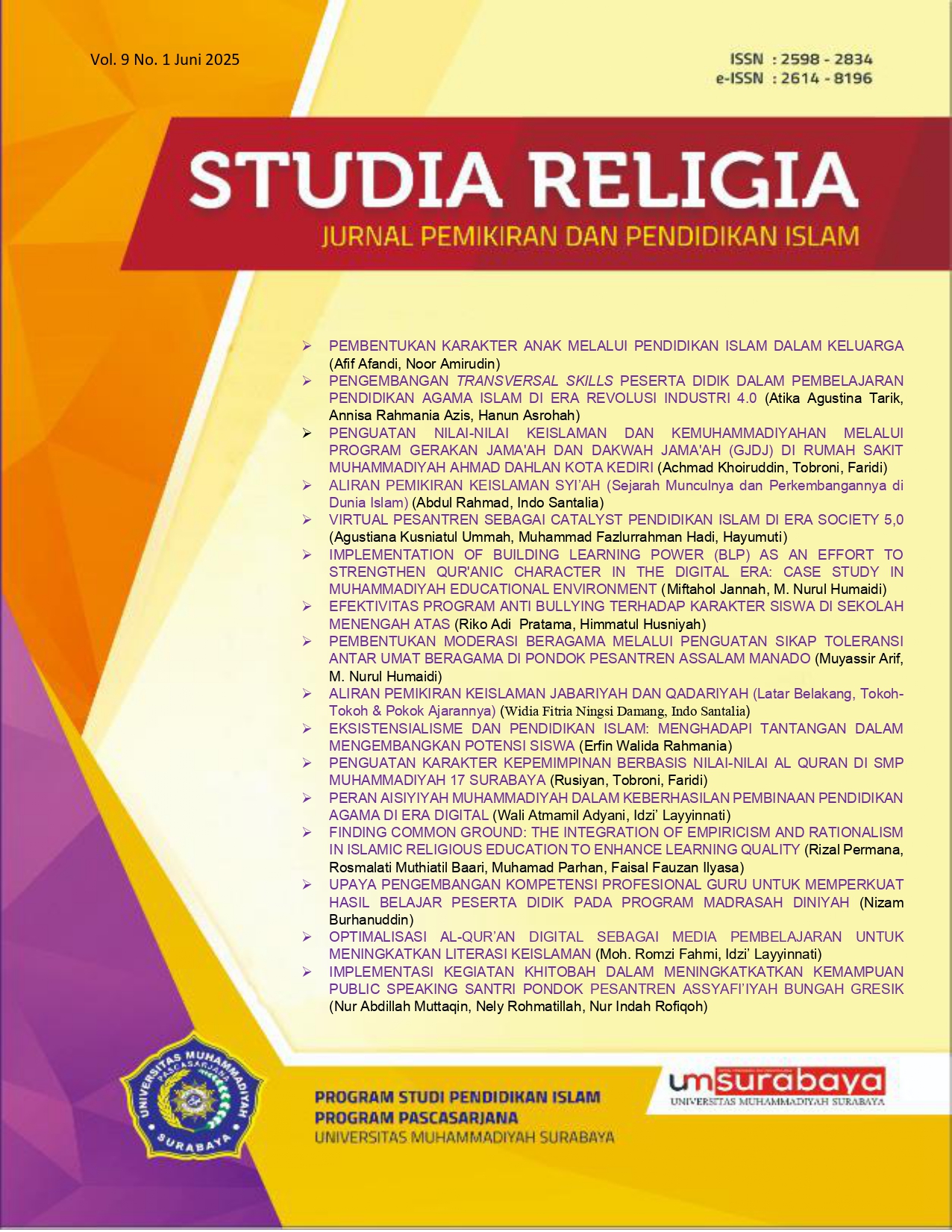
ALIRAN PEMIKIRAN KEISLAMAN SYI’AH
(Sejarah Munculnya dan Perkembangannya di Dunia Islam)
DOI:
https://doi.org/10.30651/sr.v9i01.25238Keywords:
Islam, Syiah, Ali bin Abi Thalib, Ahlul-BaitAbstract
Etymologically, Shia comes from the Arabic word Syia'ah, which means follower. Shia can also mean follower, supporter, lover, or it can also mean group. Thus, if Shia means the expression Shia Ali, it means followers of Ali, or in a simple sense, Shia is a group of Muslims who in their spiritual and religious fields always refer to the descendants of the Prophet Muhammad SAW, or what are called Ahlul-Bait. In terms of terminology, Shia is a sect or ideology that idolizes Ali bin Abi Talib and his descendants are imams or religious leaders after the Prophet Muhammad. Muslim scholars differ in their opinions regarding the history of the emergence of Shia. There are those who think that Shia was born directly after the death of the Prophet Muhammad SAW, namely the struggle for power between the Muhajirin and Ansar groups at the Saqifah Bani Saidah Meeting Hall. There are also those who think that Shia was born at the end of the reign of Caliph Uthman bin Affan or at the beginning of the reign of Ali bin Abi Talib. However, the most popular opinion is that Shia was born after the failure of negotiations between Caliph Ali's troops and the rebels of Muawiyah bin Abu Sufyan during the Shiffin war, which is often referred to as arbitration or the tahkim incident. The Shia development phase was divided into several sects, including; Saba'iyah, Ghurabiyyah, Kaisaniyyah, Zaidiyah, Imam Itsna A'syariyyah (Imam of the Twelve), Isma'iliyyah, Hakimiyyah and Druz, and Nashiriyyah. The development of Shiism in the Islamic world can be traced to the reign of the Umayyad Dynasty (661-750 H), the Abbasid Dynasty (750-945 H), and the Buwaihiyah (945-1055 H).
References
Armia, Muhammad Siddiq. Serpihan Pemikiran Hukum Islam dalam Mazhab Syafii. Dusturiyah: Jurnal Hukum Islam, Perundang-Undangan dan Pranata Sosial. 7 (2) 2017.
Febrianti, Mila. Aliran Syiah dan Pemikirannya. MIMBAR: Jurnal Media Intlektual Muslim dan Bimbingan Rohani. 6 (1), 2020.
Febrianti, Mila. “Aliran Syiah Dan Pemikirannya.” Jurnal Mimbar: Media Intelektual Muslim dan Bimbingan Rohani 6, no. 1 (2020): 86–97.
Moeleong, Lexy. Metodologi Penelitian Kualitatif. Bandung: Remaja Rosdakarya, 2002. Muhammad, Basri, Sumargono. Media Pembelajaran Sejarah. Graha Ilmu Yogyakarta. Graha
Ilmu, 2018.
Rusli. Metode Pembelajaran Sejarah Untuk Meningkatkan Nasionalisme Siswa. Bengkalis: Dotplus Publisher, 2023.
Shafwan, Muhammad Hambal. Intisari Sejarah Pendidikan Islam. Solo: Pustaka Arafah, 2019. Hasim, Moh. Syiah: Sejarah Timbul dan Perkembangannya di Indonesia. Harmoni. 11 (4), 2012. Herman, Hamzah Harun dan Andi Aderus. Suni dan Syiah: Titik Perbedaan dan Perseteruan.,
Jurnal Pendidikan Sosiologi, 7 (1), 2024.
Muhammadong. Menakar Peta Aliran Syiah dalam Aliran Keagamaan Pada Dunia Islam.
Sulesana. 17(2), 2023.
Zulfikar dan Indo Santalia. Sejarah Munculnya Syiah dan Perkembangannya di Dunia Islam.
SETYAKI: Jurnal Studi Keagamaan Islam. 2(1), 2024.
Downloads
Published
Issue
Section
License
Copyright (c) 2025 abdul rahmad, Indo Santalia

This work is licensed under a Creative Commons Attribution-NonCommercial 4.0 International License.
Penulis tetap memegang hak atas karyanya dan memberikan hak publikasi pertama kepada jurnal ini yang secara simultan karya tersebut dilisensikan di bawah:
Creative Commons Attribution-NonCommercial 4.0 International License