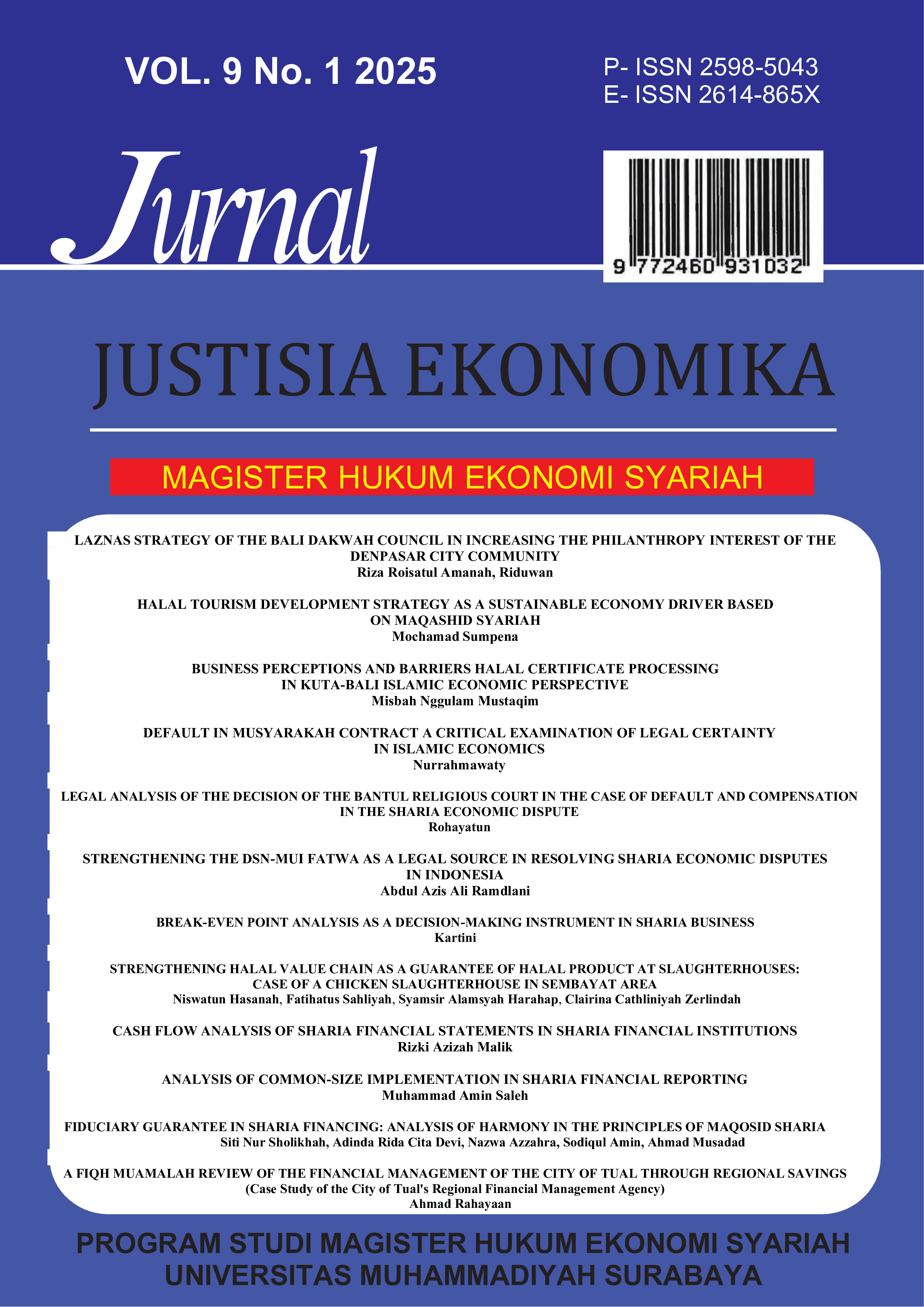
ANALYSIS OF COMMON-SIZE IMPLEMENTATION IN SHARIA FINANCIAL REPORTING
DOI:
https://doi.org/10.30651/justeko.v9i1.25983Kata Kunci:
Common Size, Sharia Financial, ReportingAbstrak
The implementation of common-size analysis in Sharia financial reporting offers an effective approach to enhancing the transparency, comparability, and consistency of financial statements in Islamic financial institutions. This study analyzes how the application of common-size techniques contributes to the quality and clarity of Sharia-compliant financial disclosures. Using a qualitative descriptive method with a case study approach, the research explores the practical aspects and implications of implementing common-size analysis within selected Islamic financial institutions. The findings indicate that common-size analysis supports better financial interpretation, facilitates benchmarking across periods or institutions, and improves overall stakeholder understanding. Moreover, it strengthens external trust by ensuring that financial reports are more accessible and informative. This study highlights the importance of adopting analytical tools such as common-size techniques to advance the practice and credibility of Sharia financial reporting.
Referensi
[1] AAOIFI. (2015). Accounting and Auditing Organization for Islamic Finansial Institution: Governance Standards.
[2] Aisyah, S. (2024). Synergizing the Sustainable Islamic Finance Ecosystem in Indonesia The Management Collaboration Line. Jurnal Bisnisman : Riset Bisnis Dan Manajemen, 6(1), 28–44. https://doi.org/10.52005/bisnisman.v6i1.208.
[3] Akhtar, M., Zia, M. H., & Shehzad, F. (2018). True and Fair View of Financial Reporting Practices: Accountants’ Perspective. 8. https://journal.riphah.edu.pk/index.php/jibm/article/view/134.
[4] Alhabshi, S. O., & Noor, M. M (2022).The Role of Common Size Analysis In Enhancing Financial Reporting in Islamic Banks. Journal of Islamic Accounting and Business and Research, 13(1), 45-60.
[5] Al-Qudah, A., Al-Makhamreh, S., & Al-AAzzam, M. (2020). Transparency in Finansial Reporting and Its Impact on Investor Confidence: Evidence from Jordan. International Journal of Finansial Studies, 8 (4), 45-57.
[6] Bank Syariah Indonesia. (2022). Laporan Tahunan 2022. Jakarta: PT Bank Syariah Indonesia Tbk. https://ir.bankbsi.co.id/annual_reports.html
[7] Bank Syariah Indonesia. (2023). Laporan Tahunan 2023. Jakarta: PT Bank Syariah Indonesia Tbk. https://ir.bankbsi.co.id/annual_reports.html
[8] Bank Syariah Indonesia. (2024). Laporan tahunan 2024. Jakarta: PT Bank Syariah Indonesia Tbk. https://ir.bankbsi.co.id/annual_reports.html
[9] BIMB. (2021). Annual Report 2021. Bank Islam Malaysia Berhad.
[10] Brealey, R. A., Myers, S. C., & Allen, F. (2014). Principles of corporate finance. McGraw-hill.
[11] Deloitte. (2021). Digital Transformation in Islamic Finance: Trends and Insights. https://www2.deloitte.com.
[12] Fauzi, M. R. (2023). Analisa Komparasi Laporan Keuangan Bank Syariah Indonesia Sebelum dan Sesudah Merger. Jurnal Bisnis Mahasiswa, 3(3), 120-125.
[13] Global Reporting Intiative (GRI). (2020). Sustainability reporting in islamic finance: Aglobal Perspective. https://www.globalreporting.org.
[14] Haniffa, R.M., & Hudaib, M. (2007). Exploring The Ethical Identity Of Islamic Banks Via Communication in Annual Report. Journal of Business Ethics, 76, 97-116. https://doi.org/10.1007/s10551-006-9272-5.
[15] Hassan, M., & Naim, M. (2022). Finansial Performance Analysis Using Common Size Analysis: A Case Study of Selected Firms. Jounal of Business and Management, 10 (2), 205-214.
[16] Harahap, S.S (2018). Akuntansi Syariah: Teori dan Praktik. Jakarta: Salemba Empat.
[17] Ibrohim, M., & Ali, A (2020). The Role of Common Size Analysis in Finansial Reporting: Evidence from Islamic Banks. Journal of Islamic Accounting and Business Researcah, 11 (3), 621-634.
[18] Islamic Finansial Services Board (IFSB) (2022). Islamic Finansial Stability Report 2022. https://www.ifsb.org/publication-document/islamic-financial-services-industry-stability-report-2022.
[19] Jaradat, H., & Oudat, M. S (2025). Enhancing Clarity and Transparency in Islamic Financial Practices: The Role of Regulatory Influence. Journal of Financial Reporting and Accounting.
[20] Kamil, W. A. R., Bakhor, S. A. S. M., De Luna-Martinez, J., Zhang, W. G., & Abdul Aziz, A. H. B. (2019). Islamic Green Finance : Development, Ecosystem and Prospects. 1–111.https://documents.worldbank.org/curated/en/591721554824346344/Islamic-Green-Finance-Development-Ecosystem-and-Prospects.
[21] KPMG. (2021). The Future of Islamic Finance: Embracing Digital Transformation. https://home.kpmg.
[22] Laksase, S., Rusmardiana, A., Kholid, M., K., & Silaban, B. T (2024). The Role of Shariah Compliance in Enhancing Finansial Reporting Transparency: A Comparative Study of Islamic and Conventional Finansial Institutions. The journal of Academic Science, 1(8), 1052-1062.
[23] Latif, A. R. A., & Ahmad, S. (2021). Financial Reporting Of Islamic Bank In The Light Of Shariah: A Conceptual Framework. 26(2), 10–19. https://doi.org/10.33102/JFATWA.VOL26NO2.396.
[24] McKinsey & Company. (2021). The State of Islamic Banking: A Global Perspective. https://www.mckinsey.com.
[25] Mohd Haridan, N., Sheikh Hassan, A. F., Mohammed Shah, S., & Mustafa, H. (2023). Financial Innovation in Islamic Banks: Evidence on The Interaction between Shariah Board and Fintech. Journal Of Islamic Accounting And Business Research, 14(6), 911-930.
[26] Mohamad, S., & Ibrahim, M. (2020). Enhancing financial literacy in Islamic finance through education: A case study. International Journal of Islamic and Middle Eastern Finance and Management, 13(3), 455-470.
[27] Mohammadiyan, M. (2024). The Impact of Financial Reporting Quality on Investment Decisions: Evidence from Tehran Stock Exchange. Creative Economy and New Business Management Approaches, 92-105.
[28] Muzafar, N., & Ullah, K. (2017). Success Factors of Collaboration in Islamic Banks. 9(1), 119–130. https://doi.org/10.22547/BER/9.1.7.
[29] Nabhan, F. (2013). Pengembangan kapabilitas kolaborasi dinamis untuk meningkatkan kinerja bisnis koperasi jasa keuangan syariah di jawa tengah. 7(1), 207–230. https://doi.org/10.18326/INFSL3.V7I1.207-230.
[30] OJK. (2022). Laporan Perkembangan Keuangan Syariah 2021. Otoritas Jasa Keuangan.
[31] PwC. (2022). Enhancing Transparency in Islamic Banking: A Path Forward. https://www.pwc.com.
[32] Radziwill, N. (2018). Blockchain Revolution: How the Technology Behind Bitcoin is Changing Money, Business, and The Word. 2016. And Tapscott and Alex Tapscott. New York: Penguin Random House. 348 Pages.
[33] Rahman, A. Zain, M., & Sulaiman, N. (2021). The Importance of collaboration in Enhancing Finansial Reporting Practices in Islamic Finance. Journal of Islamic Accounting and Business Research, 12 (3), 345-359.
[34] Sanad, Z. (2024). Insights Into Financial Reporting Practices in The Metaverse: Evidence From Islamic Financial Institutions in Bahrain. Journal of Islamic Marketing. https://doi.org/10.1108/jima-01-2024-0029.
[35] Schumpeter, J. A (1934). The Theory of Economic Development. Harvard University Press.
[36] Sri, R., & Nugroho, A. (2022). Integrating big data analytics in finansial reporting: the future of Finansial management in islamic finance. Internasional journal of islamis finance, 14 (1), 89-103.
[37] White, G. I., Sondhi, A. C., & Fried, D. (2002). The analysis and use of financial statements. John Wiley & Sons.
Unduhan
Diterbitkan
Cara Mengutip
Terbitan
Bagian
Lisensi
HAK CIPTA
Penulis yang mengirimkan artikel dalam jurnal Justisia Ekonomika harus memahami dan menyetujui persyaratan tentang hak cipta jurnal Justisia Ekonomika sebagai berikut:
1. Hak Cipta tulisan / artikel yang diterbitkan di jurnal Justisia Ekonomika otomatis menjadi hak pengelola jurnal atau publisher
2. Meskipun Hak Cipta atas tulisan yang telah diterbitkan di jurnal Justisia Ekonomika adalah menjadi haknya publisher, tetapi penulis masih mempunyai hak untuk : a). Penulis boleh meng-upload di repository kampus, b). Penulis boleh meng-upload di webnya sendiri, c). Penulis boleh meng-upload di google schoolar, orchid dan sinta
LISENSI
Lisensi atas tulisan / artikel yang diterbitkan di jurnal Justisia Ekonomika adalah menggunakan Creative Commons dengan atribusi CC-BY-NC 4.0