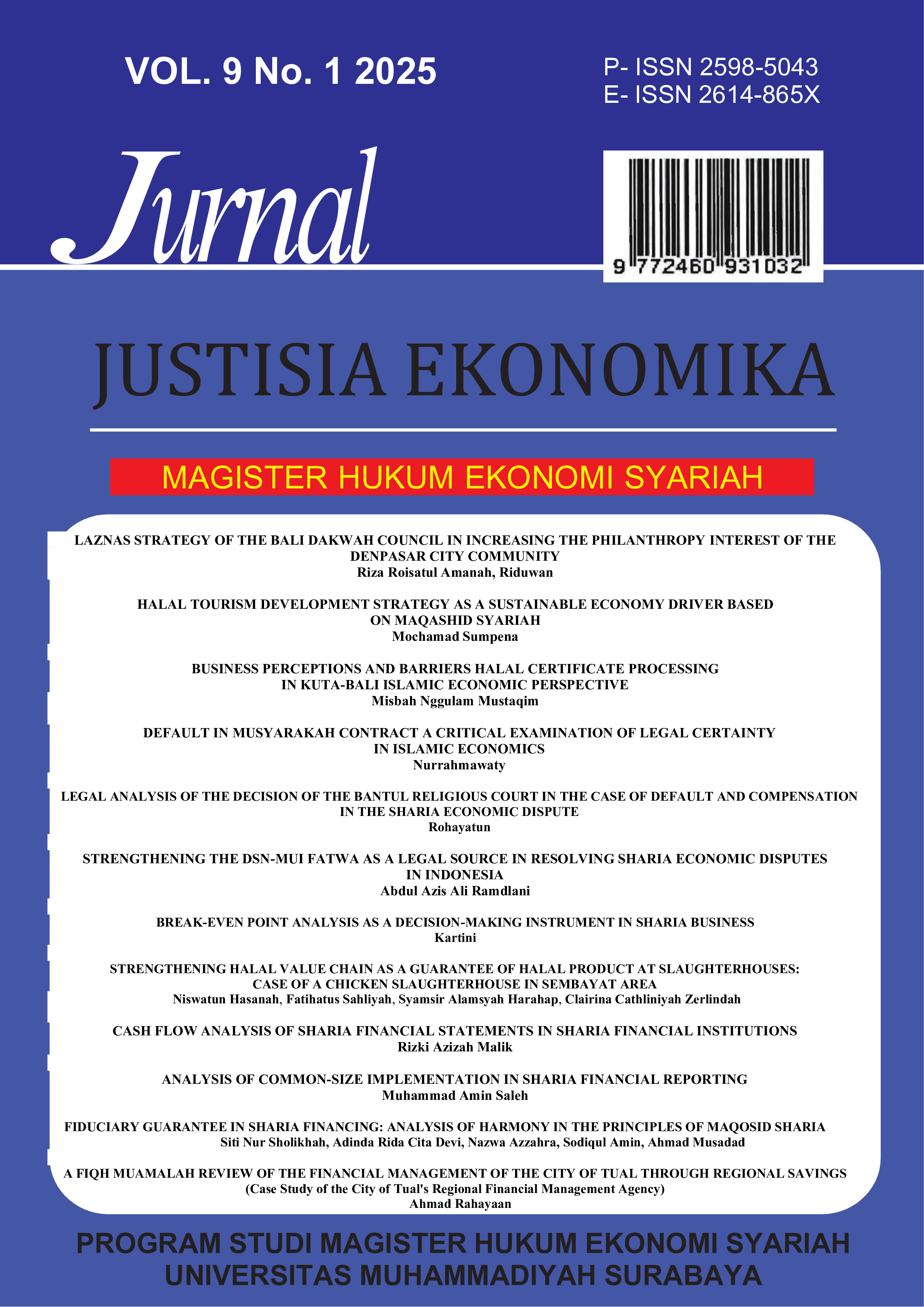
HALAL TOURISM DEVELOPMENT STRATEGY AS A SUSTAINABLE ECONOMY DRIVER BASED ON MAQASHID SYARIAH
DOI:
https://doi.org/10.30651/justeko.v9i1.23198Kata Kunci:
Halal Tourism, Sustainable Economy, Maqashid SyariahAbstrak
In the era of globalization and rapid growth of the tourism industry, a halal tourism development strategy has become an urgent need to encourage a sustainable economy based on the principles of Maqashid Sharia. This research aims to analyze halal tourism development strategies as a driving element for sustainable economic growth based on the concept of Maqashid Sharia. The research method used is a qualitative approach. The results of this research confirm that halal tourism has the potential to positively impact the economy sustainably. This approach involves key components such as halal food, accommodation that is friendly to Muslim needs, and interactions with religious norms. This creates an environment that is in line with Maqashid Sharia, which involves the protection of religion (Hifz al-Din), soul (Hifz al-Nafs), intellect (Hifz al-Aql), descendants (Hifz al-Nasl), property (Hifz al-Mal), and environment (Hifz al-Bi’ah). In the context of the halal tourism development strategy, three important factors were identified: the development of infrastructure that supports halal principles, the promotion of appropriate destinations, and the implementation of the principles of crowdfunding within the Sharia framework.
Referensi
[1] K. Hussain, H. Sun, M. Ramzan, S. Mahmood, and M. Zubair Saeed, “Interpretive Structural Modeling of Barriers to Sustainable Tourism Development: A Developing Economy Perspective,” Sustainability (Switzerland), vol. 16, no. 13, Jul. 2024, doi: 10.3390/su16135442.
[2] T. Jiang, J. Gao, X. Zheng, and Y. Liao, “Engendering prosociality through tourist-to-tourist interaction in religious tourism: an existential transformative perspective,” Journal of Sustainable Tourism, vol. 32, no. 12, pp. 2442–2458, Dec. 2024, doi: 10.1080/09669582.2023.2277126.
[3] D. Hariani, M. H. Hanafiah, N. A. M. Anuar, and K. N. Ahmad, “Promoting halal tourism in sharia-compliant destination: Insights on Aceh competitiveness and tourist perceived value and behavior,” Tourism and Hospitality Research, 2024, doi: 10.1177/14673584241283902.
[4] M. A. F. Chowdhury, M. Abdullah, and Z. Sulong, “Examining the impact of Halal tourism industry sustainability on stock returns,” Tourism Economics, p. 13548166241265820, Jul. 2024, doi: 10.1177/13548166241265820.
[5] Z. Sulong, M. A. F. Chowdhury, M. Abdullah, and C. M. Hall, “Constructing sustainable halal tourism composite performance index for the global halal tourism industry,” Asia Pacific Journal of Tourism Research, vol. 29, no. 7, pp. 852–868, Jul. 2024, doi: 10.1080/10941665.2024.2350413.
[6] S. A. Mohamed, M. Miricho, and M. A. Nzioka, “Adoption of Halal Tourism Concept in Star-Rated Hotels in Mombasa County, Kenya: The Role of Perceived Benefits,” Journal of Hospitality and Tourism Management, vol. 5, no. 2, pp. 21–27, Nov. 2022, doi: 10.53819/81018102t5132.
[7] A. Al-Ansi, H. Olya, and H. Han, “Two decades of research on halal hospitality and tourism: a review and research agenda,” International Journal of Contemporary Hospitality Management, vol. 35, no. 6, pp. 2017–2055, Jan. 2023, doi: 10.1108/IJCHM-12-2021-1515.
[8] N. A. Muslim, A. Taeali, and F. S. Renaldi, “Reinterpreting Iddah for Career Women: Najmuddin Tufi's Maqashid Sharia Approach,” Ulul Albab: Jurnal Studi dan Penelitian Hukum Islam, vol. 8, no. 1, p. 65, Oct. 2024, doi: 10.30659/jua.v8i1.38887.
[9] A. Syafi, “APPLICATION OF ISLAMIC BUSINESS ETHICS IN THE FINTECH INDUSTRY: AN ANALYSIS OF THE FOUNDATION OF SHARIA MAQASHID,” AJEMB (American Journal of Economic and Management Business), vol. 2, no. 12, pp. 39–45, Dec. 2023, doi: https://doi.org/10.58631/ajemb.v2i12.68.
[10] T. D. Pertiwi and S. Herianingrum, “Menggali Konsep Maqashid Syariah: Perspektif Pemikiran Tokoh Islam,” Jurnal Ilmiah Ekonomi Islam, vol. 10, no. 1, p. 807, Mar. 2024, doi: 10.29040/jiei.v10i1.12386.
[11] A. Isman, S. Hidayat, I. Rosyadi, M. S. Firman, and N. A. Sholehah, “Penelitian Hukum Empiris Berbasis Teori Maqashid Syariah Jasser Auda,” AL-AFKAR: Journal for Islamic Studies, vol. 6, no. 4, pp. 14–29, Aug. 2023, doi: 10.31943/afkarjournal.v6i4.730.
[12] Q. Muttaqin and U. Khasanah, “Analisis Kepatuhan Prinsip Syariah dalam Layanan E-Money Perspektif Maqashid Syariah,” Jurnal Ilmiah Ekonomi Islam, vol. 9, no. 2, p. 1806, Jul. 2023, doi: 10.29040/jiei.v9i2.8972.
[13] M. Solihat, D. P. Basir, A. Mubarokah, and Raisa, “Maqashid Sharia-Based Pesantren Development Index,” 2023, doi: 10.58968/msr.v2i1.331.
[14] M. Azali, N. Kamal Basha, Y. S. Chang, X. J. Lim, and J. H. Cheah, “Why Not Travel to Malaysia? Variations in Inbound Tourists’ Perceptions toward Halal-Friendly Destination Attributes,” Journal of Hospitality and Tourism Research, vol. 47, no. 1, pp. 177–206, Jan. 2023, doi: 10.1177/1096348020987634.
[15] L. S. Budovich, “The impact of religious tourism on the economy and tourism industry,” HTS Teologiese Studies / Theological Studies, vol. 79, no. 1, 2023, doi: 10.4102/HTS.V79I1.8607.
[16] M. Tabrani, “Maqâshid Revitalization in Global Era: Istidlâl Study from Text to Context,” AL-IHKAM: Jurnal Hukum & Pranata Sosial, vol. 13, no. 2, p. 310, Dec. 2018, doi: 10.19105/al-ihkam.v13i2.1814.
[17] D. Putranto, A. M. Tri, H. F. Amonio, M. Milawati, and S. Leonard, “Unlocking the Potential of Halal Tourism in Bandung City: A Qualitative Analysis of Public Diplomacy and Economic Growth,” Jurnal Multidisiplin Madani, vol. 4, no. 8, pp. 1179–1186, Aug. 2024, doi: 10.55927/mudima.v4i8.10776.
[18] S. Pongsakornrungsilp, P. Pongsakornrungsilp, T. Chouykaew, H. Niyomdecha, S. Chansamran, and Y. He, “Integrating Sustainability and Cultural Sensitivity: Clustering Muslim Tourist Lifestyles in the Andaman Coastal Cluster, Thailand,” Sustainability (Switzerland), vol. 16, no. 21, Nov. 2024, doi: 10.3390/su16219542.
[19] Sugiyono, Metodelogi Penelitian Kuantitatif dan Kualitatif Dan R&D. Bandung: ALFABETA, 2019.
[20] F. Nisha and C. Cheung, “Locating Muslimah in the travel and tourism research,” Tour Manag Perspect, vol. 41, p. 100940, 2022, doi: https://doi.org/10.1016/j.tmp.2022.100940.
[21] S. Yousaf, “Understanding Halal leisure: a preliminary view,” Leisure Studies, vol. 42, no. 2, pp. 314–323, 2023, doi: 10.1080/02614367.2022.2115110.
[22] V. Gaffar et al., “Digital halal literacy and halal destination attribute as the antecedents of revisit intention,” International Journal of Tourism Cities, vol. ahead-of-print, no. Ahead-of-print, Jan. 2024, doi: 10.1108/IJTC-12-2023-0259.
[23] M. T. Mannaa, “Halal food in the tourist destination and its importance for Muslim travellers,” Current Issues in Tourism, vol. 23, no. 17, pp. 2195–2206, Sep. 2020, doi: 10.1080/13683500.2019.1616678.
[24] A. Shalihin, H. Nasution, J. Hidayati, and I. Vanany, “Halal Practice Adoption Behaviour in The Food Industry: A Focus Group Discussion,” Jul. 2024. doi: https://doi.org/10.70082/esiculture.vi.702.
[25] R. C. G. C. Jasminah J. Malabi Charisse Jane H. Chavez and S. D. Manala-O, “Exploring inclusivity in travel and leisure: Insights from Filipino Muslim families,” J Leis Res, vol. 0, no. 0, pp. 1–21, 2024, doi: 10.1080/00222216.2024.2424208.
[26] D. Bazin, A. Bhukuth, M. Dragasevic, and Q. Faviandhani, “From halal tourism to the sharia economy: The case of Lombok honeymoon halal tourism,” Tourism and Hospitality Research, pp. 1–15, May 2024, doi: 10.1177/14673584241257085.
[27] E. Nursanty and A. Wulandari, “UNVEILING THE AUTHENTICITY OF ISLAMIC VALUES: THE EVOLUTION AND TRANSFORMATION OF TRADITIONAL VILLAGES,” Journal of Islamic Architecture, vol. 7, no. 4, pp. 595–612, Dec. 2023, doi: 10.18860/jia.v7i4.21258.
[28] A. Tusakdia, L. N. Hakim, and E. Zulfikar, “The Relevance Of Hifdzun Nafs With The Law of Qishash: An Analysis Of Ibnu ’Ashur’s Interpretation In Tafsir al-Tahrir Wa al-Tanwir,” 2024.
[29] N. A. Wahab, N. Hamid, N. Man, and S. N. I. Hashim, “Konsep hifz al-’aql dalam aktiviti pelancongan: satu kajian awal: concept of hifz al-’aql in tourism activities: an overview,” Journal of Muwafaqat, vol. 2, no. 2, pp. 73–92, Dec. 2019, [Online]. Available: https://muwafaqat.kuis.edu.my/index.php/journal/article/view/32
[30] J. Aldhi Wijaya and I. R. Kusumawati, “The Relevance of the Standard of Maintenance in the Classical Book of Turats Syafi’iyyah and the Local Wisdom of the Javanese People to Family Harmony,” Jurnal Indonesia Sosial Teknologi, vol. 5, no. 9, 2024, [Online]. Available: http://jist.publikasiindonesia.id/
[31] S. A. Hassan, R. Abdul Rashid, and Z. Z. Mohd Zakuan, “THE PRESERVATION OF PROPERTY IN MAQASID AL-SYARIAH: WITH SPECIAL REFERENCE TO THE APPOINTMENT AND DUTIES OF WASI IN ESTATE ADMINISTRATION,” International Journal of Law, Government and Communication, vol. 7, no. 29, pp. 318–328, Sep. 2022, doi: 10.35631/ijlgc.729022.
[32] A. Muhamad, A. H. Syihab, and A. H. Ibrahim, “Preserving Human–Nature’s Interaction for Sustainability: Quran and Sunnah Perspective,” Sci Eng Ethics, vol. 26, no. 2, pp. 1053–1066, Apr. 2020, doi: 10.1007/s11948-020-00192-7.
[33] F. Setiawan, L. Qadariyah, S. Nahidloh, Dzikrulloh, Holis, and J. Jumanto, “TOWARDS SDG SUSTAINABLE HALAL TOURISM DEVELOPMENT: INTEGRATION OF SUSTAINABILITY AND RELIGIOUS MORALITY,” Journal of Lifestyle and SDG Review, vol. 5, no. 2, Nov. 2024, doi: 10.47172/2965-730X.SDGsReview.v5.n02.pe02893.
[34] Jayant Isaac, “EXPLORING THE IMPACT OF HALAL TOURISM STANDARDS ON INTERNATIONAL TRAVEL CHOICES: A COMPARATIVE STUDY OF KEY DESTINATIONS,” INTERNATIONAL JOURNAL OF HALAL ECOSYSTEM AND MANAGEMENT PRACTICES (IJHEMP), vol. 2, no. 2, Sep. 2024, doi: 10.35631/IJHEMP.22002.
[35] Lalu Adi Permadi, I Made Wardana, Ni Wayan Ekawati, and Ni Putu Saroyini Piartrini, “Halal destination attributes and its relationship with destination image based on local wisdom and revisit intention,” World Journal of Advanced Research and Reviews, vol. 24, no. 2, pp. 1646–1659, Nov. 2024, doi: 10.30574/wjarr.. 2024.24.2.3437.
[36] G. Prayag, “Halal tourism: looking into the future through the past,” Tourism Recreation Research, vol. 45, no. 4, pp. 557–559, Oct. 2020, doi: 10.1080/02508281.2020.1762044.
[37] A. Moshin, A. Brochado, and H. Rodrigues, “Halal tourism is traveling fast: Community perceptions and implications,” Journal of Destination Marketing and Management, vol. 18, Dec. 2020, doi: 10.1016/j.jdmm.2020.100503.
[38] W. Pangestoeti, E. Amalia, A. Alfiandri, F. Firman, O. R. Azizi, and R. Gemilang, “Halal Tourism and Industry in Blue Economy (Analysis on Kepulauan Riau Challenges Towards the Cross Border strategic location with neighbouring countries Singapore and Malaysia - Case Study Pulau Penyengat),” in BIO Web of Conferences, EDP Sciences, Oct. 2024. doi: 10.1051/bioconf/202413403006.
Unduhan
Diterbitkan
Cara Mengutip
Terbitan
Bagian
Lisensi
HAK CIPTA
Penulis yang mengirimkan artikel dalam jurnal Justisia Ekonomika harus memahami dan menyetujui persyaratan tentang hak cipta jurnal Justisia Ekonomika sebagai berikut:
1. Hak Cipta tulisan / artikel yang diterbitkan di jurnal Justisia Ekonomika otomatis menjadi hak pengelola jurnal atau publisher
2. Meskipun Hak Cipta atas tulisan yang telah diterbitkan di jurnal Justisia Ekonomika adalah menjadi haknya publisher, tetapi penulis masih mempunyai hak untuk : a). Penulis boleh meng-upload di repository kampus, b). Penulis boleh meng-upload di webnya sendiri, c). Penulis boleh meng-upload di google schoolar, orchid dan sinta
LISENSI
Lisensi atas tulisan / artikel yang diterbitkan di jurnal Justisia Ekonomika adalah menggunakan Creative Commons dengan atribusi CC-BY-NC 4.0