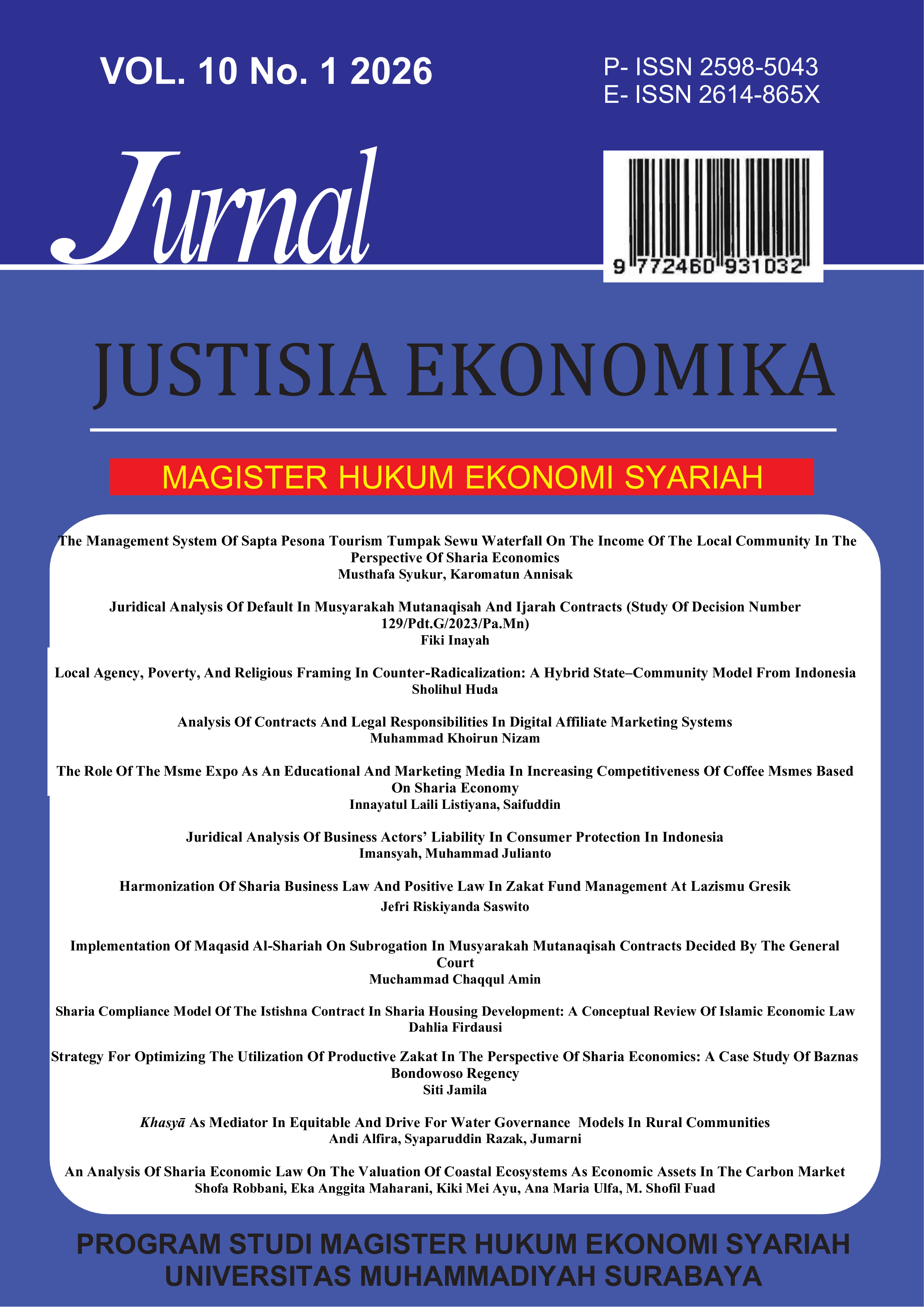
ANALYSIS OF CONTRACTS AND LEGAL RESPONSIBILITIES IN DIGITAL AFFILIATE MARKETING SYSTEMS
DOI:
https://doi.org/10.30651/justeko.v10i1.30378Keywords:
Digital affiliate marketing, legal responsibility, Islamic economic law, maqāṣid al-sharī‘ah, Indonesian positive law.Abstract
The rapid development of digital technology has transformed commercial systems and legal relationships, including the emergence of digital affiliate marketing as a performance-based marketing model. In this system, affiliates promote products or services through digital platforms and receive commissions based on successful transactions. Despite its efficiency, affiliate marketing raises legal and ethical issues such as unclear contractual agreements, misleading promotions, and potential consumer harm. This study aims to analyze the contractual framework and legal responsibilities of merchants, affiliates, and digital platforms from the perspectives of Indonesian positive law and Islamic economic law. Using a normative analytical method, the study examines legal regulations, Islamic legal doctrines, and digital marketing practices related to affiliate systems. The findings show that affiliate marketing practices can be categorized into juʿālah and wakālah bil ujrah contracts, which are valid as long as they fulfill the principles of transparency, fairness, and accountability. Merchants are responsible for product accuracy and commission payments, affiliates must provide honest promotions, and digital platforms must ensure transparent tracking systems and dispute resolution mechanisms. The study also finds that practices involving deception, misinformation, or unclear commission systems contradict the principles of maqāṣid al-sharī‘ah, particularly the protection of property (hifẓ al-māl) and individual rights (hifẓ al-nafs). Therefore, clear contractual terms, ethical promotion standards, and transparent digital systems are essential to create a fair and Sharia-compliant affiliate marketing ecosystem.
References
[1] Abdul Rahman Ghazaly, 2018, Fiqh Muamalah, Prenadamedia Group, Jakarta.
[2] Ahmad Mahfud, 2019, Metodologi Penelitian Hukum: Pendekatan Yuridis Normatif (Legal Research Methodology: A Normative Juridical Approach), LaksBang Press, Surabaya.
[3] Ainun Najib, 2024, “A Sharia Perspective on E-Commerce Affiliate Marketing in Indonesia,” Prophetic Law Review, Vol. 6, No. 1.
[4] Al-Syāṭibī, n.d., Al-Muwāfaqāt fī Uṣūl al-Sharī‘ah, Dar Ibn ‘Affan
[5] DSN-MUI, 2017, Fatwa DSN-MUI No. 114/DSN-MUI/IX/2017 tentang Akad Syirkah (DSN-MUI Fatwa No. 114 concerning Syirkah Contract), Majelis Ulama Indonesia, Jakarta
[6] Fuady, M., 2018, Metode Riset Hukum: Pendekatan Teori dan Konsep (Legal Research Methods: Theory and Conceptual Approaches), Rajagrafindo Persada, Depok.
[7] Ibrahim, J., 2017, Teori dan Metodologi Penelitian Hukum Normatif (Theory and Methodology of Normative Legal Research), Bayumedia Publishing, Malang.
[8] Ibn Mājah, n.d., Sunan Ibn Mājah, Hadith No. 2340
[9] Kholisah, N., and Isnaeni, 2025, “Affiliate Business in the Digital Era,” Urwatul Wutsqo, Vol. 14, No. 3.
[10] Kotler, P., and Keller, K. L., 2016, Marketing Management, 15th Edition, Pearson Education, Harlow.
[11] Lexy J. Moleong, 2021, Metodologi Penelitian Kualitatif (Qualitative Research Methodology), PT Remaja Rosdakarya, Bandung.
[12] Marzuki, P. M., 2019, Penelitian Hukum (Legal Research), Kencana, Jakarta
[13] Ministry of Trade of the Republic of Indonesia, 2023, Peta Jalan Ekonomi Digital Indonesia (Indonesian Digital Economy Roadmap).
[14] Nurfitriani, I., and Khairan, 2025, “Etika Bisnis Islam pada Affiliate Marketing” (Islamic Business Ethics in Affiliate Marketing), Realita.
[15] Republic of Indonesia, 1999, Undang-Undang Nomor 8 Tahun 1999 tentang Perlindungan Konsumen (Law Number 8 of 1999 concerning Consumer Protection).
[16] Republic of Indonesia, 2008, Undang-Undang Nomor 11 Tahun 2008 tentang Informasi dan Transaksi Elektronik (Law Number 11 of 2008 concerning Electronic Information and Transactions).
[17] Ridwan Khairandy, 2019, Hukum Kontrak Indonesia dalam Perspektif Perbandingan (Indonesian Contract Law in a Comparative Perspective), FH UII Press, Yogyakarta.
[18] Rohimah, S., and Huda, N., 2025, “Analisis Implementasi Akad Juʿālah dalam Program Afiliasi Digital” (Analysis of the Implementation of Juʿālah Contracts in Digital Affiliate Programs), Al-Kharaj.
[19] Soekanto, S., and Mamudji, S., 2018, Penelitian Hukum Normatif: Suatu Tinjauan Singkat (Normative Legal Research: A Brief Overview), Rajawali Pers, Jakarta.
[20] Sugiyono, 2020, Metode Penelitian Kualitatif (Qualitative Research Methods), Alfabeta, Bandung.
[21] Wahbah al-Zuhayli, 2002, Al-Fiqh al-Islāmī wa Adillatuhu, Vol. 5, Dar al-Fikr, Damascus.
[22] Wahbah al-Zuhayli, 2010, Al-Fiqh al-Islāmī wa Adillatuh, Vol. 5, Dar al-Fikr, Damascus
[23] Efendi, M., Warsidi, W., and Swadjaja, I., 2025, Analisis Hukum Ekonomi Syariah terhadap Pelaksanaan Pembiayaan tanpa Agunan pada Bank Syariah Indonesia (BSI) di Kabupaten Tuban, RIGGS: Journal of Artificial Intelligence and Digital Business, Vol. 4, No. 3, 8202-8210
[24] Warsidi, W., Khan, S. U., and Suhartono, 2025, Implementasi Maqāṣid Al-Syarī‘ah dalam Pertimbangan Hakim pada Sengketa Ekonomi Syariah, Maqasid: Jurnal Studi Hukum Islam, Vol. 14, No. 3.
Downloads
Published
How to Cite
Issue
Section
License
HAK CIPTA
Penulis yang mengirimkan artikel dalam jurnal Justisia Ekonomika harus memahami dan menyetujui persyaratan tentang hak cipta jurnal Justisia Ekonomika sebagai berikut:
1. Hak Cipta tulisan / artikel yang diterbitkan di jurnal Justisia Ekonomika otomatis menjadi hak pengelola jurnal atau publisher
2. Meskipun Hak Cipta atas tulisan yang telah diterbitkan di jurnal Justisia Ekonomika adalah menjadi haknya publisher, tetapi penulis masih mempunyai hak untuk : a). Penulis boleh meng-upload di repository kampus, b). Penulis boleh meng-upload di webnya sendiri, c). Penulis boleh meng-upload di google schoolar, orchid dan sinta
LISENSI
Lisensi atas tulisan / artikel yang diterbitkan di jurnal Justisia Ekonomika adalah menggunakan Creative Commons dengan atribusi CC-BY-NC 4.0