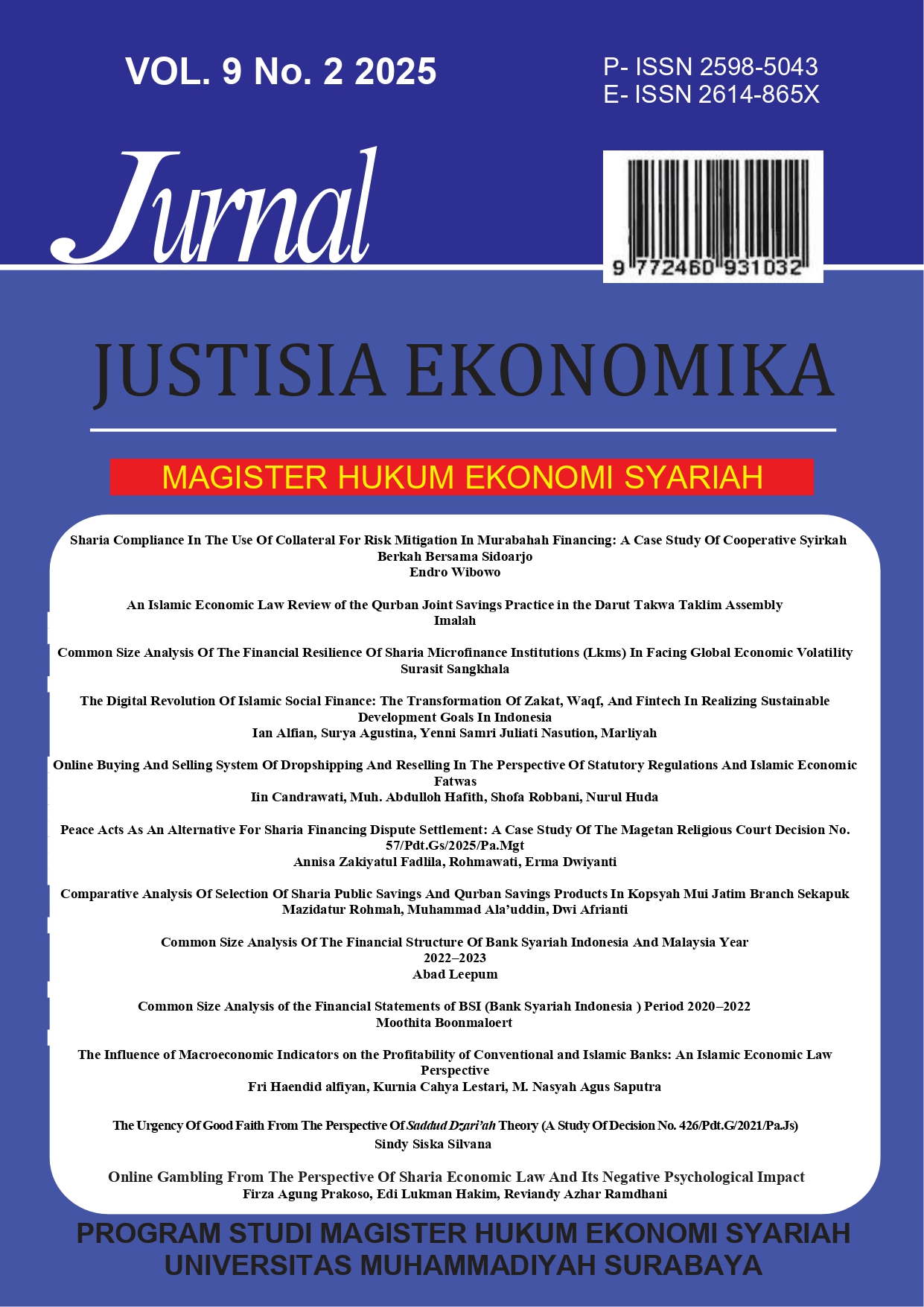
THE URGENCY OF GOOD FAITH FROM THE PERSPECTIVE OF SADDUD DZARI’AH THEORY (A STUDY OF DECISION NO. 426/Pdt.G/2021/PA.JS)
DOI:
https://doi.org/10.30651/justeko.v9i2.28811Keywords:
Sharia insurance dispute, principle of good faith, saddud dzari’ah, judicial determinationAbstract
This study examines the application of the principle of good faith in a Sharia insurance dispute, as presented in Case No. 426/Pdt.G/2021/PA.JS and evaluates its legal relevance from the perspective of Saddud Dzari’ah. Using a qualitative normative-empirical method through the examination of judicial decisions, policy terms, and Sharia insurance regulations, the research finds that the Plaintiff provided inaccurate information concerning medical history, other insurance ownership, and domicile. These inaccuracies constituted a breach of the principle of utmost good faith (uberrimae fidei), giving the Defendant legal grounds to rescind the policy and deny the claim in accordance with applicable laws and contract provisions. Normatively, such a violation at the pre-contractual stage should have led to the rejection of the lawsuit in its entirety. However, the judges applied the Saddud Dzari’ah principle to realize substantive justice by ordering the return of premiums to prevent harm and maintain fairness and proportionality of rights and obligations. The study highlights the need for stricter verification and auditing standards for participant data in Sharia insurance. It also shows that Saddud Dzari’ah provides a normative and argumentative basis for harmonizing legal certainty and fairness in dispute resolution. Additionally, the research reveals weaknesses in the fact-finding process, emphasizing the importance of a more proactive and rigorous judicial approach to ensure thoroughly examined material facts and a fair judgment.
References
[1] Abubakar, Rifa'i. (2021). Introduction to Research Methodology. Yogyakarta: SUKA-Press UIN Sunan Kalijaga.
[2] Andi Nurul Islamiah, “Aplikasi Sadd Adz-Dzari’ah dalam Perkembangan Ekonomi Islam,” Justisia Ekonomika: Magister Hukum Ekonomi Syariah 6, no. 1 (2022): 390–400, https://journal.um-surabaya.ac.id/index.php/JE/article/view/12091
[3] Ayub, Muhammad. Understanding Islamic Finance. New York: Wiley, 2007.
[4] Billah, Mohd Ma’Sum. Islamic Insurance (Takaful). Kuala Lumpur: Ilmiah Publishers, 2019.
[5] Clarke, Malcolm. The Law of Insurance Contracts. London: Informa Law, 2016.
[6] Dusuki, Asyraf Wajdi. “Maqasid al-Shariah and Ethical Risk Management.” ISRA Journal, 2017.
[7] El-Gamal, Mahmoud. Islamic Finance: Law, Economics, and Practice. Cambridge: Cambridge University Press, 2006.
[8] Fattah, Abdul. Good Faith in Contract Law. Jakarta: Prenadamedia, 2018.
[9] Hadi, Abd, Asrori, and Rusman. (2021). Qualitative Research: Phenomenology, Case Study, Grounded Theory, Ethnography, and Biography. Central Java: Pena Persada.
[10] Kawakib, Yusuf, and Hafdz Syuhud. (2021, January). Sadd Al-Dzari'ah as Islamic Legal Evidence (A Comparative Study of Ibn Al-Qayyim Al-Jauziyah and Ibn Hazm). Al-Bayan: Journal of Qur'anic and Hadith Sciences / Volume 4, No. 1. p-ISSN: 2615-2568 e-ISSN: 2621-3699.
[11] Kahf, Monzer. Islamic Economics. Jeddah: IRTI-IDB, 2010.
[12] Kamali, Mohammad Hashim. Principles of Islamic Jurisprudence. Cambridge: Islamic Texts Society, 2003.
[13] Mehr, Robert. Principles of Insurance. Homewood: Irwin, 1980.
[14] Muhaimin. (2020). Legal Research Methods. NTB: Mataram University Press.
[15] Nyazee, Imran Ahsan Khan. Outlines of Islamic Jurisprudence. Islamabad: Center for Excellence, 2000.
[16] Rahman, Afzalur. Economic Doctrines of Islam. London: Islamic Publications Ltd., 1990.
[17] Ridwan. (2004). Statistics for Government/Private Institutions and Agencies. Bandung: Alfabeta.
[18] Shanmuganathan, K. “Utmost Good Faith in Insurance Law.” Journal of Insurance Law, 2019.
[19] Sativa, Annisa. (2022, October). Insurance Dispute Resolution Through Non-Litigation and a Sharia Law Perspective. Journal of Islamic Sciences: Rayah Al Islam Vol. 6, No. 2.
[20] Suryabrata, Sumandi. (2010). Research Methodology. Jakarta: PT. Raja Grafindo Persada.
[21] Suadi, Amran. Hukum Ekonomi Syariah dalam Praktik Peradilan. Jakarta: Kencana, 2020.
[22] Tri and Lukman. (2017, December). Comparison of the Validity Requirements for "Lawful Cause" in Conventional and Sharia Agreements. Journal of Legal Thought and Islamic Law: Yudisia. Vol. 8, No. 2.
[23] Vogel, Frank, and Samuel Hayes. Islamic Law and Finance. The Netherlands: Kluwer Law International, 1998.
Downloads
Published
How to Cite
Issue
Section
License
HAK CIPTA
Penulis yang mengirimkan artikel dalam jurnal Justisia Ekonomika harus memahami dan menyetujui persyaratan tentang hak cipta jurnal Justisia Ekonomika sebagai berikut:
1. Hak Cipta tulisan / artikel yang diterbitkan di jurnal Justisia Ekonomika otomatis menjadi hak pengelola jurnal atau publisher
2. Meskipun Hak Cipta atas tulisan yang telah diterbitkan di jurnal Justisia Ekonomika adalah menjadi haknya publisher, tetapi penulis masih mempunyai hak untuk : a). Penulis boleh meng-upload di repository kampus, b). Penulis boleh meng-upload di webnya sendiri, c). Penulis boleh meng-upload di google schoolar, orchid dan sinta
LISENSI
Lisensi atas tulisan / artikel yang diterbitkan di jurnal Justisia Ekonomika adalah menggunakan Creative Commons dengan atribusi CC-BY-NC 4.0