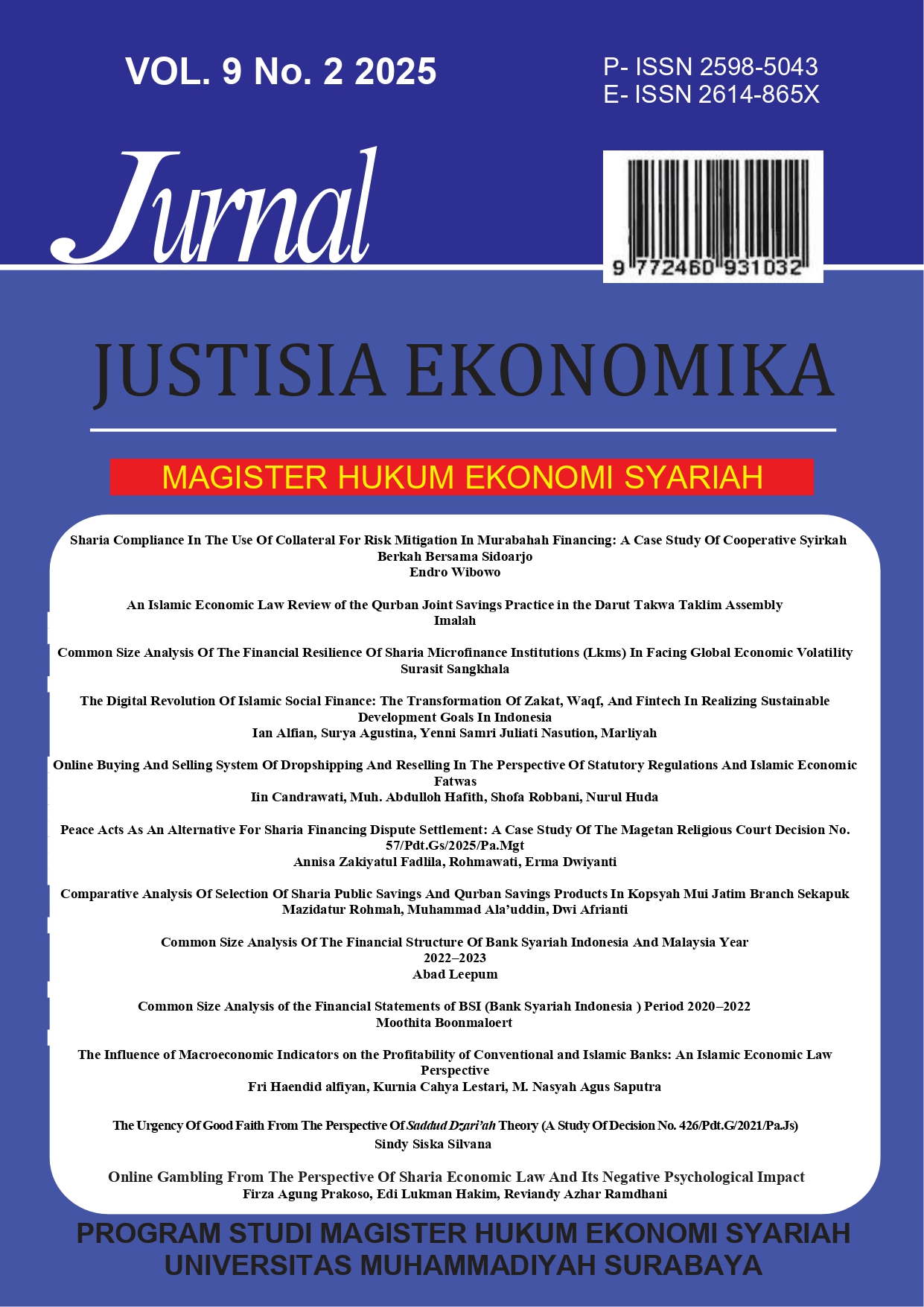
ONLINE GAMBLING FROM THE PERSPECTIVE OF SHARIA ECONOMIC LAW AND ITS NEGATIVE PSYCHOLOGICAL IMPACT
DOI:
https://doi.org/10.30651/justeko.v9i2.28407Keywords:
Online Gambling , Islamic Perspective, PsychologyAbstract
Online gambling is increasingly prevalent among the Indonesian population, with a wide range of online gambling products available and popular across nearly all levels of society. Legally, gambling in Indonesia is considered an illegal activity, and individuals who engage in it may face criminal sanctions in accordance with the applicable laws and regulations. In practice, online gambling is typically conducted in private locations, given that gambling is regarded as an unlawful act and may result in criminal penalties. This study employs a qualitative approach using a literature review method. The types of online gambling commonly played can be categorised into nine groups: online poker, domino QQ, online football betting, capsa susun, virtual sports, online e-games betting, number games, online ceme dealers, and blackjack. From an Islamic perspective, gambling is clearly prohibited (haram), and the profits derived from gambling are considered usury (riba). Participation in gambling is often influenced by environmental factors, such as interactions with dealers or peers who also gamble, thereby encouraging involvement. Additionally, the motivation to gamble can stem from internal factors, such as an individual’s personal desire to attain wealth rapidly.
References
[1] Achiruddin. Perilaku Perjudian di Era Digital: Sebuah Analisis Psikososial. Jakarta: Penerbit Nusantara, 2022.
[2] Ali, A. Yusuf, The Holy Qur’an: Text, Translation and Commentary (Brentwood, MD: Amana Publications, 2001), 263.
[3] Antonio, Muhammad Syafi’i, Bank Syariah: Dari Teori ke Praktik (Jakarta: Gema Insani Press, 2001), 72–75.
[4] Aini, Siti Nur, “Metode Penelitian Normatif dan Library Research dalam Studi Hukum Ekonomi Syariah,” Justisia Ekonomika: Jurnal Magister Hukum Ekonomi Syariah 5, no. 2 (2021): 95–112.
[5] Aini, Siti Nur, dan M. Ridwan, “Perlindungan Hukum Masyarakat terhadap Praktik Ekonomi Digital yang Bertentangan dengan Prinsip Syariah,” Justisia Ekonomika: Jurnal Magister Hukum Ekonomi Syariah 7, no. 1 (2023): 89–107.
[6] Al-Bukhari, Muhammad ibn Ismaʿil, Ṣaḥīḥ al-Bukhārī, Kitab al-Adab, Hadith no. 5750 (Beirut: Dar Ibn Kathir, 1987).
[7] Al-Qaradawi, Yusuf, Halal dan Haram dalam Islam, trans. Muhammad Thalib (Jakarta: Robbani Press, 1995), 312.
[8] Al-Qaradawi, Yusuf, The Lawful and the Prohibited in Islam (Indianapolis: American Trust Publications, 1999), 298–305.
[9] Al-Zuhayli, Wahbah, Al-Fiqh al-Islami wa Adillatuhu, vol. 5 (Damascus: Dar al-Fikr, 1984), 3421–3425.
[10] Creswell, John W., Qualitative Inquiry and Research Design: Choosing Among Five Approaches, 4th ed. (Los Angeles: SAGE Publications, 2018), 76.
[11] Creswell, John W., dan Cheryl Poth, Qualitative Inquiry and Research Design: Choosing Among Five Approaches, 4th ed. (Thousand Oaks, CA: SAGE Publications, 2018), 42–45.
[12] Dow Schüll, Natasha, Addiction by Design: Machine Gambling in Las Vegas (Princeton: Princeton University Press, 2012), 61–88.
[13] Fauzi, Ahmad, “Larangan Maysir dalam Perspektif Hukum Ekonomi Syariah dan Implementasinya di Indonesia,” Justisia Ekonomika: Jurnal Magister Hukum Ekonomi Syariah 6, no. 2 (2022): 145–162.
[14] Gainsbury, Sally, Internet Gambling: Current Research Findings and Implications (New York: Springer, 2012), 119–130.
[15] Griffiths, Mark D., “Internet Gambling: Issues, Concerns, and Recommendations,” CyberPsychology & Behavior 6, no. 6 (2003): 557–568.
[16] Hadzami, KH. M. Sjafi’i, Taudhih al-Adillah: Kajian Hukum Islam (Jakarta: Pustaka Azzam, 2005), 114.
[17] Hull, Clark L., Principles of Behavior (New York: Appleton-Century-Crofts, 1943), 22–34.
[18] Hull, Clark L., Principles of Behavior: An Introduction to Behavior Theory (New York: Appleton-Century, 1943).
[19] Kamali, Mohammad Hashim, Principles of Islamic Jurisprudence, 3rd ed. (Cambridge: Islamic Texts Society, 2003), 221–225.
[20] Karim, Abdul, “Dampak Sosial dan Ekonomi Transaksi Non-Halal dalam Perspektif Hukum Ekonomi Syariah,” Justisia Ekonomika: Jurnal Magister Hukum Ekonomi Syariah 5, no. 1 (2021): 33–58.
[21] Karim, Abdul, dan Ahmad Fauzi, “Analisis Yuridis-Normatif sebagai Metode Penelitian dalam Pengembangan Hukum Ekonomi Syariah,” Justisia Ekonomika: Jurnal Magister Hukum Ekonomi Syariah 7, no. 1 (2023): 55–73.
[22] King, Daniel L., et al., “Immersive Technologies and Youth Exposure to Online Gambling,” Journal of Behavioral Addictions 9, no. 4 (2020): 1012–1025.
[23] Krippendorff, Klaus, Content Analysis: An Introduction to Its Methodology, 3rd ed. (Los Angeles: SAGE, 2013), 24–28.
[24] Krippendorff, Klaus, Content Analysis: An Introduction to Its Methodology, 4th ed. (Thousand Oaks, CA: SAGE Publications, 2018), 62–70.
[25] Moleong, Lexy J., Metodologi Penelitian Kualitatif, rev. ed. (Bandung: PT Remaja Rosdakarya, 2017), 248–255.
[26] Muhammad, Manajemen Pembiayaan Bank Syariah (Jakarta: RajaGrafindo Persada, 2016).
[27] Pickthall, M. Marmaduke, The Meaning of the Glorious Koran (New York: Mentor Books, 1953), 32.
[28] Rahman, Muhammad Arif, “Budaya Instan dan Perilaku Ekonomi Masyarakat Urban,” Jurnal Psikologi Sosial 15, no. 2 (2021): 145–160.
[29] Republik Indonesia, Undang-Undang Nomor 11 Tahun 2008 tentang Informasi dan Transaksi Elektronik, pasal 27 ayat (2).
[30] Ridwan, M., “Pendekatan Penelitian Kualitatif dalam Kajian Hukum Ekonomi Syariah,” Justisia Ekonomika: Jurnal Magister Hukum Ekonomi Syariah 6, no. 1 (2022): 1–18.
[31] Spence, Kenneth, “The Nature of Drive,” Psychological Review 47, no. 6 (1940): 519–533.
[32] Williams, Robert J., Robert T. Wood, dan Jonathan Parke, Gambling and Problem Gambling in North America (Lethbridge: University of Lethbridge, 2012), 43.
[33] Kepolisian Negara Republik Indonesia (POLRI), Laporan Tahunan: Statistik Kejahatan Siber dan Judi Online 2024 (Jakarta: Divisi Humas POLRI, 2024).
Downloads
Published
How to Cite
Issue
Section
License
HAK CIPTA
Penulis yang mengirimkan artikel dalam jurnal Justisia Ekonomika harus memahami dan menyetujui persyaratan tentang hak cipta jurnal Justisia Ekonomika sebagai berikut:
1. Hak Cipta tulisan / artikel yang diterbitkan di jurnal Justisia Ekonomika otomatis menjadi hak pengelola jurnal atau publisher
2. Meskipun Hak Cipta atas tulisan yang telah diterbitkan di jurnal Justisia Ekonomika adalah menjadi haknya publisher, tetapi penulis masih mempunyai hak untuk : a). Penulis boleh meng-upload di repository kampus, b). Penulis boleh meng-upload di webnya sendiri, c). Penulis boleh meng-upload di google schoolar, orchid dan sinta
LISENSI
Lisensi atas tulisan / artikel yang diterbitkan di jurnal Justisia Ekonomika adalah menggunakan Creative Commons dengan atribusi CC-BY-NC 4.0