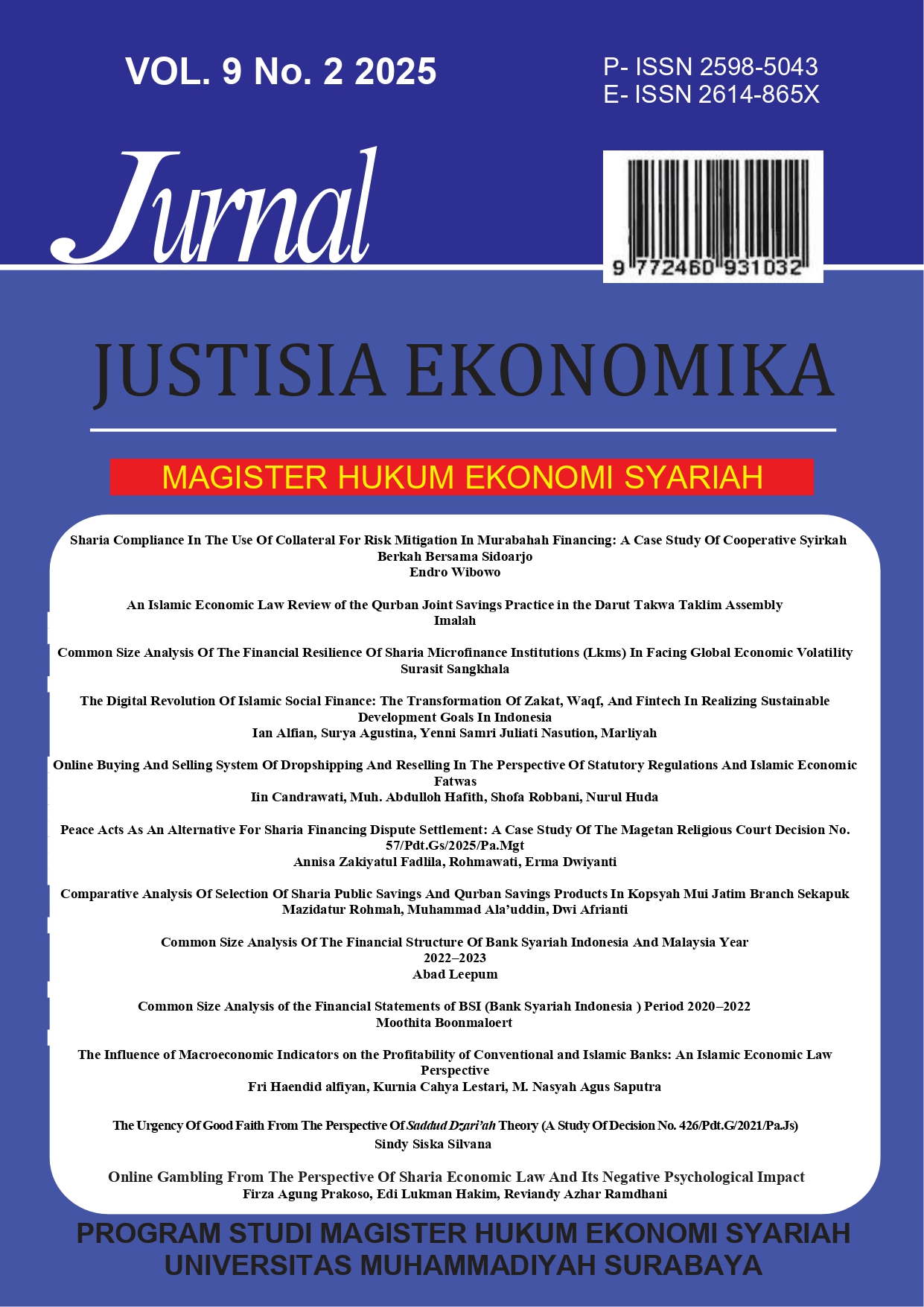
COMMON SIZE ANALYSIS OF THE FINANCIAL RESILIENCE OF SHARIA MICROFINANCE INSTITUTIONS (LKMS) IN FACING GLOBAL ECONOMIC VOLATILITY
DOI:
https://doi.org/10.30651/justeko.v9i2.27049Keywords:
Common size, LKMS, financial resilience , global economy, shariaAbstract
This study aims to analyze the level of financial resilience of Islamic Microfinance Institutions (LKMS) in facing increasingly uncertain global economic dynamics. Using a common size analysis approach, this study seeks to evaluate the ability of LKMS to maintain the efficiency and sustainability of its financial structures amidst external pressures such as inflation, exchange rate depreciation, and slowing economic growth. In the context of financial inclusion in Indonesia, LKMS plays a vital role as a provider of sharia-based alternative financial services and reaches the grassroots community. This study uses a qualitative method based on case studies with secondary data from officially published LKMS financial reports. The analysis results indicate that most LKMS exhibit adaptive patterns through strengthening liquid assets, diversifying revenue, operational cost efficiency, and increasing risk reserves. Thus, it can be concluded that LKMS has sufficient financial resilience to survive amidst global economic uncertainty. The implications of this study can serve as a reference for LKMS managers, regulators, and academics in strengthening sustainable Islamic microfinance governance.
References
REFERENCES
[1] Aisyah, A., Ashari, A., Handayani, I.S., & Soliha, N. (2024). Analysis of microfinance services in Islamic banking. Jurnal Media Akademik, 2(6).
[2] Andriani, W., Surya, F., & Zahara, Z. (2024). Assessing the Financial Performance of Islamic Banking on the Indonesian Stock Exchange: A Ratio and Common Size Analysis Approach. ISTIKHLAF: Journal of Islamic Economics, Banking and Management, 6(2), 17-33.
[3] Anna Marina, Sentot Imam Wahjono, Warsidi, Tri Kurniawati (2022), Islamic Accounting Information System to Enhance Islamic Hospital Performance in Indonesia, Journal of Business Theory and Practice, Vol 10 No 2, https://www.scholink.org/ojs/index.php/jbtp/article/view/4899
[4] Aulia, DN, & Arisandy, Y. (2025). ASSESSING THE FINANCIAL PERFORMANCE OF PT BANK SYARIAH INDONESIA TBK USING THE COMMON SIZE METHOD (2021-2023 PERIOD). Journal of Applied Accounting Research, 9(1), 124-133.
[5] Harahap, H., Ritonga, I., & Lubis, A. (2023). Characteristics and institutional forms of Islamic Microfinance Institutions in Indonesia. Studia Economica: Journal of Islamic Economics, 9(1).
[6] Hasibuan, K., Nurbaiti, N., & Daulay, A. N. (2023). Common Size Analysis in Measuring the Financial Performance of Islamic Commercial Banks in Indonesia. Intizar, 29(1), 72-78.
[7] Imsar, I., & Saragih, R.F. (2023). The performance of Islamic financial institutions towards MSMEs for economic growth. Journal of Islamic Economics and Finance Research, 1(4), 1–7.
[8] Nurjanah, N. (2023). Development of Islamic financial institutions and macroeconomic conditions in Indonesia. Scientific Journal of Islamic Economics, 9(1), 346–357.
[9] Financial Services Authority. (2022). Statistics on the Development of Islamic Microfinance Institutions in Indonesia. Jakarta: OJK. Available at:https://www.ojk.go.id
[10] Kartini (2024), BREAK-EVEN POINT ANALYSIS AS A DECISION-MAKING INSTRUMENT IN SHARIA BUSINESS, Journal Justisia Ekonomika: Magister Hukum Ekonomi Syariah, Vol 9, No 1, E-ISSN: 2614-865X, https://journal.um-surabaya.ac.id/JE/article/view/25948
[11] Nurul Mauludiyah, Warsidi (2023), The Joints of Economic Strength According to Ibn Khaldun, Paradigma: Journal of Science, Religion and Culture Studies, Vol 20, No 1, https://jurnal.unismabekasi.ac.id/index.php/paradigma/article/view/5931
[12] Rifai, A., Faizah, I., Mariyanti, L., & Lestari, S.I. (2022). Common Size Analysis of Indonesian Sharia Banks Post-Merger. Al-Mashrof: Islamic Banking and Finance, 3(2), 165-184.
[13] Rizki Azizah Malik (2025), CASH FLOW ANALYSIS OF SHARIA FINANCIAL STATEMENTS IN SHARIA FINANCIAL INSTITUTIONS, Jurnal Justisia Ekonomika, Vo 9 no 1, E-ISSN: 2614-865X,https://journal.um-surabaya.ac.id/JE/article/view/25990
[14] Sari, RK (2021). Analysis of financial performance measurement in the banking sector using the common size method (case study: PT. Bank Rakyat Indonesia Syariah Tbk, 2016–2017 period). Monex: Journal of Accounting Research, 10(1), 16-25.
[15] Simanjuntak, RA (2016). Comparative analysis of financial statements using the common size method in assessing the performance of Islamic banks in Indonesia (Doctoral dissertation, IAIN Padangsidimpuan).
[16] Sodiq, A. (2025). The Role of BMT Nusantara Umat Mandiri in Encouraging the Inclusion of Non-Bank Sharia Financial Institutions in Tulungagung. At-Tamwil Journal: Sharia Economic Studies, 7(1), 90-104.
[17] Sugiyono. (2021). Qualitative, Quantitative, and R&D Research Methods. Bandung: Alfabeta.
[18] Tanjung, H. (2020). Islamic Economics and Finance: Contemporary Issues. Elex Media Komputindo.
[19] Tulasmi, T., & Komariyah, S. (2023). Bibliometric analysis of the direction and development of research on Islamic microfinance institutions in Indonesia, 2013–2022. Al-Kharaj: Journal of Islamic Economics, Finance & Business, 5(6), 3768–3780.
[20] Warsidi, Abdurrahman Raden Aji Haqqi, Isma Swadjaja, Implementation of Sharia System in Sharia-Certified Hospitals, JIEI: Jurnal Ilmiah Ekonomi Islam, (2024), E-ISSN: 2579-6534, Vol 10, No 3 https://jurnal.stie-aas.ac.id/index.php/jei/article/view/14713.
Downloads
Published
How to Cite
Issue
Section
License
HAK CIPTA
Penulis yang mengirimkan artikel dalam jurnal Justisia Ekonomika harus memahami dan menyetujui persyaratan tentang hak cipta jurnal Justisia Ekonomika sebagai berikut:
1. Hak Cipta tulisan / artikel yang diterbitkan di jurnal Justisia Ekonomika otomatis menjadi hak pengelola jurnal atau publisher
2. Meskipun Hak Cipta atas tulisan yang telah diterbitkan di jurnal Justisia Ekonomika adalah menjadi haknya publisher, tetapi penulis masih mempunyai hak untuk : a). Penulis boleh meng-upload di repository kampus, b). Penulis boleh meng-upload di webnya sendiri, c). Penulis boleh meng-upload di google schoolar, orchid dan sinta
LISENSI
Lisensi atas tulisan / artikel yang diterbitkan di jurnal Justisia Ekonomika adalah menggunakan Creative Commons dengan atribusi CC-BY-NC 4.0