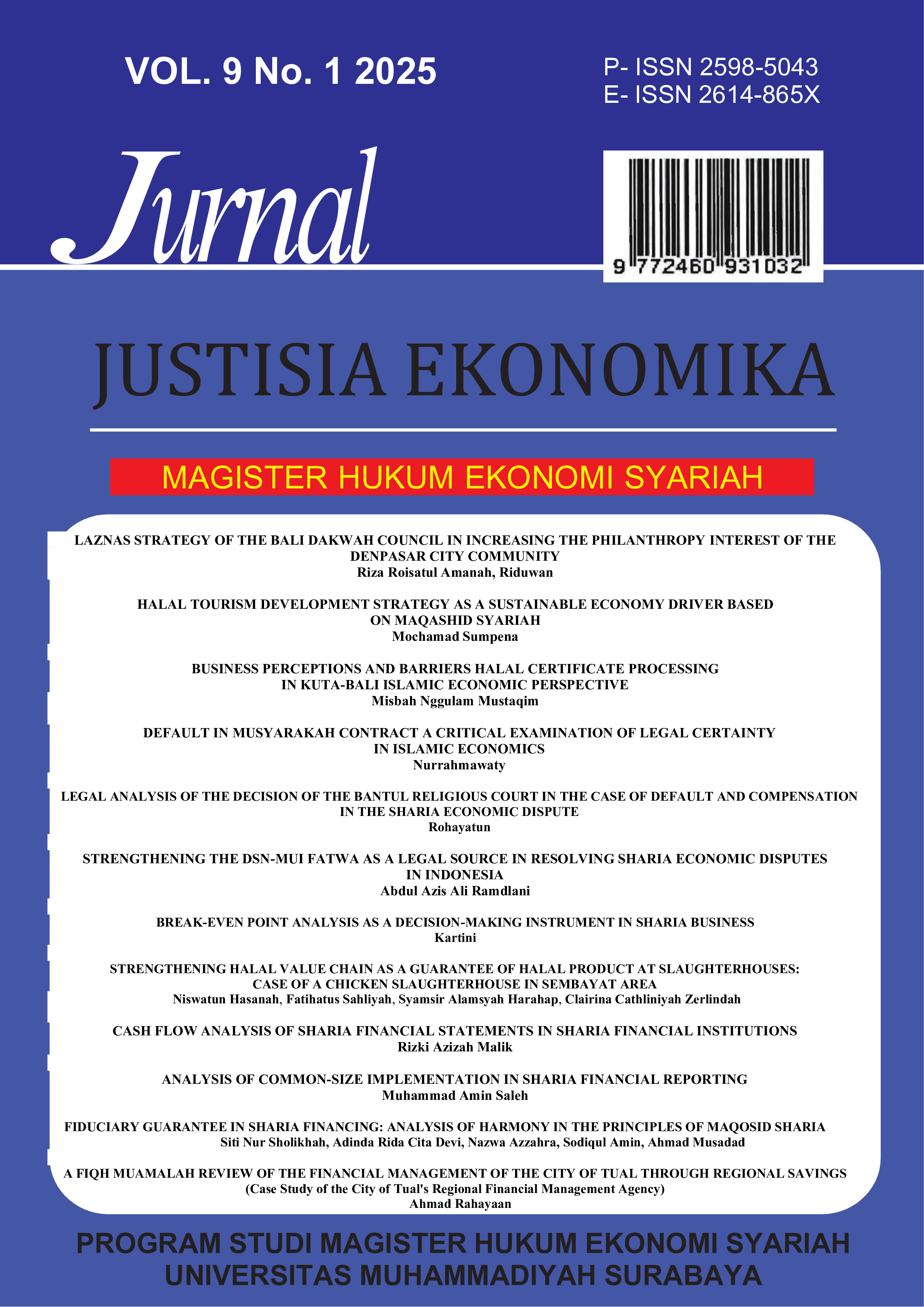
STRENGTHENING THE DSN-MUI FATWA AS A LEGAL SOURCE IN RESOLVING SHARIA ECONOMIC DISPUTES IN INDONESIA
DOI:
https://doi.org/10.30651/justeko.v9i1.25858Keywords:
DSN-MUI Fatwa, Strengthening of DSN-MUI Fatwas , DSN-MUI Fatwa as a Source of Law , Sharia Economic Disputes.Abstract
This study, titled "Strengthening the DSN-MUI Fatwa as a Legal Source within the Indonesian Legislative System in Resolving Sharia Economic Disputes", is driven by concerns over the lack of binding legal authority of DSN-MUI (National Sharia Council of the Indonesian Ulema Council) fatwas. Despite their valuable content and relevance to Islamic economic practices, these fatwas are not yet formally recognized as binding legal sources. To address this issue, the research raises two main questions: (1) What is the current legal status of DSN-MUI fatwas within Indonesia's regulatory system in resolving sharia economic disputes? and (2) How can these fatwas be strengthened to gain formal legal recognition?. Using a qualitative-normative method through literature review, the study examines both fatwas that have been adopted into legislation and those that have not. The findings reveal that DSN-MUI fatwas, in practice, lack binding legal force in Sharia economic dispute resolution. The study also explores ways to enhance their legal standing. The analysis concludes that: (1) DSN-MUI fatwas do not yet have binding legal power, and their application still faces challenges in legal practice; and (2) Their legal authority can be strengthened by collaborating with state institutions, such as the Supreme Court, to issue judicial regulations (PERMA) that formally incorporate DSN-MUI fatwas. This approach would provide them with stronger legal legitimacy in Indonesia’s regulatory framework
References
[1] Ahmad Arief rahman Saidi, Warsidi, Indonesia One Seacrh, Implementasi Fatwa-fatwa DSN-MUI Pada Pembiayaan Dana Talangan Haji (Studi Kasus Pada KSPPS BTM Mulia Babat– Lamongan), link: Link: https://onesearch.id/Record/IOS5223.article-5234?widget=1
[2] Amalia, Nanda. Hukum Perikatan, Nanggroe Aceh Darussalam: Unimalpress, 2013.
[3] Ambo, Rahman. Fiqih Ekonomi Dan Keuangan Syariah Antara Realits Dan Kontekstual, Cet. I, Yogyakarta: TrustMedia Publishing, 2016.
[4] Ansori, Isa. Kedudukan Fatwa di Beberapa Negara Muslim (Malaysia, Brunei Darussalam dan Mesir), Jurnal Analis, Volume 17, Nomor 1, Juni 2017.
[5] Firatmaja, Fian. “Hukum Islam Adalah The Living Law” Republika.co.id, 2016, https://www.republika.co.id/ amp_version/oiope6301.
[6] Hasanah, Nur. Metode Penelitian Kepustakaan, Malang: Litnus, 2023
[7] Hasanah. Sovia. “Kedudukan Fatwa MUI Dalam Hukum Indonesia” 2016, https://www.hukumonline.com/ klinik/a/kedudukan-fatwa-mui-dalam-hukum-indonesia-lt5837dfc66ac2d.
[8] Ismail, Idris. “Penyerapan Fatwa Dewan Syariah Nasional (DSN-MUI) Dalam Sistem Peraturan Perundangan (Kajian Fiqh Siyasah)”, Tesis UIN Sultan Syarif Kasim Riau, 2017. diakses pada tanggal 30 November 2024, https://inlislite.uin-suska.ac.id/opac/detail-opac?id=11235
[9] Kriyantono, Rachmat. Teknik Praktis Riset Komunikasi, Jakarta: Prenada, 2006.
[10] Latifah, Luluk. At al, “The Existence of Islamic Economic Thought in the Time of the Prophet Adam”. Jurnal Ilmiah Ekonomi Islam, 9 (02), 2023. https://jurnal.stie-aas.ac.id/index.php/jie.
[11] Perdana Raya Waruwu, Riki. “Penerapan Asas Fiksi Hukum dalam PERMA”, Mahkamah Agung RI, https://jdih.mahkamahagung.go.id/berita-detail/penerapan-asas-fiksi-hukum-dalam-perma diakses 30 November 2024
[12] Pujianti, Sri. “BI: Fatwa DSN MUI Penentu Produk Perbankan Syariah” Mahkamah Konstitusi RI, https://www.mkri.id/index.php?page=web.Berita&id=18123# diakses tanggal 30 November 2024.
[13] Rosyadi, Imron. Jaminan Kebendaan Berdasarkan Akad Syariah (Aspek Perikatan, Prosedur Pembebanan, dan Eksekusi). Depok: Kencana. 2017.
[14] Undang-Undang Nomor 21 Tahun 2008 tentang Pebankan Syariah.
Downloads
Published
How to Cite
Issue
Section
License
HAK CIPTA
Penulis yang mengirimkan artikel dalam jurnal Justisia Ekonomika harus memahami dan menyetujui persyaratan tentang hak cipta jurnal Justisia Ekonomika sebagai berikut:
1. Hak Cipta tulisan / artikel yang diterbitkan di jurnal Justisia Ekonomika otomatis menjadi hak pengelola jurnal atau publisher
2. Meskipun Hak Cipta atas tulisan yang telah diterbitkan di jurnal Justisia Ekonomika adalah menjadi haknya publisher, tetapi penulis masih mempunyai hak untuk : a). Penulis boleh meng-upload di repository kampus, b). Penulis boleh meng-upload di webnya sendiri, c). Penulis boleh meng-upload di google schoolar, orchid dan sinta
LISENSI
Lisensi atas tulisan / artikel yang diterbitkan di jurnal Justisia Ekonomika adalah menggunakan Creative Commons dengan atribusi CC-BY-NC 4.0