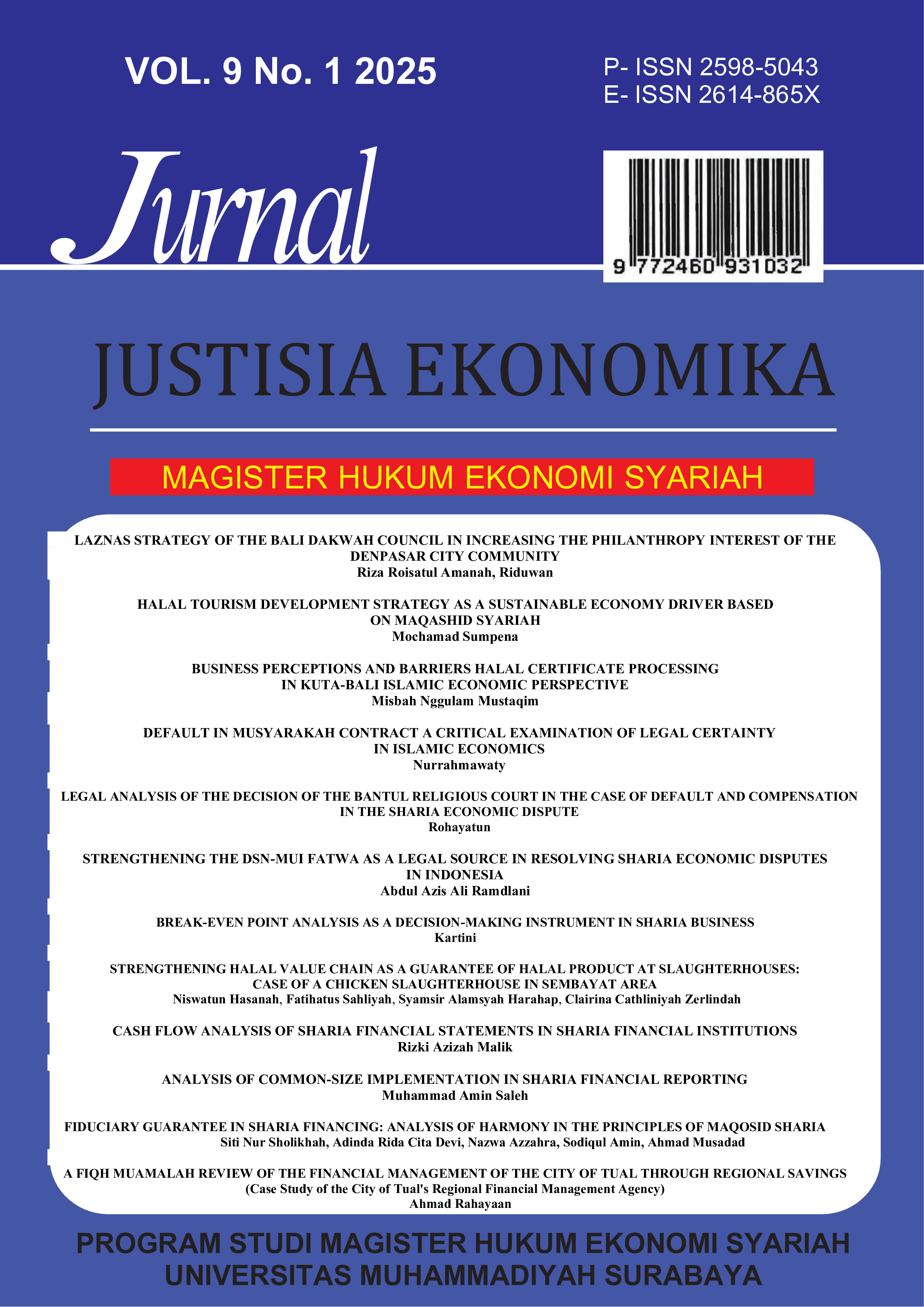
STRENGTHENING HALAL VALUE CHAIN AS A GUARANTEE OF HALAL PRODUCT AT SLAUGHTERHOUSES: CASE OF A CHICKEN SLAUGHTERHOUSE IN SEMBAYAT AREA
DOI:
https://doi.org/10.30651/justeko.v9i1.24498Keywords:
Halal Value Chain, Chicken Slaughter House, Consumer ProtectionAbstract
This research aims to analyze the halal value chain of slaughter and processing in broiler chicken businesses at AFJ JAYA Sembayat from an Islamic economic perspective, as well as consumers' views of the halal value chain in these businesses. The research method used in this research is field research using a descriptive qualitative approach. Primary data was obtained through in-depth interviews with slaughterhouse managers and consumers. The results of the research show that the halal value chain practices for the chicken slaughter process at AFJ JAYA Sembayat comply with the provisions with MUI Fatwa Number 12 of 2009’s requirements concerning Halal Slaughter Certification Standards. However, chicken processing practices are not by the provisions of MUI Fatwa Number 12 of 2009 because they do not separate dirty and clean spaces. Due to business owners' ignorance of the significance of halal certification for the chicken slaughterhouse sector, AFJ JAYA Sembayat does not currently hold halal certification. However, consumers still choose to continue purchasing because they feel confident that the chicken meat is halal and high-quality. All of this is purely caused by a lack of halal literacy, so ongoing counseling and assistance are necessary.
References
[1] Amin, Ma’ruf. Himpunan Fatwa Majelis Ulama Indonesia Sejak 1975. Jakarta: Erlangga, 2011.
[2] Amir, Abdul Siaidir, and Waspodo Tjipto Subroto. “The Creation of Halal Value Chains: A Theoretical Approach.” IOSR Journal of Economics and Finance 10, no. 1 (2019): 14–22. https://doi.org/10.9790/5933-1001011422.
[3] Amrun Hamidi Nst, and Dini Wahyuni. “Analisis Risiko Halal Supply Chain Dengan Adopsi Model SCOR (Supply Chain Operations Reference).” Talenta Conference Series: Energy and Engineering (EE) 2, no. 4 (2019). https://doi.org/10.32734/ee.v2i4.676.
[4] Apriani, Fitri. “Penerapan Sistem Jaminan Halal Pada Rumah Potong Hewan (Rph) Ruminansia Kota Singkawang.” Cross-Border 5, no. 2 (2022): 1717–23.
[5] Azmi, Fadhlur Rahim, Abu Abdullah, Mohammed Hariri Bakri, Haslinda Musa, and Mailasan Jayakrishnan. “The Adoption of Halal Food Supply Chain towards the Performance of Food Manufacturing in Malaysia.” Management Science Letters 8, no. 7 (2018): 755–66. https://doi.org/10.5267/j.msl.2018.5.010.
[6] Dennis, A. System Analysis and Design. USA: John Wiley & Sons, Inc., 2012.
[7] Hamid, Atiqah. Buku Pintar Halal Haram Sehari-Hari. Yogyakarta: Diva Press, 2012.
[8] I Vanany, D.I Maftuhah. “Modelling Halal Internal Traceability in Open Source ERP System for Chicken Meat Processing Company.” Proc. of the 2019 IEEE IEEM 1 (2019): 1017–21.
[9] Lever, John, and Mara Miele. “The Growth of Halal Meat Markets in Europe: An Exploration of the Supply Side Theory of Religion.” Journal of Rural Studies 28, no. 4 (2012): 528–37. https://doi.org/10.1016/j.jrurstud.2012.06.004.
[10] Muhammad Yusuf Qardhawi. Halal Dan Haram Dalam Islam. Surabaya: Bina Ilmu, 2010.
[11] Noor, Ruslan Abdul Ghofur. Konsep Distribusi Dalam Ekonomi Islam Dan Format Keadilan Ekonomi Di Indonesia. Yogyakarta: Pustaka Pelajar, 2013.
[12] OPOP Jabar. “Halal Value Chain Jadikan Indonesia Sebagai Pusat Ekonomi Dan Keuangan,” n.d. https://opop.jabarprov.go.id/halal-value-chain-jadikan-indonesia-sebagai-pusat-%0Aekonomi-dan-keuangan-syariah/,%0A.
[13] Pratiwi, Heni, Qorry Ambiya, Muhammad Nanda Saputra, and Universitas Jambi. “Halal Slaughterhouse To Achieve Halal Value Chain Of The Restaurant And Meat-Processed Food Industry.” … International Seminar of … 4 (2023): 1201–6. https://jurnal.umsu.ac.id/index.php/insis/article/view/13934.
[14] Rahmaniati, Popi, and Dini Nur Hakiki. “Perancangan Sistem Jaminan Halal (SJH) Di Rumah Potong Ayam TPA Akbar Bandar Lampung.” IJMA: International Journal Mathla’ul Anwar of Halal Issues 1, no. 2 (2021): 89–98.
[15] Rasi, Raja Zuraidah, Nor Ratna Masrom, Siti Sarah Omar, Md Fauzi Ahmad, and Rohana Sham. “Withdrawn Article: Designing Halal Supply Chain: Malaysia’s Halal Industry Scenarios.” MATEC Web of Conferences 135 (2017): 00040. https://doi.org/10.1051/matecconf/201713500040.
[16] Setiawan, Amelia, and Ria Satyarini. “LAPORAN Identifikasi Dan Analisis Value Chain Pada Usaha Kecil Yang Dikelola Mahasiswa Disusun Oleh : Amelia Setiawan , SE ., MAk ., AK ., CISA Ria Satyarini , SE ., MSi Lembaga Penelitian Dan Pengabdian Kepada Masyarakat Universitas Katolik Parahyangan,” 2015, 1–22.
[17] Siregar, Muhammad Lutfi, and Afuan Zahradika. “Halal Traceability System (Hts) Untuk Integrasi Halal Meat Supply Chain (Hmsc) Terhadap Proses Industri Daging Ayam Pada Rumah Potong Hewan.” Agroindustrial Technology Journal 7, no. 1 (2023): 74–87. https://doi.org/10.21111/atj.v7i1.9418.
[18] Subianto, Pratiwi. “Rantai Nilai Dan Perspektif Kesadaran Masyarakat Muslim Akan Makanan Halal.” Conference on Islamic Management Accounting and Economics 1 (2018): 141–46.
[19] Sugiono. Metode Penelitian Kuantitatif, Kualitatif Dan R&D. Bandung: Alfabeta, 2016.
[20] Sutarmin, and Dadang Prasetyo Jatmiko. “Value Chain Analysis to Improve Corporate Performance: A Case Study of Essential Oil Export Company in Indonesia.” Investment Management and Financial Innovations 13, no. 3 (2016): 183–90. https://doi.org/10.21511/imfi.13(3-1).2016.04.
[21] Tieman, Marco, Jack G.A..C Van Der Vorst, and Maznah Che Ghazali. “Principles in Halal Supply Chain Management.” Journal of Islamic Marketing 3, no. 3 (2012): 217–43.
[22] Wahyuni, Dini, Nazaruddin, M. Fauzan Rizki, and Irwan Budiman. “Slaughtering System Design in Halal Beef Supply Chain Using Value Chain Analysis.” IOP Conference Series: Materials Science and Engineering 1003, no. 1 (2020). https://doi.org/10.1088/1757-899X/1003/1/012035.
[23] Wisdaningrum, Oktavima. “Analisis Rantai Nilai ( Value Chain ) Dalam Lingkungan Internal Perusahaan.” Jurnal Analisa 1, no. 1 (2013): 40–48.
Downloads
Published
How to Cite
Issue
Section
License
HAK CIPTA
Penulis yang mengirimkan artikel dalam jurnal Justisia Ekonomika harus memahami dan menyetujui persyaratan tentang hak cipta jurnal Justisia Ekonomika sebagai berikut:
1. Hak Cipta tulisan / artikel yang diterbitkan di jurnal Justisia Ekonomika otomatis menjadi hak pengelola jurnal atau publisher
2. Meskipun Hak Cipta atas tulisan yang telah diterbitkan di jurnal Justisia Ekonomika adalah menjadi haknya publisher, tetapi penulis masih mempunyai hak untuk : a). Penulis boleh meng-upload di repository kampus, b). Penulis boleh meng-upload di webnya sendiri, c). Penulis boleh meng-upload di google schoolar, orchid dan sinta
LISENSI
Lisensi atas tulisan / artikel yang diterbitkan di jurnal Justisia Ekonomika adalah menggunakan Creative Commons dengan atribusi CC-BY-NC 4.0