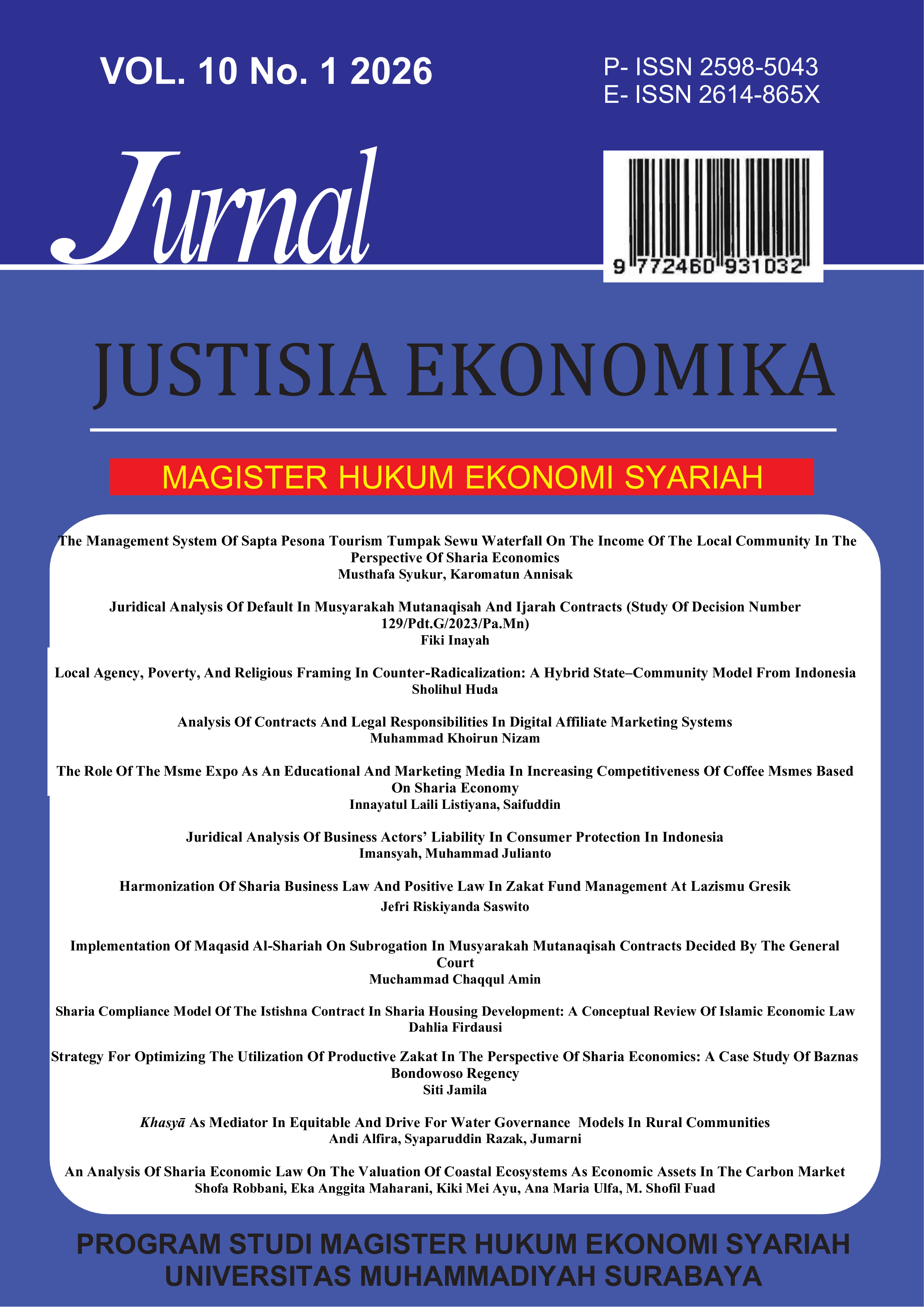
AN ANALYSIS OF SHARIA ECONOMIC LAW ON THE VALUATION OF COASTAL ECOSYSTEMS AS ECONOMIC ASSETS IN THE CARBON MARKET
DOI:
https://doi.org/10.30651/justeko.v10i1.31764Kata Kunci:
coastal ecosystem valuation, carbon market, blue carbon, maqasid al-shari’ahAbstrak
Carbon trading has become a market-based mechanism to reduce greenhouse gas emissions while promoting environmental sustainability. From an Islamic perspective, this mechanism can be aligned with sharia principles such as justice, barakah, and environmental stewardship. This study aims to analyze the valuation of coastal ecosystems as economic assets within the carbon market from the perspective of Sharia Economic Law. The research employs a descriptive qualitative method to examine the potential and challenges of integrating Sharia principles into carbon trading practices in Indonesia. The results demonstrate that coastal ecosystems, including mangroves, seagrass beds, and coastal wetlands, possess a significant carbon absorption capacity and substantial economic value. Their utilization in carbon markets is permissible in Islam, provided that transactions are conducted transparently and are free from riba, gharar, and maysir. Additionally, fairness in the distribution of benefits to coastal communities must be ensured. Carbon market governance should prioritize public welfare, environmental protection, and social justice. Therefore, sharia-based regulatory frameworks are necessary to ensure that carbon trading not only generates economic benefits but also supports sustainability and community well-being.
Referensi
[1] Alongi, Daniel M. “Carbon Sequestration in Mangrove Forests.” Carbon Management 3, no. 3 (2012): 313–22. https://doi.org/10.4155/cmt.12.20.
[2] Ari Wibowo, Pungki, and Fia Birtha Al Sabet. “2.+Pungki+(74-85).” OECONOMICUS Journal of Economics 6, no. 2 (2022).
[3] Aryanto, Rudy, and M. Yuwana Mardjuka. “Valuasi Ekonomi Dengan Travel Cost Method Pada Objek Ekowisata Pesisir (Kasus Kawasan Ujung Genteng, Sukabumi).” Jurnal Ilmiah Pariwisata 10, no. 1 (2005): 58–76.
[4] Daindo Milla, Deni Apriana S.,. “Potensi Pemanfaatan Ekosistem Pesisir Pantai Labuhan Haji Lombok Timur Sebagai Daerah Ekowisata.” Jurnal Biologi Tropis 17, no. 1 (2017). https://doi.org/10.29303/jbt.v17i1.388.
[5] Diva, Fara. “Peran Blue Carbon Sebagai Solusi Berkelanjutan Untuk Penyerapan Karbon Di Wilayah Pesisir.” Maliki Interdisciplinary Journal (MIJ) EISSN 2, no. 8 (2024): 377–82. http://urj.uin-malang.ac.id/index.php/mij/index.
[6] Eko-syariah, Perspektif, and Moh Mufid. “Fikih Mangrove : Formulasi Fikih Lingkungan Pesisir” 7, no. April 2017 (n.d.).
[7] Fatmawati, Susan, Wahyu Andriyadi, and Ahmad Sigit Febriyanto. “Dampak Mekanisme Perdagangan Karbon Di Pasar Modal Indonesia: Membuat Portofolio Optimal Model Markowitz.” EKOMA : Jurnal Ekonomi, Manajemen, Akuntansi 5, no. 1 (2025): 770–84. https://doi.org/10.56799/ekoma.v5i1.12351.
[8] Fenetiruma, Daniel, and I Made Dedy Priyanto. “Pengaturan Hukum Dan Implementasi Perdagangan Karbon Di Indonesia.” Journal Media Akademik (JMA) 3, no. 3 (2025): 1–17. https://jurnal.mediaakademik.com/index.php/jma/article/view/1653.
[9] Hamid, Ahmad Munir. “Sharia Perspective: The Urgency of Islamic Economic, Banking and Finance (IEBF) Reform in Realizing the Sustainable Development Goals (SDGs) through Knowledge Integration (IoK) Approach.” ADILLA : Jurnal Ilmiah Ekonomi Syari’ah 7, no. 1 (2024): 111–40. https://doi.org/10.52166/adilla.v7i1.6026.
[10] Hendro, Galih, Azhari Azhari, and West Bangka. “An Extended Approach of Weight Collective Influence An Extended Approach Weight Collective Influence Graph for Detection Influence Actor c n e u l f n i e v i t c e l l o c t h g i e w f o h c a o r p p a d e d n e t Graph for Detection Influence Actor a e c n e u Mustofa for Detection” 8, no. 1 (2022): 1–11.
[11] Hirmawan. A.A., S. W. Saputra, dan C. Ain. “Hirmawan.” Jurnal Pasir Laut 4(2), no. 2 (2020): 124–33.
[12] Ilmiah, Jurnal, Akuntansi Manajemen, and Ekonomi Islam. “J A M – E K I S,” n.d.
[13] Ilvi Nur Diana. “Strategi Pengembangan Bandeng Tanduri UMKM Cahaya di Kabupaten Maros.” Jurnal Pemikiran dan Penelitian Ekonomi Islam 2 Juli, no. 10 (2022): 1–15.
[14] Kusumaningrum, Alfia Ayu. “Proceeding Legal Symposium” 2, no. 1 (2024): 90–102.
[15] Macreadie, Peter I., Andrea Anton, John A. Raven, Nicola Beaumont, Rod M. Connolly, Daniel A. Friess, Jeffrey J. Kelleway, et al. “The Future of Blue Carbon Science.” Nature Communications 10, no. 1 (2019): 1–13. https://doi.org/10.1038/s41467-019-11693-w.
[16] Nono, Elfridus A. L. “Kajian Peranan Ekonomi Lingkungan Dalam Pembangunan Nasional.” Jurnal Ilmu Pertanian Tropis 1, no. 1 (2024): 24–28.
[17] Risa Lestari, Alfia, Muhammad Yunus, mahasiswa Ilmu Kelautan Fakultas Perikanan dan Ilmu Kelautan, dan dosen Ilmu Kelautan Fakultas Perikanan dan Ilmu Kelautan. “VALUASI EKONOMI EKOSISTEM MANGROVE DI BANUA PANGKA DESA BAWALIPU KECAMATAN WOTU KABUPATEN LUWU TIMUR PROVINSI SULAWESI SELATAN Economic Valuation Of The Mangrove Ecosystem In Banua Pangka Bawalipu Village Wotu District East Luwu District South Sulawesi Pr” 1, no. 2 (2024): 168–79.
[18] Septyanun, Nurjannah, Julmansyah Julmansyah, Rina Rohayu Harun, Indra Jaya, and Zaenafi Ariani. “Regulasi Dan Tata Laksana Penerapan Nilai Ekonomi Karbon Berbasis Voluntary Dan Mandatory Di Nusa Tenggara Barat.” GEOGRAPHY : Jurnal Kajian, Penelitian dan Pengembangan Pendidikan 11, no. 2 (2023): 399. https://doi.org/10.31764/geography.v11i2.17210.
[19] Stelah Kharina Hairunnisa, Ardiyanto Maksimilianus Gai, dan Ida Soewarni. “Valuasi Ekonomi Hutan Mangrove Provinsi Sulawesi Utara.” Journal Planoearth 3, no. 1 (2018): 17–22.
[20] Syahid, Umar. “Blue Sukuk : Inovasi Pembiayaan Syariah Untuk Konservasi Kelautan Berkelanjutan Tinjauan Maqashid Syariah” 7, no. 1 (2025): 48–55.
[21] Warsidi, Sami Ullah Khan, and Suhartono. “Implementasi Maqāṣid Al-Syarī‘ah dalam Pertimbangan Hakim pada Sengketa Ekonomi Syariah.” Maqasid: Jurnal Studi Hukum Islam 14, no. 3 (2025). E-ISSN: 2615-2622. https://journal.um-surabaya.ac.id/Maqasid/article/view/28691.
[22] Zaini, Muh., Vrita Putri Azzahroh, and Eny Widiaty. “Analisis Kesejahteraan Ekonomi Masyarakat Pesisir Dalam Perspektif Maqashid Syariah : Studi Kasus Pantai Gading , Mataram.” Peradaban Journal of Economic and Business 4, no. 1 (2025): 55–70.
Unduhan
Diterbitkan
Cara Mengutip
Terbitan
Bagian
Lisensi
HAK CIPTA
Penulis yang mengirimkan artikel dalam jurnal Justisia Ekonomika harus memahami dan menyetujui persyaratan tentang hak cipta jurnal Justisia Ekonomika sebagai berikut:
1. Hak Cipta tulisan / artikel yang diterbitkan di jurnal Justisia Ekonomika otomatis menjadi hak pengelola jurnal atau publisher
2. Meskipun Hak Cipta atas tulisan yang telah diterbitkan di jurnal Justisia Ekonomika adalah menjadi haknya publisher, tetapi penulis masih mempunyai hak untuk : a). Penulis boleh meng-upload di repository kampus, b). Penulis boleh meng-upload di webnya sendiri, c). Penulis boleh meng-upload di google schoolar, orchid dan sinta
LISENSI
Lisensi atas tulisan / artikel yang diterbitkan di jurnal Justisia Ekonomika adalah menggunakan Creative Commons dengan atribusi CC-BY-NC 4.0