
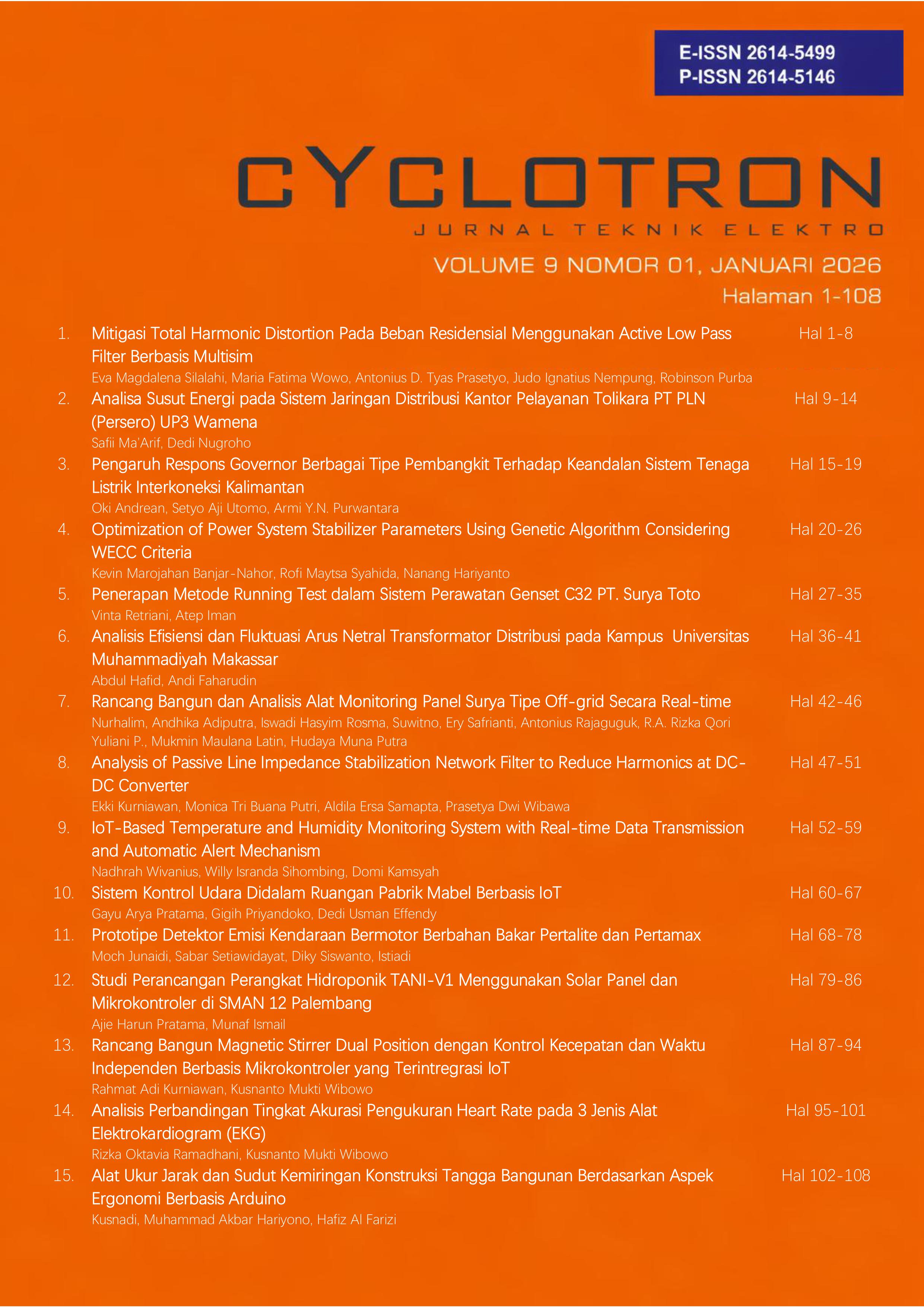
IoT-Based Temperature and Humidity Monitoring System with Real-Time Data Transmission and Automatic Alert Mechanism
Artikel Sidebar
-
Internet of Things, , environmental monitoring, ESP32, DHT11 sensor, real-time acquisition
Abstrak
This study presents the design and implementation of an Internet of Things (IoT)-based system for real-time monitoring of room temperature and humidity. The system integrates a DHT11 sensor with an ESP32-C3-WROOM-2 microcontroller to measure environmental parameters within ranges of 0–50°C and 20–90% relative humidity, achieving accuracies of ±2°C and ±5% RH, respectively. Measurement data are displayed on a 20×4 I2C LCD and transmitted wirelessly via Wi-Fi to Google Sheets for cloud-based storage and analysis. The system features an automatic notification mechanism that sends alerts through WhatsApp when environmental conditions exceed predefined thresholds. Calibration testing against the HTC-2 reference standard device demonstrated a total average measurement error of 1.594%, confirming compliance with the DHT11 sensors specified tolerance limits. Consistency tests conducted in both air-conditioned and non-air-conditioned environments revealed that the system effectively captures genuine environmental variations, with higher variability observed in mechanically controlled spaces due to HVAC operational cycles. The developed prototype successfully addresses limitations of conventional monitoring methods by eliminating manual intervention requirements, enabling continuous real-time surveillance, and facilitating rapid preventive actions. Results indicate that the system provides sufficient measurement accuracy and stability for practical applications in residential, commercial, and industrial environmental monitoring, while offering a cost-effective and accessible solution for IoT-based climate control systems.
Artikel teks lengkap
Referensi
[1] M. Sequeira, “Towards autonomous environmental monitoring systems,” Talanta, vol. 56, no. 2, pp. 355–363, Feb. 2002, doi: 10.1016/S0039-9140(01)00601-4.
[2] T. L. Narayana et al., “Advances in real time smart monitoring of environmental parameters using IoT and sensors,” Heliyon, vol. 10, no. 7, p. e28195, Apr. 2024, doi: 10.1016/j.heliyon.2024.e28195.
[3] S. A. Sani, A. Ibrahim, A. A. Musa, M. Dahiru, and M. A. Baballe, “Drawbacks of Traditional Environmental Monitoring Systems,” Comput. Inf. Sci., vol. 16, no. 3, p. 30, Aug. 2023, doi: 10.5539/cis.v16n3p30.
[4] A. Parkavi et al., “Air quality and dust level monitoring systems in hospitals using IoT,” Discov. Internet Things, vol. 5, no. 1, p. 23, Mar. 2025, doi: 10.1007/s43926-025-00120-w.
[5] A. E. Elwakeel, “A smart automatic control and monitoring system for environmental control in poultry houses integrated with earlier warning system,” Sci. Rep., vol. 15, no. 1, p. 31630, Aug. 2025, doi: 10.1038/s41598-025-17074-2.
[6] A. C. M. M. C. E. Castro and M. Mestria, “Temperature and humidity monitoring using the internet of things,” Acta Sci. Technol., vol. 47, no. 1, p. e70931, Mar. 2025, doi: 10.4025/actascitechnol.v47i1.70931.
[7] J. Rosa-Bilbao, F. S. Butt, D. Merkl, M. F. Wagner, J. Schäfer, and J. Boubeta-Puig, “IoT-Based Indoor Air Quality Management System for Intelligent Education Environments,” IEEE Internet Things J., vol. 12, no. 11, pp. 18031–18041, June 2025, doi: 10.1109/JIOT.2025.3539886.
[8] M. A. Navarrete-Sanchez, Re. Olivera-Reyna, Ro. Olivera-Reyna, R. J. Perez-Chimal, and J. U. Munoz-Minjares, “IoT-Based Classroom Temperature Monitoring and Missing Data Prediction Using Raspberry Pi and ESP32,” J. Robot. Control JRC, vol. 6, no. 1, pp. 234–245, Jan. 2025, doi: 10.18196/jrc.v6i1.24345.
[9] Sunardi, A. Yudhana, and Furizal, “Tsukamoto Fuzzy Inference System on Internet of Things-Based for Room Temperature and Humidity Control,” IEEE Access, vol. 11, pp. 6209–6227, 2023, doi: 10.1109/ACCESS.2023.3236183.
[10] R. Figueiredo, A. Alves, V. Monteiro, J. Pinto, J. Afonso, and J. Afonso, “Development and Evaluation of Smart Home IoT Systems applied to HVAC Monitoring and Control,” EAI Endorsed Trans. Energy Web, vol. 8, no. 34, p. 167205, July 2021, doi: 10.4108/eai.19-11-2020.167205.
[11] J. G. Caselles Nuñez, O. A. Contreras Negrette, K. De Jesús Beleño Sáenz, and C. G. Díaz Sáenz, “Design and Implementation of an Indoor and Outdoor Air Quality Measurement Device for the Detection and Monitoring of Gases with Hazardous Health Effects,” in CITIIC 2023, MDPI, Jan. 2025, p. 13. doi: 10.3390/engproc2025083013.
[12] K. Lee, J. S. Park, and S. Yun, “A study on indoor air quality at daycare centers using IoT environmental sensors,” J. Asian Archit. Build. Eng., pp. 1–13, Oct. 2024, doi: 10.1080/13467581.2024.2412154.
[13] M. T. A. Seman, M. N. Abdullah, and M. K. Ishak, “MONITORING TEMPERATURE, HUMIDITY AND CONTROLLING SYSTEM IN INDUSTRIAL FIXED ROOM STORAGE BASED ON IOT,” JESTEC, vol. 15, no. 6, pp. 3588–3600, 2020.
[14] R. Ab Rahman, U. R. Hashim, and S. Ahmad, “IoT based temperature and humidity monitoring framework,” Bull. Electr. Eng. Inform., vol. 9, no. 1, pp. 229–237, Feb. 2020, doi: 10.11591/eei.v9i1.1557.
[15] K. Chan et al., “Low-cost electronic sensors for environmental research: Pitfalls and opportunities,” Prog. Phys. Geogr. Earth Environ., vol. 45, no. 3, pp. 305–338, June 2021, doi: 10.1177/0309133320956567.
[16] M. T. A. Seman, M. N. Abdullah, and M. K. Ishak, “MONITORING TEMPERATURE, HUMIDITY AND CONTROLLING SYSTEM IN INDUSTRIAL FIXED ROOM STORAGE BASED ON IOT,” vol. 15, 2020.
[17] A. M. Al-Amri, “Printed Sensors for Environmental Monitoring: Advancements, Challenges, and Future Directions,” Chemosensors, vol. 13, no. 8, p. 285, Aug. 2025, doi: 10.3390/chemosensors13080285.
[18] M. Krichen et al., “A Formal Testing Model for Operating Room Control System using Internet of Things,” Comput. Mater. Contin., vol. 66, no. 3, pp. 2997–3011, 2021, doi: 10.32604/cmc.2021.014090.
[19] T. L. Narayana et al., “Advances in real time smart monitoring of environmental parameters using IoT and sensors,” Heliyon, vol. 10, no. 7, p. e28195, Apr. 2024, doi: 10.1016/j.heliyon.2024.e28195.
[20] M. Taştan, “Machine Learning–Based Calibration and Performance Evaluation of Low-Cost Internet of Things Air Quality Sensors,” Sensors, vol. 25, no. 10, p. 3183, May 2025, doi: 10.3390/s25103183.
[21] R. Dao, Y. Wen, T. Yang, and L. Li, “Optimization of Temperature and Humidity Monitoring for Warehouse in the same Geographical Environment,” E3S Web Conf., vol. 520, p. 01018, 2024, doi: 10.1051/e3sconf/202452001018.
[22] L. García, A.-J. Garcia-Sanchez, R. Asorey-Cacheda, J. Garcia-Haro, and C.-L. Zúñiga-Cañón, “Smart Air Quality Monitoring IoT-Based Infrastructure for Industrial Environments,” Sensors, vol. 22, no. 23, p. 9221, Nov. 2022, doi: 10.3390/s22239221.
[23] M. Sequeira, “Towards autonomous environmental monitoring systems,” Talanta, vol. 56, no. 2, pp. 355–363, Feb. 2002, doi: 10.1016/S0039-9140(01)00601-4.
[24] J. G. Caselles Nuñez, O. A. Contreras Negrette, K. De Jesús Beleño Sáenz, and C. G. Díaz Sáenz, “Design and Implementation of an Indoor and Outdoor Air Quality Measurement Device for the Detection and Monitoring of Gases with Hazardous Health Effects,” in CITIIC 2023, MDPI, Jan. 2025, p. 13. doi: 10.3390/engproc2025083013.
[25] Sreevas R, Shanmughasundaram R, and VRL Swami Vadali, “Development of an IoT based Air Quality Monitoring System,” Int. J. Innov. Technol. Explor. Eng., vol. 8, no. 10S, pp. 23–28, Sept. 2019, doi: 10.35940/ijitee.J1004.08810S19.
[26] C. M. D. Morais, D. Sadok, and J. Kelner, “An IoT sensor and scenario survey for data researchers,” J. Braz. Comput. Soc., vol. 25, no. 1, p. 4, Dec. 2019, doi: 10.1186/s13173-019-0085-7.
Penulis
Hak Cipta (c) 2026 Nadhrah Wivanius, Willy Isranda Sihombing, Domi Kamsyah

Artikel ini berlisensi Creative Commons Attribution-NonCommercial 4.0 International License.
Hak cipta berada di tangan penulis
Artikel yang terbit dapat digunakan di bawah lisensi Creative Commons Atribusi Non-Komersial 4.0 InternasionalÂ
Anda diperbolehkan:
Berbagi menyalin dan menyebarluaskan kembali materi ini dalam bentuk atau format apapun;
Adaptasi menggubah, mengubah, dan membuat turunan dari materi ini
Pemberi lisensi tidak dapat mencabut ketentuan di atas sepanjang Anda mematuhi ketentuan lisensi ini.
Berdasarkan ketentuan berikut:
Atribusi Anda harus mencantumkan nama yang sesuai, mencantumkan tautan terhadap lisensi, dan menyatakan bahwa telah ada perubahan yang dilakukan. Anda dapat melakukan hal ini dengan cara yang sesuai, namun tidak mengisyaratkan bahwa pemberi lisensi mendukung Anda atau penggunaan Anda.
NonKomersial Anda tidak dapat menggunakan materi ini untuk kepentingan komersial.