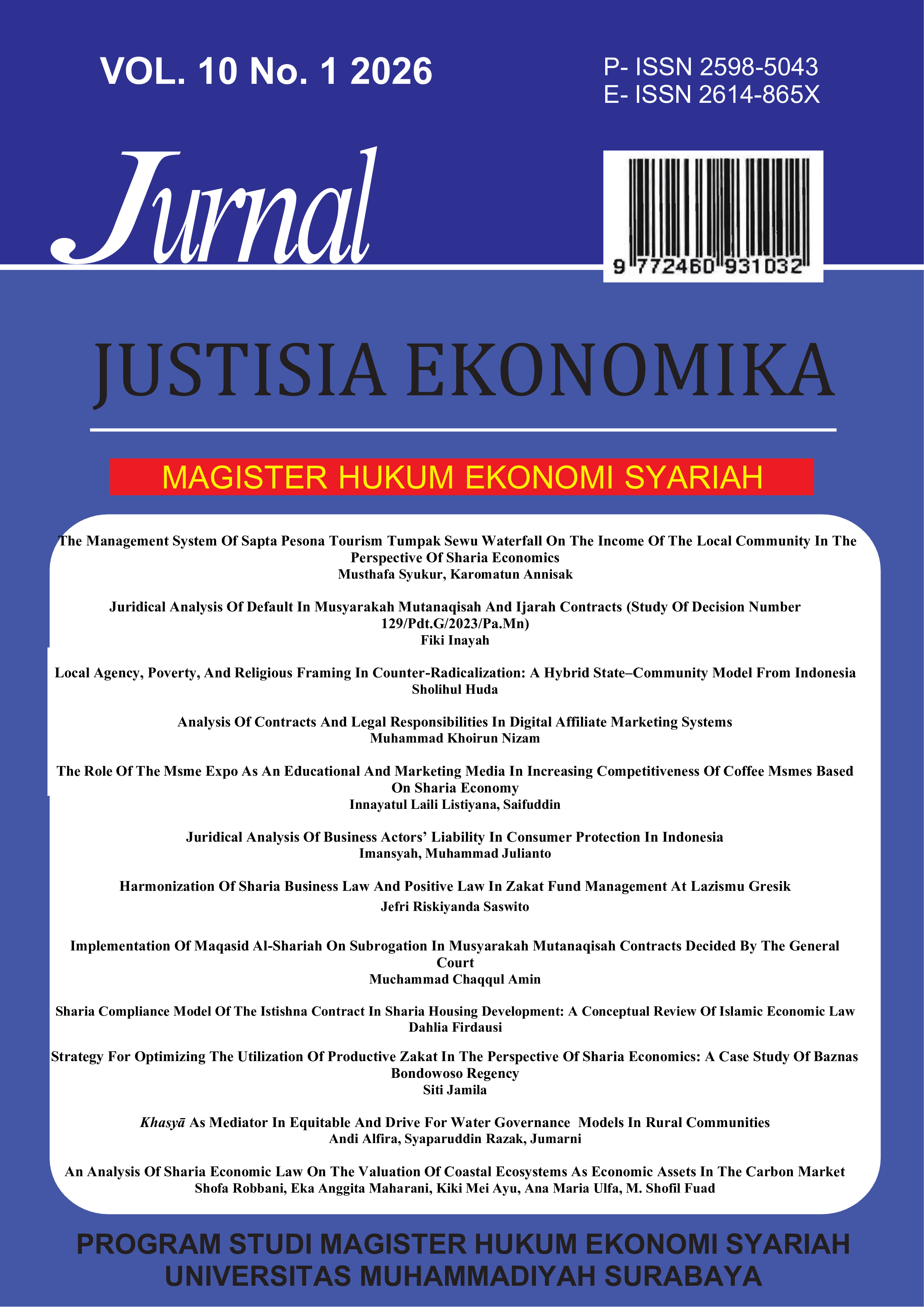
STRATEGY FOR OPTIMIZING THE UTILIZATION OF PRODUCTIVE ZAKAT IN THE PERSPECTIVE OF SHARIA ECONOMICS: A CASE STUDY OF BAZNAS BONDOWOSO REGENCY
DOI:
https://doi.org/10.30651/justeko.v10i1.31344Kata Kunci:
productive zakat, sharia economics, mustahik empowerment, optimization strategy, BAZNASAbstrak
This study examines strategies for optimizing the utilization of productive zakat in the economic empowerment of mustahik at BAZNAS Bondowoso Regency. The study uses a qualitative case study approach conducted through semi-structured interviews, documentation, and field findings. The informants consisted of BAZNAS administrators, zakat management officers, program companions, administrative staff, and mustahik who received productive business assistance. The data were analyzed using data reduction, data presentation, and conclusion drawing, while data validity was strengthened through source triangulation, technique triangulation, and member checking. The findings show that productive zakat optimization is implemented through five main strategies: administrative and field-based mustahik selection, provision of business tools according to business needs, business mentoring, program monitoring, and strengthening zakat fundraising. Productive zakat contributes to increasing mustahik income, creating independent business opportunities, reducing dependence on informal work, and strengthening local economic activities. However, the program still faces limitations in zakat funds, human resources, and structured monitoring systems. The study contributes to Islamic economic literature by showing that productive zakat can function as a sustainable empowerment instrument when managed through integrated selection, assistance, supervision, and institutional capacity building based on maqasid al-sharia principles.
Referensi
[1] Ahyar, L. A. Z., and Hasbi, U. H., 2024, Innovation of Zakat Literacy Program to Optimize Zakat Funds at BAZNAS Province and BAZNAS Central Lombok Regency Indonesia, Tasamuh, Vol. 22, No. 2, 245-268.
[2] Anshari, N. A., Surahman, M., and Malik, Z. A., 2024, Analisis Strategi Fundraising Zakat oleh BAZNAS Kabupaten Purwakarta terhadap Potensi Zakat Maal, Bandung Conference Series: Sharia Economic Law, Vol. 4, No. 2, 501-509.
[3] Azim, I., and Alfitri, B., 2024, Optimalisasi Zakat Produktif dalam Program Tastura Sejahtera BAZNAS Kabupaten Lombok Tengah, Mudabbir: Jurnal Manajemen Dakwah, Vol. 5, No. 2, 163-174.
[4] Chotib, M., Faiz, M. F., and Abdullah, I., 2023, Establishing a Zakat Culture Based on Good Zakat Governance and Good Zakat Empowerment in Indonesia, Journal of Islamic Economics Perspectives, Vol. 5, No. 2, 1-11.
[5] Fathoni, M., and Amelila, A., 2025, Productive Zakat Fund Strategy Towards Economic Empowerment: Case Study at BAZNAS OKU District, International Journal of Economics, Business and Innovation Research, Vol. 4, No. 2, 604-618.
[6] Fikri, S., Hasibuan, A., and Daulay, M., 2023, Mustahik Economic Empowerment through Optimizing Zakat Maal and Professional Zakat in South Tapanuli Regency, KnE Social Sciences.
[7] Hamim, 2024, Analisis Strategi Manajemen Zakat pada BAZNAS Kabupaten Bondowoso dan Jember, Jurnal Ekonomi Syariah Darussalam, Vol. 5, No. 1, 134-159.
[8] Holifah, L., 2025, Analisis Implementasi Good Corporate Governance di Bank BPR Jatim Bank UMKM Jawa Timur Cabang Bondowoso, Accounting Journal of Ibrahimy, Vol. 3, No. 2, 76-82.
[9] Khuzaimah, I., Syakir, A., and Harianto, B., 2024, The Effect of Capital Assistance and Business Assistance on the Empowerment of Mustahik Zakat MSMEs DT Peduli North Sumatra, Jurnal Manajemen Bisnis, Vol. 11, No. 2, 859-873.
[10] Mahmudah, S. N., and Alwa, M. A. A., 2022, Maqāshid Sharia-Based Zakat Distribution Model: Zakat Distribution Program in National Zakat Agency DKI Jakarta, Invest Journal of Sharia and Economic Law, Vol. 2, No. 2, 155-168.
[11] Munir, R., and Abdullah, M., 2022, Strategi Pendayagunaan Zakat Produktif oleh BAZNAS Kabupaten Garut Perspektif Hukum Ekonomi Islam, Jurnal Hukum Ekonomi Syariah, Vol. 1, No. 1, 258-266.
[12] Mustofa, U. A., and Novita, R., 2022, Productive Zakat as Economic Empowerment Mustahiq Amil Zakat Institute Daarut Tauhid Peduli Lampung, Az-Zarqa’: Jurnal Hukum Bisnis Islam, Vol. 14, No. 2, 197-219.
[13] Nicmanis, M., 2024, Reflexive Content Analysis: An Approach to Qualitative Data Analysis, Reduction, and Description, International Journal of Qualitative Methods, Vol. 23.
[14] Nurmaki, M. I., and Sumarni, S., 2022, The Implementation of Productive Zakat Utilization in Economic Empowerment of Zakat Recipients: A Case Study of BAZNAS Ciamis Regency, Syari’ah Economics, Vol. 6, No. 2, 75.
[15] Nurwahidin, Islami, D. G., Salma, R. F., and Suyurno, S. S., 2024, Productive Zakat and Economic Empowerment: Impact on Mustahiq Income at Darul Ilmi Islamic School, Mu’amalah: Jurnal Hukum Ekonomi Syariah, Vol. 3, No. 1, 115-128.
[16] Razali, R., Maulana, N., Taufiq, T., and Putra, M. D., 2024, Optimization of Productive Zakat: A Catalyst for Achieving Economic Independence in Aceh, Management of Zakat and Waqf Journal, Vol. 6, No. 1, 39-62.
[17] Rifuddin, B., Rismayanti, Mas, N. A., and Kartika, B., 2022, Analyzing the Impact of Productive Zakat Utilization on the Mustahiq Economic Independence in Malaysia and Indonesia, Ikonomika, Vol. 7, No. 1, 75.
[18] Warsidi, Haqqi, A. R. A., and Swadjaja, I., 2024, Implementation of Sharia System in Sharia-Certified Hospitals, Jurnal Ilmiah Ekonomi Islam, Vol. 10, No. 3.
[19] Warsidi, Khan, S. U., and Suhartono, 2025, Implementasi Maqāṣid Al-Syarī‘ah dalam Pertimbangan Hakim pada Sengketa Ekonomi Syariah, Maqasid: Jurnal Studi Hukum Islam, Vol. 14, No. 3.
[20] Zhao, P., Qi, W., Li, P. J., and Li, P., 2024, Reconceptualizing the Link Between Validity and Translation in Qualitative Research, International Journal of Qualitative Methods, Vol. 23.
Unduhan
Diterbitkan
Cara Mengutip
Terbitan
Bagian
Lisensi
HAK CIPTA
Penulis yang mengirimkan artikel dalam jurnal Justisia Ekonomika harus memahami dan menyetujui persyaratan tentang hak cipta jurnal Justisia Ekonomika sebagai berikut:
1. Hak Cipta tulisan / artikel yang diterbitkan di jurnal Justisia Ekonomika otomatis menjadi hak pengelola jurnal atau publisher
2. Meskipun Hak Cipta atas tulisan yang telah diterbitkan di jurnal Justisia Ekonomika adalah menjadi haknya publisher, tetapi penulis masih mempunyai hak untuk : a). Penulis boleh meng-upload di repository kampus, b). Penulis boleh meng-upload di webnya sendiri, c). Penulis boleh meng-upload di google schoolar, orchid dan sinta
LISENSI
Lisensi atas tulisan / artikel yang diterbitkan di jurnal Justisia Ekonomika adalah menggunakan Creative Commons dengan atribusi CC-BY-NC 4.0