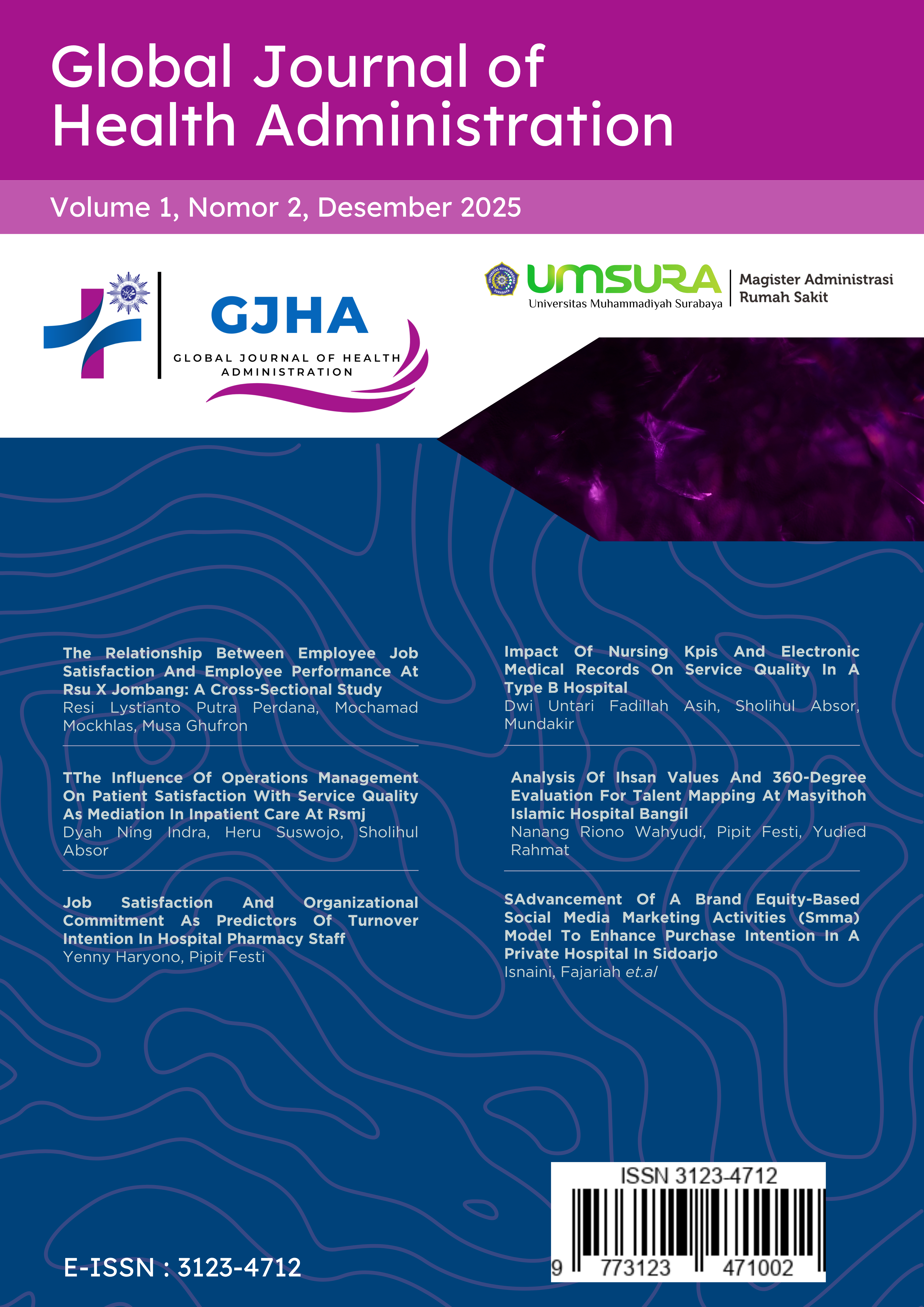
Advancement Of A Brand Equity-Based Social Media Marketing Activities (Smma) Model To Enhance Purchase Intention In A Private Hospital In Sidoarjo
DOI:
https://doi.org/10.30651/gjha.v1i2.27539Keywords:
SMMA, Brand Equity, Purchase IntentionAbstract
Objective: Comprehensive researches regarding the effect of the component of brand equity on Social Media Marketing Activities (SMMA) and purchase intention are lacking. This study provides an integrated analysis of those variables on SMMA and purchase intention. Furthermore, this study expands the concept of SMMA by means of incorporating advertisement and perceived risk analyses to the concept.
Methods: This study employs an explanatory research design. The research utilizes a cross-sectional data approach. Data collection was conducted through a questionnaire survey using a Likert scale for measurement. The study population consists of all inpatients who meet the inclusion criteria. The sampling technique applied was purposive sampling across various inpatient room categories, including Class 1, Class 2, Class 3, VIP, Suite Room, and President Suite. Data analysis was carried out using Structural Equation Modeling–Partial Least Squares (SEM-PLS) with the assistance of SmartPLS 4 software.
Results: This study found the following: SMMA had a significant effect on brand equity with r square value 0,656, p <0.05 and purchase intention with r square value 0.631, p<0.05. Brand equity neither significantly affected purchase intention with r square value 0.003, p = 0.528 nor mediated SMMA and purchase intention p=0.544.
Conclusion: Respondent characteristics have a significant influence on the variables examined. Consequently, social media marketing can be considered to have a stronger impact on respondents' decision-making compared to brand equity in the context of a hospital. Brand equity is not able to serve as a mediating variable between SMMA and Purchase Intention.
References
Alalwan, A. A. (2018). Investigating the impact of social media advertising features on customer purchase intention. International Journal of Information Management, 42(April), 65–77. https://doi.org/10.1016/j.ijinfomgt.2018.06.001
Alamsyah, D. P., Indriana, Ratnapuri, C. I., Aryanto, R., & Othman, N. A. (2021). Digital Marketing: Implementation of Digital Advertising Preference To Support Brand Awareness. Academy of Strategic Management Journal, 20(Special Issue 2), 1–11.
Aslam, B., & Karjaluoto, H. (2017). Digital advertising around paid spaces, E-advertising industry’s revenue engine: A review and research agenda. Telematics and Informatics, 34(8), 1650–1662. https://doi.org/10.1016/j.tele.2017.07.011
Bidmon, S., & Terlutter, R. (2015). Gender differences in searching for health information on the internet and the virtual patient-physician relationship in Germany: Exploratory results on how men and women differ and why. Journal of Medical Internet Research, 17(6), e156. https://doi.org/10.2196/jmir.4127
Chahal, H., & Bala, M. (2012). Significant components of service brand equity in healthcare sector. International Journal of Health Care Quality Assurance, 25(4), 343–362. https://doi.org/10.1108/09526861211221518
de Assis, W. M., & Vilela, B. (2025). Purchase intent in social media for healthcare services: the influence of value co-creation, brand equity and engagement. International Journal of Pharmaceutical and Healthcare Marketing, 19(1), 37–50. https://doi.org/10.1108/IJPHM-06-2023-0057
Dehghani, M., & Tumer, M. (2015). A research on effectiveness of Facebook advertising on enhancing purchase intention of consumers. Computers in Human Behavior, 49, 597–600. https://doi.org/10.1016/j.chb.2015.03.051
Dilham, A., Sofiyah, F. R., & Muda, I. (2018). The internet marketing effect on the customer loyalty level with brand awareness as intervening variables. International Journal of Civil Engineering and Technology, 9(9), 681–695.
Efendioğlu, İ. H., & Durmaz, Y. (2022). The Impact of Perceptions of Social Media Advertisements on Advertising Value, Brand Awareness and Brand Associations: Research on Generation Y Instagram Users. Transnational Marketing Journal, 10(2), 251–275. https://doi.org/10.33182/tmj.v10i2.1606
Fawzeea, B. K., Sofiyah, F. R., Sudardjat, I., & Muda, I. (2019). The role of technology marketing micro business, small and medium enterprises (Smes) agents for repurchase intention and its impact on the community satisfaction (case in Indonesia). International Journal of Scientific and Technology Research, 8(12), 1724–1730.
Godey, B., Manthiou, A., Pederzoli, D., Rokka, J., Aiello, G., Donvito, R., & Singh, R. (2016). Social media marketing efforts of luxury brands: Influence on brand equity and consumer behavior. Journal of Business Research, 69(12), 5833–5841. https://doi.org/10.1016/j.jbusres.2016.04.181
Hendro, H., & Keni, K. (2020). eWOM dan Trust sebagai Prediktor terhadap Purchase Intention: Brand Image sebagai Variabel Mediasi. Jurnal Komunikasi, 12(2), 298. https://doi.org/10.24912/jk.v12i2.7760
Lee, D. H. (2019). A model for designing healthcare service based on the patient experience. International Journal of Healthcare Management, 12(3), 180–188. https://doi.org/10.1080/20479700.2017.1359956
Lee, Y. C., & Wu, W. L. (2014). The effects of situated learning and health knowledge involvement on health communications. Reproductive Health, 11(1). https://doi.org/10.1186/1742-4755-11-93
Seo, E. J., & Park, J. W. (2018). A study on the effects of social media marketing activities on brand equity and customer response in the airline industry. Journal of Air Transport Management, 66(September 2017), 36–41. https://doi.org/10.1016/j.jairtraman.2017.09.014
Smailhodzic, E., Hooijsma, W., Boonstra, A., & Langley, D. J. (2016). Social media use in healthcare: A systematic review of effects on patients and on their relationship with healthcare professionals. BMC Health Services Research, 16(1), 1–14. https://doi.org/10.1186/s12913-016-1691-0
We Are Social. (n.d.). https://wearesocial.com/id/blog/2025/02/digital-2025/
Widasmara, D., Setijowati, N., & Rahmah, S. N. (2024). Impact of Social Media Marketing Activities and Customer Experience on Instagram on Outpatient Relationship Quality. JMMR (Jurnal Medicoeticolegal Dan Manajemen Rumah Sakit), 13(3), 361–375. https://doi.org/10.18196/jmmr.v13i3.486
Yang, Q., Hayat, N., Mamun, A. Al, Makhbul, Z. K. M., & Zainol, N. R. (2022). Sustainable customer retention through social media marketing activities using hybrid SEM-neural network approach. PLoS ONE, 17(3 March), 1–23. https://doi.org/10.1371/journal.pone.0264899
Zhang, E. M. (2010). Understanding the Acceptance of Mobile SMS Advertising among Young Chinese Consumers. Psychology & Marketing, 30(6), 461–469. https://doi.org/10.1002/mar
Zia, S., Khan, A., & Tufail, M. M. B. (2022). CONSUMER-BASED BRAND EQUITY. 4(1), 120–139
Downloads
Published
How to Cite
Issue
Section
License
Copyright (c) 2026 Isnaini Fajariah, Mundakir, Sukadiono, Pipit Festi Wiliyanarti

This work is licensed under a Creative Commons Attribution 4.0 International License.

Global Journal of Health Administration by MARS UM Surabaya is liscence under Lisensi Creative Commons Atribusi 4.0 Internasional.
Authors retain all their rights to the article published by this journal, such as (but not limited to) the copyright and other proprietary rights relating to the article, such as patent rights; the right to use the substance of the article in own future works, including lectures and books; the right to reproduce the article for own purposes, the right to self-archive the article; the right to enter into separate, additional contractual arrangements for the non-exclusive distribution of the article's published version (e.g., post it to an institutional repository or publish it in a book), with an acknowledgment of its initial publication in this journal.